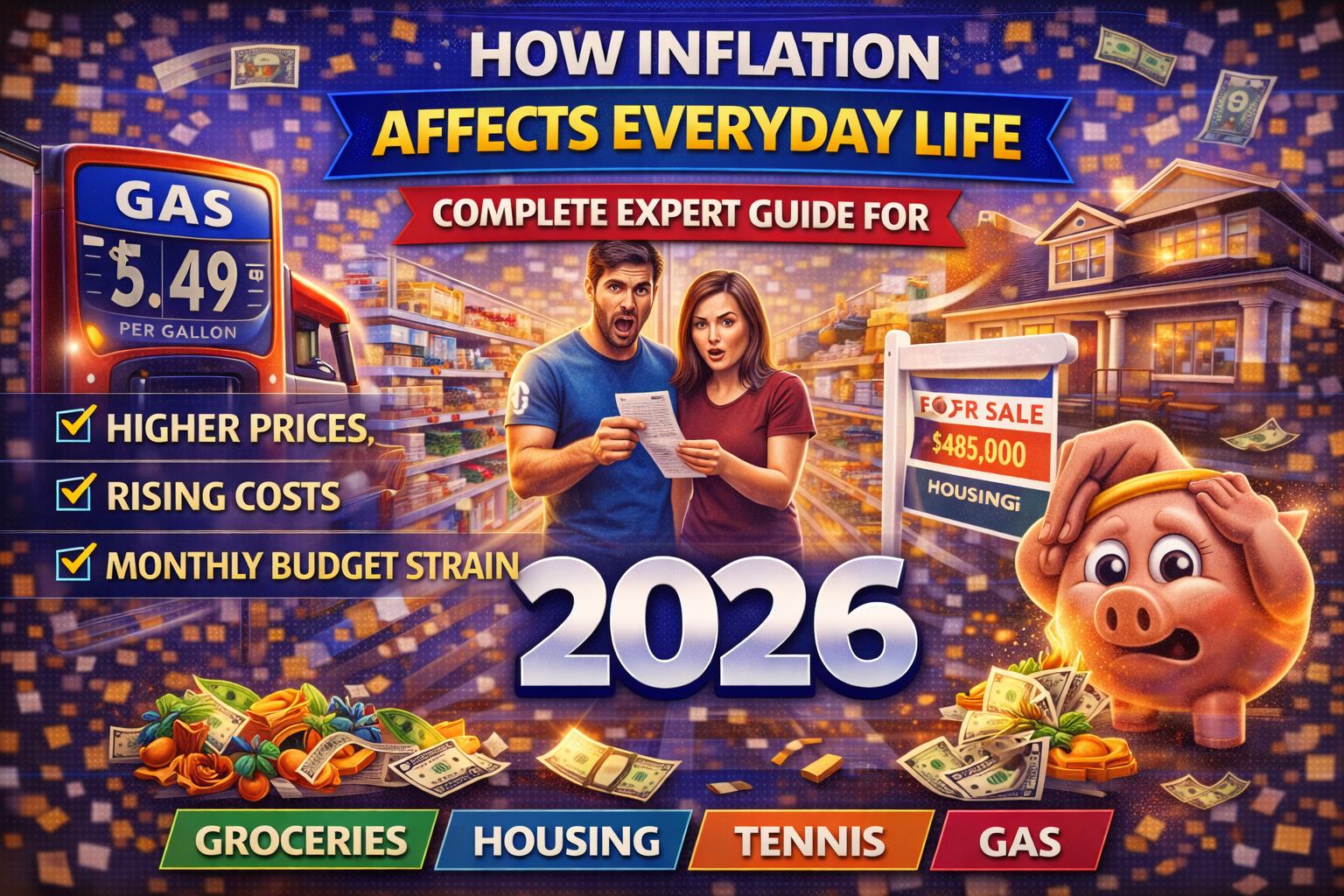
Maria opened her refrigerator on a Tuesday morning in early 2026 and did the calculation she had been doing every week for the past year. The eggs were up forty cents from last month. The milk had crossed the four-dollar mark again. The loaf of bread she always bought — the one her kids preferred — was now a dollar more than it had been eighteen months ago. She earned a reasonable salary. She had not changed her habits. And yet, every month, the same money bought less.
Maria’s experience is not unique. It is, in fact, the defining economic story of millions of households in 2026 — the invisible tax of How Inflation Affects Everyday Life, eroding purchasing power in ways that are small enough each week to seem manageable and large enough across a year to fundamentally reshape how families live, save, and plan. Understanding this phenomenon is not an academic exercise. It is essential knowledge for navigating the economy we actually live in.
The Everyday Reality of How Inflation Affects Everyday Life
Economic concepts have a reputation for abstraction — the domain of textbooks, central bank reports, and financial news tickers that scroll past most people’s attention. But How Inflation Affects Everyday Life operates in the most concrete possible terms: the price of your groceries, the cost of your rent, the interest on your car loan, the number on your utility bill. It is economics made flesh, translated from theory into the lived experience of everyday decisions.
When economists discuss How Inflation Affects Everyday Life, they are ultimately describing a system of forces that shapes the choices available to ordinary people. The family that can no longer afford their neighbourhood. The student who delays graduation because part-time work barely covers rent. The retiree on a fixed income watching their savings buy progressively less. These are the human stories behind the economic data — and understanding the mechanism behind those stories is the first step toward responding to them intelligently.
The scale of the issue is worth establishing. According to economic research and consumer data, the cumulative effect of sustained changes in How Inflation Affects Everyday Life compounds significantly over time. A household experiencing even modest annual erosion of purchasing power loses tens of thousands of dollars in effective wealth over a decade — wealth that never shows up on any balance sheet but is felt acutely in the lived constraints of daily life. This is why economists, policymakers, and financial advisors treat How Inflation Affects Everyday Life as one of the central concerns of modern economic management.
How How Inflation Affects Everyday Life Actually Works: The Mechanisms Explained
To understand How Inflation Affects Everyday Life properly, we need to move past surface-level observation into the mechanisms that drive it. This is where economics as a discipline earns its complexity — the forces at work are multiple, interactive, and often counterintuitive, which is precisely why so much public discussion of economic topics produces more heat than light.
The primary drivers begin at the macroeconomic level, where decisions made by central banks, governments, and large institutions cascade down through the economy to affect individual households and businesses. Interest rate decisions by the Federal Reserve, for example, affect mortgage rates, credit card rates, business borrowing costs, and the relative attractiveness of savings versus spending — all of which ripple outward through the economy in ways that ultimately land on the kitchen table where Maria does her Tuesday morning calculation.
Supply and demand dynamics play an equally fundamental role. When supply of essential goods is constrained — whether by geopolitical disruption, natural disaster, production bottlenecks, or policy choices — prices rise even when consumer demand has not changed. When demand surges — as it did dramatically during the post-pandemic period of 2021-2023 — prices rise even when supply is relatively stable. The interaction of these forces determines the price environment that households and businesses navigate every day.
Global interconnection has made How Inflation Affects Everyday Life increasingly complex in the modern era. A drought in Ukraine affects grain prices in Egypt and tortilla costs in Mexico. A policy decision by the OPEC+ cartel in Vienna affects fuel costs in Iowa and shipping rates in Singapore. A factory disruption in Taiwan affects car prices in Germany and smartphone availability in Brazil. The modern economy is a system of extraordinary complexity, and understanding How Inflation Affects Everyday Life means grappling with this interconnection rather than pretending national economies operate in isolation.
Historical Context: How We Got Here
The history of How Inflation Affects Everyday Life is a history of cycles — periods of stability disrupted by shocks, followed by policy responses, followed by new equilibria that eventually give way to new disruptions. Understanding this cyclical history does not provide a crystal ball for the future, but it does provide essential context for understanding where we are now and why the policy debates of the present look the way they do.
The great economic disruptions of the twentieth century — the Great Depression, the stagflation of the 1970s, the financial crisis of 2008 — each produced lasting changes in how economists, policymakers, and the public think about economic management. Each crisis revealed limitations in prevailing theories and forced reconsideration of assumptions that had seemed settled. The economic frameworks that dominate policy discussions in 2026 are shaped by these historical lessons, for better and for worse.
The specific dynamics shaping How Inflation Affects Everyday Life in 2026 have deep roots. The extraordinary monetary stimulus applied during the COVID-19 pandemic, the subsequent supply chain disruptions, the geopolitical realignments triggered by the Russia-Ukraine conflict, the accelerating energy transition, and the structural shifts in labour markets driven by automation and demographic change — all of these forces have combined to create an economic environment unlike any that preceded it. Applying historical analogies without accounting for these specific contemporary factors produces misleading analysis.
The Policy Response: What Governments and Central Banks Can (and Cannot) Do
When How Inflation Affects Everyday Life creates economic stress, the instinctive expectation is that governments and central banks will intervene to alleviate it. This expectation is reasonable — these institutions exist precisely to manage economic conditions — but the reality of what policy can achieve is considerably more constrained and complex than popular discussion typically acknowledges.
Central banks’ primary tool is interest rate policy. Raising rates reduces borrowing, cools demand, and typically moderates price pressures — but at the cost of slower economic growth and higher unemployment. Cutting rates stimulates economic activity but risks reigniting inflation if underlying price pressures have not been fully resolved. This fundamental tension — between growth and price stability, between unemployment and inflation — defines the central challenge of monetary policy and explains why central bank decisions are always contested and their outcomes never guaranteed.
Fiscal policy — government spending and taxation decisions — offers different tools with different tradeoffs. Targeted spending on infrastructure, education, and social support can address specific economic weaknesses without the broad impact of monetary policy. Tax policy can redistribute economic outcomes, incentivise specific behaviours, and affect the overall level of demand in the economy. But fiscal policy is inherently political, making it slower, messier, and more subject to non-economic considerations than monetary policy. The result is that fiscal and monetary policy often work at cross-purposes, complicating the economic management that each is designed to achieve.
There are also profound limits to what either type of policy can achieve. Supply-side constraints — insufficient housing, inadequate infrastructure, skills mismatches in labour markets — do not respond to interest rate changes or government spending in straightforward ways. Structural problems require structural solutions, which typically unfold over years or decades rather than the quarters that dominate policy discussion cycles. Acknowledging these limits is not defeatism; it is intellectual honesty about the nature of economic governance in complex modern societies.
Who Is Most Affected: The Unequal Distribution of Economic Impact
One of the most important but least discussed aspects of How Inflation Affects Everyday Life is the profound inequality in how its effects are distributed across different groups in society. The aggregate economic statistics that dominate news coverage — GDP growth rates, headline inflation figures, unemployment rates — mask enormous variation in how different households and communities experience economic conditions.
Lower-income households are consistently hit hardest by How Inflation Affects Everyday Life. They spend a larger proportion of their income on essential goods — food, housing, utilities, transportation — whose prices tend to be most volatile and least responsive to budget adjustments. They have fewer financial buffers — savings, investments, assets — that can absorb economic shocks. They have less access to the financial tools — diversified investment portfolios, variable-rate debt refinancing, tax-advantaged savings vehicles — that can partially offset the effects of adverse economic conditions. When economists speak of the broad aggregate effect of How Inflation Affects Everyday Life, they are describing an average that conceals the disproportionate burden falling on those least equipped to bear it.
Geographic variation compounds this inequality. Urban renters in expensive cities face a fundamentally different economic reality than rural homeowners in affordable regions. Workers in industries exposed to automation face different labour market conditions than those in protected professional services. Young adults entering the labour market face different wealth accumulation trajectories than those who established themselves during periods of lower asset prices. These distributional dimensions of How Inflation Affects Everyday Life are not merely statistical abstractions — they are the lived reality of economic life for millions of people whose experience is invisible in the headlines.
Practical Responses: What Individuals and Families Can Do
While the macroeconomic forces driving How Inflation Affects Everyday Life are largely beyond individual control, there is a meaningful range of practical responses available to households seeking to manage their financial exposure to economic conditions. Understanding these responses — and their limits — is perhaps the most directly useful knowledge this article can offer.
Budgeting with precision is the foundational response. Knowing exactly where money goes — not approximately, but precisely — is the prerequisite for making the targeted adjustments that adverse economic conditions require. Most households have categories of spending that have grown through inertia rather than conscious choice, and a thorough budget review typically reveals opportunities for reduction that are less painful than they initially appear. Subscription services accumulated over years, dining and entertainment habits established during more comfortable economic periods, insurance policies that have not been competitively reviewed in years — these are the places where careful budgeting most commonly uncovers meaningful opportunity.
Income diversification reduces vulnerability to the economic uncertainties that How Inflation Affects Everyday Life can create. A second income stream — freelance work, a part-time role, monetisation of skills or assets — provides both additional income and reduced dependence on any single source. This strategy is more accessible than it has ever been in 2026, with digital platforms connecting skilled workers to clients globally and reducing the barriers to flexible income generation that once made it impractical for most households.
Debt management is particularly critical in economic environments shaped by the dynamics of How Inflation Affects Everyday Life. High-interest consumer debt — credit cards, personal loans, payday loans — becomes acutely costly when interest rates are elevated, and eliminating it aggressively is one of the highest-return financial decisions available to most households. Conversely, long-term fixed-rate debt — a mortgage locked in at a favourable rate — can be beneficial in inflationary environments, as the real cost of the debt decreases as the currency loses value. Understanding this distinction and managing debt accordingly is a financially sophisticated response to challenging economic conditions.
The Investment Perspective: Building Wealth Despite Economic Headwinds
For those with the financial capacity to invest — even modestly — understanding how How Inflation Affects Everyday Life affects different asset classes is essential for making decisions that preserve and grow wealth over time. The relationship between economic conditions and investment returns is complex and counterintuitive in important ways that frequently lead uninformed investors to make poor decisions precisely when good decisions matter most.
Equities — ownership stakes in productive businesses — have historically provided the best long-term protection against the purchasing power erosion associated with How Inflation Affects Everyday Life. Businesses that can raise prices in line with costs — those with genuine pricing power, strong brands, or essential products with inelastic demand — effectively pass the burden of adverse economic conditions onto their customers while maintaining their profitability. This pricing power translates into maintained or growing corporate earnings and, over time, stock price appreciation that keeps pace with or exceeds the general increase in the price level.
Real assets — real estate, commodities, infrastructure, timberland — have traditionally served as stores of value that preserve purchasing power when financial assets are under pressure. Real estate in particular combines income generation (rental yield), asset appreciation, and inflation-hedging properties in a single investment, which explains its enduring attraction as a component of wealth-building strategies across income levels.
The most important investment principle in the context of How Inflation Affects Everyday Life is time horizon. Short-term economic volatility — even severe volatility — has historically resolved into recovery over sufficient time periods, rewarding patient investors who maintained their positions through turbulence. The investors who consistently destroy value are those who react to short-term economic conditions by making reactive portfolio changes that sell low and buy high, inverting the fundamental logic of successful investing. Maintaining a long-term perspective while managing short-term risk appropriately is the strategy that evidence most consistently supports.
Looking Ahead: What the Data Suggests About the Future
Forecasting economic conditions with precision is beyond the capability of any analyst, model, or institution — a humility that is worth maintaining in the face of confident-sounding predictions that regularly prove wrong. What data and research can provide is a reasonable framework of likely scenarios, key variables to monitor, and conditions that would signal meaningful shifts in the economic environment.
The structural trends most likely to shape the future of How Inflation Affects Everyday Life include the continued adjustment of global supply chains toward greater resilience (at the cost of some efficiency), the accelerating energy transition with its complex implications for energy prices and industrial costs, the demographic aging of most advanced economies with implications for labour supply and social spending, and the ongoing integration of artificial intelligence into production processes with profound but uncertain effects on productivity and employment.
None of these trends is deterministic in its economic implications. Each could unfold in ways that are more or less favourable depending on policy choices, technological developments, geopolitical events, and the collective decisions of billions of households and businesses around the world. What is certain is that How Inflation Affects Everyday Life will continue to evolve — and that the households and policymakers who understand the underlying mechanisms will be better positioned to navigate whatever form that evolution takes.
Key Takeaways and Action Steps
Understanding How Inflation Affects Everyday Life is not merely an intellectual exercise — it is preparation for better decisions. The household that understands the mechanisms of How Inflation Affects Everyday Life can anticipate how economic conditions are likely to affect their financial situation, make proactive adjustments rather than reactive ones, and avoid the financial mistakes that economic stress most commonly produces. The citizen who understands How Inflation Affects Everyday Life can evaluate policy proposals more critically, hold elected officials more accountable, and contribute more constructively to the democratic conversations that ultimately shape the economic policies affecting everyone.
The most important action step is to stay informed — not through the anxiety-inducing stream of daily financial news, but through periodic, deep engagement with reliable economic analysis that builds genuine understanding rather than just feeding the news cycle. Reading longer-form analysis from reputable economists, understanding the key economic indicators and what they actually measure, and maintaining a realistic long-term perspective on economic cycles rather than treating each data release as a crisis or triumph will serve you far better than anxious daily monitoring of markets and headlines.
Maria, opening her refrigerator on a Tuesday morning, cannot control How Inflation Affects Everyday Life. But she can understand it — and in understanding it, she can respond to it more wisely, plan around it more effectively, and advocate for the policies most likely to address it at the systemic level. That combination of personal response and civic engagement is, in the end, how economic conditions actually change for the better: not through the actions of any single institution or policy, but through the accumulated decisions of millions of people who understand the forces shaping their lives.
Frequently Asked Questions About How Inflation Affects Everyday Life
How quickly does How Inflation Affects Everyday Life affect household budgets?
The impact of How Inflation Affects Everyday Life on household budgets is typically felt within weeks for categories like food and fuel, where prices change frequently and purchases are regular. Housing costs — rent in particular — typically reflect changing economic conditions within months, as leases are renewed or renegotiated. Other categories, like insurance premiums and utility rates, may lag economic changes by six months to a year. The cumulative effect across all spending categories usually becomes clearly visible to households within two to three months of significant economic changes, which is why survey data on consumer sentiment tends to track economic conditions with a relatively short lag.
What is the single most important thing people can do to protect themselves financially from How Inflation Affects Everyday Life?
If forced to identify one measure, it would be building and maintaining an emergency fund of three to six months of essential expenses in a liquid, interest-bearing account. This financial buffer serves multiple functions simultaneously: it prevents the need to take on expensive debt to manage unexpected costs, it provides the psychological security that allows for better long-term financial decisions, it provides time to adjust income and spending in response to changed economic conditions, and it prevents the cascading financial damage that typically follows when households without buffers encounter economic disruption. Everything else in personal financial management — investing, debt reduction, income diversification — is more effective when built on this foundation.
Why do government statistics about How Inflation Affects Everyday Life sometimes seem disconnected from personal experience?
This is one of the most common and legitimate frustrations with economic data. Government statistics are averages — they describe the aggregate experience of an entire economy, blending the experience of households at very different income levels, in different geographic locations, with different spending patterns and financial circumstances. When the official Consumer Price Index reports inflation of four percent, it does not mean that every household’s costs rose four percent; it means that the costs of a standardised basket of goods rose four percent on average. A household that spends heavily on housing and food — categories that often rise faster than average — will experience personal inflation significantly above the headline figure. Understanding this distinction between aggregate statistics and individual experience is essential for interpreting economic data accurately.
How long do the economic effects of How Inflation Affects Everyday Life typically last?
The duration of economic effects varies significantly depending on whether the underlying causes are temporary or structural. Supply disruptions caused by specific events — a hurricane, a port strike, a geopolitical crisis — typically resolve within months as the specific disruption is addressed and supply chains adjust. Structural economic changes — demographic shifts, technological disruptions, fundamental changes in energy systems — unfold over years or decades and produce lasting changes in economic conditions. The post-pandemic economic disruptions of the early 2020s had elements of both types, which is part of why their duration and resolution proved difficult to predict. Distinguishing between temporary and structural drivers of economic conditions is one of the most important and most challenging tasks in economic analysis.
Is How Inflation Affects Everyday Life worse in 2026 than in previous decades?
Comparing economic conditions across decades requires careful definition of what “worse” means and which dimensions of economic life are being compared. By some measures — headline unemployment rates, overall GDP levels, life expectancy, access to technology — 2026 represents favourable conditions relative to most of the twentieth century. By other measures — housing affordability, income inequality, the proportion of income required for essential expenses, economic mobility — the early twenty-first century has seen genuine deterioration relative to the post-war decades. The honest answer is that economic conditions are better in some important respects and worse in others, and that the aggregate statistics conceal profound variation in how different people experience the economy they live in.
The Long View: Why Understanding How Inflation Affects Everyday Life Matters More Than Ever
We live in an era of extraordinary economic complexity and equally extraordinary access to information about it. The paradox of the information age is that more data and more commentary have not necessarily produced more clarity — if anything, the sheer volume of economic content available has made it harder, not easier, for most people to develop a reliable working understanding of How Inflation Affects Everyday Life and its implications. The ability to navigate this information landscape thoughtfully — distinguishing signal from noise, evidence from advocacy, genuine uncertainty from false confidence — is an increasingly valuable skill in both personal financial management and civic life.
The study of How Inflation Affects Everyday Life ultimately reveals something profound about the nature of human societies. Economic systems are, at their core, mechanisms for coordinating the decisions of billions of individuals in ways that produce collective outcomes — outcomes that no individual planned or intended and that emerge from the interaction of countless decisions made independently by people pursuing their own goals. This emergent complexity is what makes How Inflation Affects Everyday Life simultaneously fascinating and difficult to manage. The economists, policymakers, and institutions responsible for managing it are steering a ship through waters that are continuously changing in ways that are only partially predictable, using tools that work with variable reliability and sometimes produce unintended consequences alongside their intended effects.
This complexity is not a counsel of despair but an argument for intellectual humility and sustained engagement. The societies that manage their economies best are not those that have found perfect answers — no such answers exist — but those that have developed the institutional capacity to learn from experience, adjust their approaches in response to evidence, and maintain broad social agreement about the basic rules and values that economic governance should reflect. Building and maintaining this institutional capacity requires an informed citizenry willing to engage seriously with economic complexity rather than demanding simple answers to complex questions.
Deep Dive: The Mechanisms That Drive How Inflation Affects Everyday Life
To truly understand How Inflation Affects Everyday Life, it helps to trace the causal chains that connect individual decisions to aggregate outcomes. Economic phenomena do not emerge from nowhere — they are the cumulative result of millions of individual choices made by households, businesses, financial institutions, and governments, interacting through markets, institutions, and informal social relationships. Understanding these causal mechanisms transforms How Inflation Affects Everyday Life from an abstract phenomenon into an understandable system — one that can be analysed, anticipated, and responded to intelligently.
The causal chain typically begins with some combination of structural conditions and policy choices that shape the incentives facing economic actors. These incentives then influence the behaviour of households (their spending, saving, borrowing, and work decisions), businesses (their investment, hiring, pricing, and production decisions), and financial institutions (their lending standards, interest rate setting, and risk management). The aggregate of these behaviours produces the macroeconomic outcomes that show up in official statistics — GDP growth rates, inflation figures, unemployment levels, trade balances.
What makes How Inflation Affects Everyday Life particularly interesting is the feedback loops embedded in these causal chains. Economic outcomes influence expectations, and expectations influence behaviour, creating self-reinforcing dynamics that can amplify economic trends in both directions. Rising confidence produces increased spending, which produces rising employment, which produces rising incomes, which produces further rising confidence — a virtuous cycle that can sustain economic expansion beyond what underlying fundamentals might suggest is justified. Conversely, falling confidence produces reduced spending, rising unemployment, falling incomes, and further falling confidence — the vicious cycle of economic contraction that policymakers work to interrupt before it becomes self-sustaining.
Understanding these feedback dynamics is particularly important for interpreting economic turning points — moments when the direction of economic conditions shifts from expansion to contraction or vice versa. These turning points are difficult to predict in advance precisely because they involve the interaction of multiple feedback loops that can tip in different directions depending on conditions that are not fully visible in real-time data. The post-mortems conducted after major economic turning points — the 2008 financial crisis, the 2020 COVID recession, the post-pandemic inflation surge — consistently reveal that the factors most important for understanding what happened were underweighted in contemporary analysis, precisely because their significance was not apparent until the dynamic had already played out.
Sectoral Analysis: How How Inflation Affects Everyday Life Plays Out Across Different Industries
The aggregate picture of How Inflation Affects Everyday Life conceals significant variation in how different sectors of the economy experience and respond to economic conditions. Industries differ in their exposure to domestic versus international demand, in their sensitivity to interest rate changes, in the labour intensity of their production, in the fixed versus variable cost structure of their operations, and in the competitive dynamics that determine how they respond to changing economic conditions. Understanding these sectoral differences is essential for anyone seeking to understand the specific economic conditions facing their industry or their investment portfolio.
Consumer discretionary sectors — retail, entertainment, travel, hospitality — are typically the most sensitive to changes in household income and consumer confidence. When economic conditions tighten and household budgets come under pressure, spending on non-essential goods and services declines first and most sharply. This makes consumer discretionary a leading indicator of broader economic conditions in both directions: these sectors typically deteriorate before the broader economy and recover before the broader economy. The experience of sectors like tourism and hospitality during the COVID-19 pandemic illustrated both the severity of this cyclical exposure and the resilience that businesses and workers in these sectors can demonstrate when supported by appropriate policy responses.
Consumer staples — food, pharmaceuticals, household products, utilities — show a very different sensitivity profile. Demand for these products is relatively inelastic: people continue buying food and medicine even when their budgets are under pressure, cutting back on quality and quantity at the margins but maintaining overall consumption levels. This defensive characteristic makes consumer staples relatively resilient during economic downturns, which is why they feature prominently in investment portfolios designed to weather economic cycles.
The financial sector occupies a unique position in relation to How Inflation Affects Everyday Life: it is simultaneously one of the most important transmitters of economic conditions (through its credit allocation, risk management, and payment system functions) and one of the most exposed to economic volatility. Financial institutions profit when the economy is growing, credit quality is good, and financial markets are active. They face their most acute stress during economic downturns, when credit losses mount, market volatility rises, and the systemic importance of major institutions creates risks that extend far beyond the institutions themselves — as the 2008 crisis demonstrated with devastating clarity.
The Human Side of How Inflation Affects Everyday Life: Stories Behind the Statistics
Economic statistics are abstractions of human experience. Behind every percentage point of unemployment is a person without a job. Behind every basis point of inflation is a household with less purchasing power. Behind every point of GDP growth is economic activity produced by the labour, creativity, and enterprise of real people. Keeping these human realities in mind while engaging with the statistical abstractions of economic analysis is essential for maintaining a grounded understanding of what How Inflation Affects Everyday Life actually means in the world.
The personal finance dimension of How Inflation Affects Everyday Life is ultimately about people making the best decisions they can within the economic conditions they face — conditions they did not choose and can influence only at the margins. The household that carefully budgets, saves diligently, manages debt prudently, and invests thoughtfully is doing everything within its power to navigate How Inflation Affects Everyday Life effectively. But individual financial prudence cannot fully insulate households from macroeconomic conditions that affect income opportunities, asset prices, and cost of living in ways that individual decisions cannot fully offset.
This is why the policy dimension of How Inflation Affects Everyday Life matters alongside the personal finance dimension. The economic conditions that households navigate are substantially shaped by policy choices made through democratic processes. Citizens who understand How Inflation Affects Everyday Life are better positioned to evaluate those policy choices, hold elected officials accountable for the economic outcomes their decisions produce, and advocate for policies that address the structural economic challenges that individual financial management cannot resolve. The combination of informed personal financial management and engaged democratic citizenship is the most powerful response available to the economic challenges that How Inflation Affects Everyday Life creates.
Future Trends: What Will Shape How Inflation Affects Everyday Life Over the Next Decade
While economic forecasting over long horizons is inherently uncertain, several structural trends are sufficiently well-established that they will almost certainly shape How Inflation Affects Everyday Life over the next decade regardless of how other variables evolve. Understanding these trends provides a framework for longer-term planning — both personal financial planning and broader thinking about economic policy priorities.
Demographic change is the most certain of the long-run economic forces. The aging of the large baby boom cohort through retirement age in most advanced economies is already producing measurable effects on labour supply, consumer spending patterns, healthcare demand, and fiscal pressures on public pension and healthcare systems. These effects will intensify over the next decade as the remaining boomer cohort ages further and the relatively smaller successor cohorts take their place in the workforce. Managing the fiscal implications of demographic aging while maintaining economic dynamism and intergenerational equity is one of the central economic policy challenges of the coming decade.
Artificial intelligence and automation will continue to reshape labour markets in ways that are uncertain in their specific manifestations but whose general direction is fairly clear: increasing productivity in tasks that can be standardised and automated, shifting demand toward skills involving creativity, judgment, social intelligence, and adaptability, and creating new categories of work while displacing existing ones. The distributional consequences of this transformation depend heavily on the policy frameworks through which it unfolds — the education and training systems that prepare workers for changing demands, the social safety net that supports those displaced by technological change, and the regulatory frameworks that shape how the productivity gains from automation are distributed between capital and labour.
Climate change and the energy transition will impose substantial economic costs — through both the physical damages of climate impacts and the transition costs of restructuring energy and industrial systems — while also creating significant economic opportunities in clean energy, energy efficiency, climate-resilient infrastructure, and related services. The net economic effect of climate change is almost certainly negative in the aggregate, but the distribution of costs and opportunities varies enormously across sectors, regions, and time horizons, creating very different economic experiences for different communities depending on their exposure to physical climate risks and their positioning relative to the opportunities of the clean energy transition.
Geopolitical fragmentation — the partial reversal of the globalisation trend through the reshoring of supply chains, the use of economic tools for geopolitical purposes, and the development of competing economic and technological blocs — will reshape the international economic environment in ways that increase costs and reduce efficiency but may improve resilience. The specific economic consequences of this fragmentation depend on its speed and extent, the specific sectors most affected, and the policy responses of individual countries and blocs to the changing international economic landscape.
These trends do not determine a single inevitable future for How Inflation Affects Everyday Life. They define the parameters within which human decisions — about policy, technology, investment, and values — will shape the economic outcomes of the coming decade. The economic future is genuinely open, shaped by choices that have not yet been made and events that cannot be fully anticipated. What is not open is the importance of understanding How Inflation Affects Everyday Life for navigating whatever that future holds — which is precisely why the investment in economic literacy represented by this article is one of the most valuable returns available to anyone seeking to understand and engage with the economic world they live in.
Practical Guide: Navigating How Inflation Affects Everyday Life in Your Daily Financial Life
Abstract understanding of How Inflation Affects Everyday Life is valuable, but what most people ultimately want is practical guidance they can apply to their own financial lives. This section translates the conceptual framework developed throughout this article into concrete, actionable steps that anyone can take — regardless of income level, financial sophistication, or current economic circumstances — to navigate How Inflation Affects Everyday Life more effectively.
The first practical priority is financial awareness. Most people have a rough sense of their income but a surprisingly imprecise understanding of their spending. Spending categories that grow gradually through inertia — subscription services accumulated over years, dining habits that expanded with income and contracted insufficiently when income declined, insurance and utility costs not reviewed since initial setup — collectively represent significant sums that precise tracking reveals. The simple act of knowing exactly where your money goes is the prerequisite for making intelligent decisions about changing how it flows. Modern budgeting apps like Mint, YNAB, or even a simple spreadsheet make this tracking more accessible than it has ever been.
The second practical priority is building financial resilience. Economic conditions are inherently uncertain, and households that have built financial buffers are dramatically better positioned to weather adverse conditions than those without them. The emergency fund — three to six months of essential expenses in a liquid, interest-bearing account — is the foundation of financial resilience, preventing the need to take on expensive debt or make forced asset sales when income is disrupted or unexpected expenses arise. Building this buffer should take priority over most investment activities, because the effective return on avoiding high-interest debt or forced selling during downturns dramatically exceeds the returns available from almost any investment.
The third practical priority is strategic debt management. In the current economic environment, the cost of debt — particularly high-interest consumer debt — represents the single most reliably addressable drag on household financial health. Credit card debt carrying interest rates of 20-25% represents a guaranteed negative return that no investment strategy can consistently overcome. Prioritising elimination of this debt above other financial goals is almost always the correct financial decision, with the possible exception of capturing any employer match on retirement contributions (which represents an immediate 50-100% return on the contributed amount). Once high-interest debt is eliminated, the financial capacity freed up becomes a powerful resource for building wealth through investment and savings.
Investing consistently over time, even in modest amounts, is among the most powerful financial decisions available to most households. The mathematics of compound growth means that time in the market is the single most important variable in investment outcomes — more important than investment selection, timing decisions, or the specific vehicles used. A household that begins investing modestly in its twenties and maintains consistent contributions through its working life will typically accumulate dramatically more wealth than one that waits for the “right time” to invest but starts a decade later. The behavioural challenge is maintaining investment consistency during periods of market turbulence — when the emotional impulse is to stop or reverse investment, but when history consistently shows that maintaining or increasing investment is the strategically superior choice.
Expert Perspectives: How Economists View How Inflation Affects Everyday Life
The economics profession has spent decades studying How Inflation Affects Everyday Life, and while there is more uncertainty and disagreement than popular economic commentary suggests, there are also areas of genuine professional consensus that deserve to be understood and taken seriously. This section summarises the key areas of expert consensus alongside the areas of genuine ongoing debate.
Economists broadly agree that sustained, moderate economic growth — driven by productivity improvement through technological progress, capital accumulation, and human capital development — is the most reliable path to broad improvements in living standards over time. There is also broad consensus that price stability (not zero inflation, but low and stable inflation) provides important benefits for long-term economic planning and financial system functioning. And there is substantial agreement that well-functioning labour markets — where workers can match with employers that value their skills, and where mobility between jobs and regions is not excessively impeded — are fundamental to economic efficiency and individual economic wellbeing.
The areas of genuine ongoing professional debate are worth acknowledging honestly. Economists disagree meaningfully about the optimal level of government involvement in markets, about the most effective approaches to addressing economic inequality, about the long-run effects of various trade and industrial policies, and about the appropriate response to the distributional challenges created by technological change. These disagreements are not primarily about economic ignorance — they reflect genuine empirical uncertainty and legitimate differences in values about the appropriate tradeoffs between competing economic goals. Understanding that these debates are real and unresolved helps calibrate appropriate confidence when evaluating economic policy arguments.
One area where the economics profession has genuinely evolved its consensus in recent years is the relationship between inequality and growth. Earlier economic thinking often treated inequality as a necessary byproduct of growth-enhancing policies, assuming that the benefits would eventually “trickle down” to lower-income groups. More recent research — including influential work by IMF economists — has challenged this view, finding that extreme inequality can actually reduce long-run growth by limiting human capital development, reducing economic mobility, weakening aggregate demand, and increasing political instability. This evolving consensus has significant implications for how How Inflation Affects Everyday Life should be managed and what policy priorities deserve greater emphasis.
The economics of How Inflation Affects Everyday Life ultimately reflects the economics of human wellbeing — the study of how societies organise their productive activities to meet human needs and aspirations. At its best, this field of knowledge illuminates the mechanisms through which policy choices and economic conditions affect the lives of real people, providing the analytical foundation for making those choices more wisely. Engaging with it seriously — maintaining both appropriate confidence in what research does establish and appropriate humility about the limits of economic knowledge — is one of the most worthwhile intellectual investments available to anyone trying to understand and navigate the world we share.

3 thoughts on “How Inflation Affects Everyday Life: Complete Expert Guide for 2026”