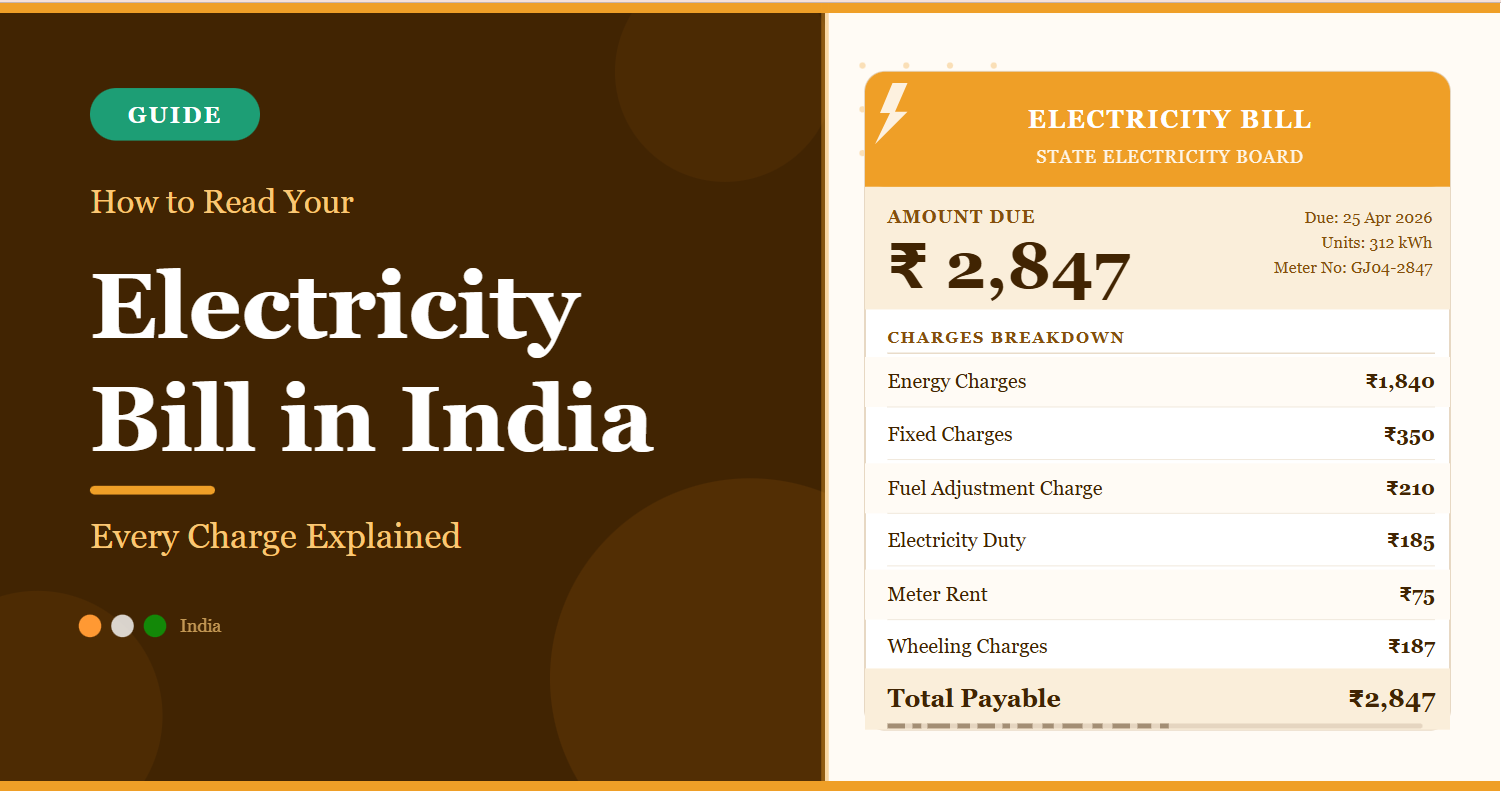
Most people glance at the total amount, wince, and pay. The rest of the bill how to read electricity bill India, the rows of abbreviations, slabs, duties, and adjustments — gets ignored like fine print.
That’s a mistake. Those lines are telling you exactly what you’re paying for. More importantly, understanding them is how you catch errors — and how you know when to push back.
This guide explains every charge on an Indian electricity bill, with specific examples for Gujarat, Maharashtra, and Delhi. It also covers what to do when your bill looks wrong.
How an Indian Electricity Bill Is Structured
Before the individual charges, here’s the skeleton of a typical domestic bill:
| Section | What It Contains |
|---|---|
| Account details | Consumer number, tariff category, sanctioned load |
| Meter readings | Previous reading, current reading, units consumed |
| Energy charges | Cost of units consumed (slab-based) |
| Fixed / demand charges | Monthly infrastructure fee |
| Fuel adjustment charge (FPCA/FAC) | Variable fuel cost pass-through |
| Electricity duty | State government tax |
| Meter rent | Monthly fee for the meter |
| Arrears / adjustments | Outstanding dues, credits, corrections |
| Total amount due | Everything added up |
Each section is explained below.
Section 1: Account Details — Read This First
The top portion of your bill has four fields that matter more than most people realise.
Consumer Number / Account Number Your unique ID with the discom (distribution company). You need this for complaints, online payments, and any official correspondence. Keep it saved somewhere accessible.
Tariff Category This tells the discom what type of consumer you are. Domestic consumers are typically coded as LT-1 or “Domestic.” Commercial connections are LT-2 or “Commercial” — and they pay significantly higher rates.
If your tariff category is wrong — a common problem in older buildings or properties that changed use — you could be overcharged for months or years. Check this line on every bill.
Sanctioned Load / Connected Load Shown in kilowatts (kW) or kilowatt-amperes (kVA). This is the maximum power draw your connection is approved for, and it’s often the basis for your fixed charges. If you’ve added ACs, geysers, or appliances over the years without updating your sanctioned load, this figure may be out of date.
Billing Period The number of days covered by this bill. A standard cycle is 30 days. A 45-day cycle is not uncommon — and it means more units consumed, more of those units landing in higher (more expensive) slabs. If your billing period is consistently longer or shorter than 30 days, it’s worth raising with your discom.
Section 2: Meter Readings and Units Consumed
The core unit on your electricity bill is the kilowatt-hour (kWh), usually called a “unit.”
One unit = 1 kilowatt of power used for 1 hour.
Practical examples:
- A 5-star 100W LED TV running for 10 hours = 1 unit
- A 1.5-ton split AC (approx. 1.5 kW) running for 8 hours = 12 units
- A 2,000W geyser running for 30 minutes = 1 unit
Your bill shows three numbers: the previous reading, the current reading, and the difference — which is your consumption for the period. If the meter reader couldn’t access your meter, you may see an estimated reading (often marked “E” or “Est.”). Estimated readings are corrected in the following cycle once an actual reading is taken.
What to do: Check your physical meter and compare it to what’s on the bill. If the difference is large, photograph your meter with the date visible and contact your discom.
Section 3: Energy Charges — Your Biggest Line Item
Energy charges are the cost of the actual electricity you consumed. In India, these are calculated using a telescopic tariff — also called slab-based billing.
You are not charged a single flat rate per unit. Instead, your total consumption is divided into slabs, with higher slabs costing progressively more per unit. The purpose is to keep electricity affordable for low consumers while charging heavy users a higher rate.
How slab billing works (example):
If you consumed 350 units in Maharashtra (MSEDCL), here’s how the charge is calculated:
| Slab | Units | Rate per Unit | Charge |
|---|---|---|---|
| First 100 units | 100 | ₹3.46 | ₹346 |
| 101–300 units | 200 | ₹7.71 | ₹1,542 |
| 301–500 units | 50 | ₹10.04 | ₹502 |
| Total energy charge | 350 | ₹2,390 |
You do not pay ₹10.04 for all 350 units — only for the 50 units that fall in that slab. This is a common misunderstanding that leads people to think their bill is wrong when it isn’t.
Important: Slab rates vary by state and are revised periodically by the State Electricity Regulatory Commission (SERC). The figures above are illustrative. Always check current rates on your discom’s official website.
Section 4: Fixed Charges — What You Pay Even on Vacation
Fixed charges appear on your bill regardless of how much (or how little) electricity you use. If you went on holiday for a month and used almost nothing, you still owe these.
The reason: your discom maintains the entire infrastructure to deliver power to your home — transformers, cables, poles, grid capacity, meter maintenance — whether or not you flip a switch. Fixed charges recover a portion of those costs.
Fixed charges are typically calculated based on your sanctioned load (in kW or kVA), not your actual consumption. A connection with a higher sanctioned load pays more in fixed charges.
Approximate fixed charges by state (domestic, single-phase):
| State / Discom | Fixed Charge |
|---|---|
| MSEDCL (Maharashtra) | ₹110–₹160/month |
| DGVCL/UGVCL (Gujarat) | ₹35–₹50/kW/month |
| BSES / Tata Power (Delhi) | ₹100–₹130/month |
If your sanctioned load is higher than your actual usage requires, you may be paying unnecessarily high fixed charges. You can apply to your discom to revise it downward — though this requires an inspection.
Section 5: Fuel and Power Purchase Cost Adjustment (FPCA / FAC)
This is the line that confuses people most — and the one that causes the most unexpected spikes.
What it is: Your discom buys electricity from power generators — thermal plants, hydro stations, solar farms. The cost of that power changes constantly based on coal prices, gas prices, hydro availability, and market conditions. Since regulators don’t revise base tariffs every month, they use the Fuel Adjustment Charge (FAC) or Fuel and Power Purchase Cost Adjustment (FPCA) to pass variable fuel costs on to consumers dynamically.
Key things to know:
- It is calculated per unit consumed and varies each billing cycle
- It can be positive (you pay extra) or negative (you get a credit)
- It is approved and audited by the state’s electricity regulator — it is not arbitrary
- You cannot control or negotiate this charge
State-specific names:
- Maharashtra (MSEDCL): “Fuel Adjustment Charge (FAC)”
- Gujarat (DGVCL etc.): “FPCA” — approved quarterly by GERC
- Delhi (BSES/Tata): “Power Purchase Cost Adjustment (PPCA)”
When this charge spikes — say, during a period of high coal prices — it can add ₹100–₹200 or more to an otherwise normal bill. This is legitimate and not an error, though it should be clearly itemised on your bill.
Section 6: Electricity Duty — The State’s Cut
Electricity duty is a state government tax collected by your discom on the government’s behalf. It is calculated as a percentage of your energy charges (and sometimes other charges, depending on the state).
Rates by state:
| State | Domestic Electricity Duty |
|---|---|
| Maharashtra | 16% of energy charges |
| Gujarat | 15–20% (varies by consumption tier) |
| Delhi | ~5% (among the lowest in India) |
| Karnataka | 6% |
| Tamil Nadu | 0% (exempted for domestic consumers) |
This is one of the biggest reasons why electricity bills in Maharashtra feel much higher than in Delhi or Tamil Nadu even for the same consumption. Nearly ₹1 in every ₹6 you pay in Maharashtra goes to the state government as duty.
Section 7: Meter Rent
Your discom owns the meter installed at your premises. Meter rent is the monthly fee you pay for it.
For most single-phase domestic consumers, this is a small amount — typically ₹10 to ₹50 per month. Three-phase meters and smart meters may carry a slightly higher rent.
It sounds trivial, but if your meter rent is unusually high, it may indicate you’ve been assigned a higher-capacity meter than your connection actually requires. Worth checking.
Section 8: Arrears, Late Payment Charges, and Adjustments
Arrears are any unpaid amounts from previous bills carried forward to the current one. If unpaid beyond the due date, most discoms apply a Late Payment Surcharge (LPS) — typically 1.5% to 2% per month on the overdue amount. Annualised, that’s 18–24%, which is higher than most savings account returns. Clearing arrears promptly is financially sensible.
Adjustments can appear as positive or negative amounts:
- A correction for an estimated reading that was too high
- A subsidy credit (Delhi’s power subsidy appears here)
- A billing dispute resolution
- A revision following a tariff category correction
Always read this section. It can be in your favour.
Sample Bill Breakdown: Three States Compared
For 250 units consumed in a month, here’s how bills compare across three major states (approximate figures based on current tariffs):
| Component | Gujarat (DGVCL) | Maharashtra (MSEDCL) | Delhi (BSES) |
|---|---|---|---|
| Fixed charges | ₹200 | ₹150 | ₹125 |
| Energy charges | ₹870 | ₹1,160 | ₹780 |
| FPCA / FAC | ₹50 | ₹65 | ₹45 |
| Electricity duty | ₹184 | ₹196 | ₹39 |
| Meter rent | ₹25 | ₹20 | ₹20 |
| Subsidy (Delhi) | — | — | −₹390 |
| Approximate total | ~₹1,329 | ~₹1,591 | ~₹619 |
Delhi’s dramatically lower effective bill at this consumption level is because it falls within the 200-unit subsidy threshold (50% subsidy on the full bill). Above 400 units, the Delhi subsidy drops to a flat ₹800 rebate, and the gap narrows considerably.
What to Do When Your Bill Looks Wrong
You have more recourse than most people realise. Here’s the correct sequence.
Step 1: Check the Meter Reading Yourself
Read your physical meter and compare it to the bill. If the figures don’t match — or if the bill shows an estimated reading (marked “E”) — photograph your meter with the date visible before doing anything else.
Step 2: Check the Billing Period
If the cycle is 45 days instead of 30, you’ll naturally have consumed more units, and those extra units land in higher, more expensive slabs. This isn’t necessarily an error, but if it happens repeatedly it’s worth confirming with your discom.
Step 3: Verify Your Tariff Category
Log into your discom’s customer portal and check whether you’re billed as “Domestic” or “Commercial.” If the category is wrong, raise a formal complaint and request a retrospective correction — most discoms allow revisions going back 12 to 24 months.
Step 4: Request a Meter Test
If you believe your meter is running fast, you have a legal right to request a meter accuracy test. Your discom will send a technician. If the meter is found faulty beyond the accepted tolerance of ±2.5%, your past bills must be revised. There’s usually a small test fee (₹100–₹500) which is refunded if the meter is found defective.
Step 5: File a Formal Complaint
| Discom | How to Complain |
|---|---|
| MSEDCL (Maharashtra) | Call 1912 or visit mahavitaran.in |
| DGVCL / UGVCL / PGVCL / MGVCL (Gujarat) | Consumer portal or local discom office |
| BSES Rajdhani / BSES Yamuna (Delhi) | BSES app, website, or consumer grievance cell |
| Tata Power Delhi | Tata Power Delhi customer care portal |
Always get a complaint reference number and follow up in writing if the issue isn’t resolved within 30 days.
Step 6: Escalate to the Electricity Ombudsman
This is the step most consumers don’t know exists. If your complaint is unresolve after 30 days — or if you’re unhappy with the resolution — you can escalate to your state’s Electricity Ombudsman, a quasi-judicial authority that can order corrections, refunds, and even compensation.
| State | Regulatory Body |
|---|---|
| Maharashtra | MERC Ombudsman — merc.gov.in |
| Gujarat | GERC — gercin.org |
| Delhi | DERC — derc.gov.in |
Filing with the ombudsman typically produces faster results than months of helpline calls. Most discoms resolve complaints quickly once an ombudsman reference is raise.
How to Actually Lower Your Bill
Understanding the bill is useful. Lowering it is better. Here’s what actually works:
Stay within your slab. If your consumption sits at 310–330 units, you’re paying slab 3 rates for just 10–30 units that minor adjustments could eliminate. Set your AC to 24°C instead of 18°C. Turn off standby power on TVs, routers, and set-top boxes when not in use. The difference between 295 units and 315 units can be ₹200–₹300 on your monthly bill due to slab pricing.
Switch to a 5-star inverter AC. Air conditioning accounts for 40–60% of electricity consumption in Indian households during summer. A 5-star inverter AC uses 30–40% less electricity than a non-inverter model at the same rating. For households that run an AC 6+ hours a day, the payback period is typically 2–3 years.
Replace the geyser or go solar water heating. Electric geysers are the second-largest consumer in most Indian homes. A solar water heater — a one-time investment of ₹15,000–₹25,000 — eliminates most of this cost in states with good sunlight (Gujarat, Rajasthan, Maharashtra, Karnataka). Many state governments also offer subsidies on solar water heaters.
Consider rooftop solar with net metering. If you own your home and have a suitable roof, rooftop solar with net metering can dramatically reduce your bill — sometimes to near zero. Units you generate are credit against your consumption. Gujarat and Maharashtra both have functional net metering policies govern GERC and MERC respectively. Your discom is legally require to accept a net metering application.
Frequently Asked Questions
What is the FPCA charge on my electricity bill? FPCA (Fuel and Power Purchase Cost Adjustment) is a variable charge that reflects changes in the cost of electricity that your discom buys from power generators. It fluctuates base on coal and gas prices and is approve the state regulator. It can be positive or negative in any given billing cycle.
Why is my electricity bill so high even though I didn’t use much? Check four things: (1) Was the billing period longer than 30 days? (2) Is your tariff category correct — Domestic, not Commercial? (3) Is the meter reading actual or estimated? (4) Are there arrears from a previous unpaid bill? One of these is almost always the answer.
What is the difference between Fix Charge and Energy Charge? Energy charges are for the units of electricity you actually consume. Fixed charges are a monthly infrastructure fee your discom charges regardless of consumption — to recover the cost of maintaining the grid, cables, and transformer that serve your connection.
Can I get my electricity meter test if I think it’s running fast? Yes. You have a legal right to request a meter accuracy test. Contact your discom and make a formal written request. If the meter is found faulty beyond ±2.5% tolerance, your bills will revise. The test fee is refund if the meter is defective.

Arav Deshmukh is a seasoned financial journalist and lead contributor to the Economy News Writer section at Insightful Post. Specializing in the complexities of the Forex market and global investment strategies, Arav provides deep-dive analysis into fiscal policy and market shifts. His mission is to bridge the gap between high-level economic data and actionable business intelligence for modern investors.
Aarav Deshmukh is an economics journalist and financial writer with a broad expertise spanning financial markets, fiscal policy, business & startups, and geopolitics. At Insightful Post, he covers the economic stories that matter most — from inflation and market volatility to the policy decisions reshaping industries and the startup ecosystems disrupting traditional business.
What makes Aarav’s writing distinctive is his ability to connect the dots between politics, policy, and money. He understands that economic events rarely happen in isolation — a central bank decision in Washington ripples into markets in Mumbai; a geopolitical conflict reshapes global supply chains overnight. Aarav gives readers the full picture, not just the headline number.
His areas of deep focus include macroeconomic trends, equity and commodity markets, government fiscal strategy, entrepreneurship and venture capital, and the geopolitical rivalries that are redrawing the global economic map. He pays particular attention to India’s emergence as a major economic force and the opportunities and challenges that come with rapid growth.
With a strong academic grounding in economics and finance, Aarav brings both analytical rigor and journalistic accessibility to every article. He believes the best economic journalism doesn’t just explain what is happening — it tells you why it matters to your business, your savings, and your future. Outside of writing, he closely tracks global markets, follows geopolitical developments, and is an avid reader of economic history.