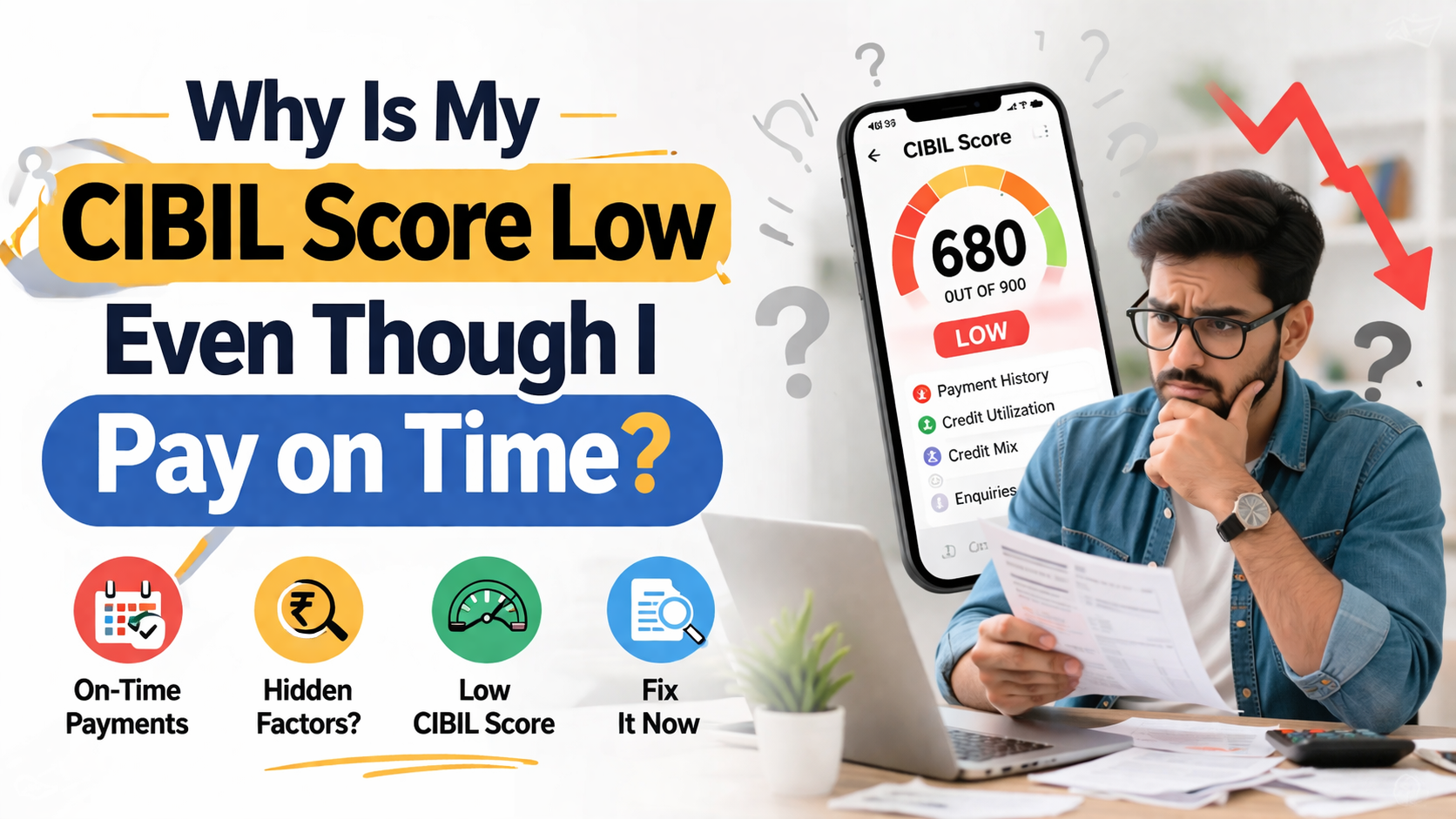
Here’s the truth most financial content won’t tell you plainly: payment history accounts for only about 35% of your CIBIL score. The remaining 65% is shaped by six other factors that most people have never heard of — and at least one of them is almost certainly dragging your score down right now.
This guide covers all seven reasons, with real examples and specific steps to fix each one.
What Actually Goes Into Your CIBIL Score?
Before diving into the reasons, it helps to understand the basic breakdown of how CIBIL calculates your score (range: 300–900):
| Factor |
Approximate Weight |
| Payment history |
~35% |
| Credit utilisation ratio |
~30% |
| Length of credit history |
~15% |
| Credit mix (types of credit) |
~10% |
| New credit enquiries |
~10% |
As you can see, even if your payment history is perfect — a full 35 out of 35 — the other 65% can easily pull your total score below 700.
Reason 1: Your Credit Utilisation Ratio Is Too High
This is the single most common reason people with spotless payment records have a mediocre score.
Credit utilisation is the percentage of your available credit limit that you’re currently using. If your credit card has a ₹1,00,000 limit and your outstanding balance is ₹70,000, your utilisation is 70%. That’s far too high — and CIBIL penalises it heavily even if you pay the full amount every month.
The reason this trips people up: your bank reports your outstanding balance to CIBIL on your statement generation date, not your payment due date. So even if you zero out the balance a few days later, CIBIL has already recorded the high utilisation figure for that month.
The safe threshold is under 30%. People with scores above 780 typically stay under 10%.
How to fix it:
- Pay a partial payment a few days before your statement date (not just before the due date) to lower the reported balance
- Request a credit limit increase from your bank — if your limit doubles and your spending stays the same, utilisation automatically halves
- If you use more than 30% regularly, consider getting a second credit card to increase your total available limit
Reason 2: Too Many Hard Enquiries in a Short Period
Every time you formally apply for a loan or credit card, the lender pulls your CIBIL report. This is called a hard enquiry, and each one slightly lowers your score — typically by 5 to 10 points.
One or two hard enquiries per year are fine. But if you applied for a personal loan, got rejected, tried another bank, then applied for a credit card — that’s three hard enquiries in a short window. Your score absorbed three hits even though you received nothing in return.
What makes this worse: rejected applications still count. CIBIL doesn’t know you were turned down; it only records that a lender checked your report.
How to fix it:
- Space out credit applications by at least 6 months where possible
- Use eligibility check tools offered by many banks — these do a “soft pull” that doesn’t affect your score
- If shopping for a home loan, do it within a 14–30 day window; multiple enquiries for the same loan type in a short period are often counted as a single enquiry by scoring models
- The impact of hard enquiries fades significantly after 12 months and disappears from your report after 2 years
Reason 3: You Are an Add-On Cardholder on a Troubled Account
This one catches people completely off guard. If you were added as a supplementary or add-on cardholder on a family member’s credit card — even if you never used that card — their account’s behaviour appears on your CIBIL report.
If that primary cardholder has high utilisation, late payments, or any disputes on that account, those negatives are reflected in your credit file too. In CIBIL’s view, you are treated as a co-borrower.
How to fix it:
- Pull your full CIBIL report (not just the score) at cibil.com and look through every account listed
- If you find an add-on account with poor history, ask the primary cardholder to remove you from the account
- Once the bank updates CIBIL after removal, the account should stop affecting your score
- Build your own independent credit history with a primary card in your name so your score isn’t dependent on someone else’s habits
Reason 4: You Have No Credit Mix
If the only credit product you’ve ever had is a credit card, your score will be limited — not because you’ve done anything wrong, but because you’ve only demonstrated one type of financial responsibility.
CIBIL rewards a mix of credit types:
- Revolving credit — credit cards, overdraft facilities
- Instalment credit — home loans, car loans, personal loans, education loans
Having both types on your record signals that you can manage different financial obligations. Someone who has only a credit card hasn’t proven they can handle the discipline of fixed monthly EMIs over a multi-year period.
How to fix it:
- A small consumer durable loan (for a phone, laptop, or appliance) via EMI introduces instalment credit at low risk — especially if it’s a purchase you were already planning
- A secured credit card (backed by a fixed deposit) or a credit-builder loan from an NBFC can diversify your profile
- Don’t borrow money you don’t need purely to improve your credit mix — but if an EMI opportunity arises naturally, it will genuinely help
Reason 5: There’s an Error in Your CIBIL Report
This is the most frustrating reason — because the problem isn’t you at all. Banks sometimes report incorrect data to credit bureaus: an account that was closed is shown as active, a fully repaid loan is marked as overdue, or a stranger’s loan appears on your PAN due to a data error.
These errors are more common than most people realise. According to consumer complaints data, a significant number of credit disputes in India involve inaccurate reporting by lenders — not actual borrower default. One wrong entry can reduce your score by 40 to 80 points with no justification.
Common errors to look for:
- A loan you closed years ago still showing an outstanding balance
- A loan marked “written off” when it was fully repaid
- A settled or disputed loan showing as “active” and overdue
- Someone else’s account appearing against your name or PAN
How to fix it:
- Get your full CIBIL report for free once a year at cibil.com — read every account, not just the score
- Raise a dispute on the CIBIL portal with supporting documents (loan closure certificate, NOC from bank, bank statements)
- Also write directly to the bank whose entry is incorrect — CIBIL can only update records after the lender confirms the correction
- Resolution typically takes 30–45 days once the lender acknowledges the error
Reason 6: Your Credit History Is Too Short
CIBIL doesn’t just look at how you’ve managed credit — it also looks at how long you’ve been managing it. An 18-month track record of perfect payments is promising, but it isn’t as convincing as a 10-year track record.
Two things make up your credit age:
- The age of your oldest account
- The average age of all your accounts combined
This is why opening several new credit cards at once can temporarily hurt your score — each new card reduces the average age of your entire credit portfolio.
How to fix it:
- If you’re reading this early in your credit journey, the single best thing you can do is open a basic credit card now and keep it open — the clock starts working in your favour immediately
- Never close your oldest credit card, even if you barely use it. That account’s age is a genuine asset. Keep it alive with occasional small purchases so the bank doesn’t deactivate it
- Avoid opening multiple new accounts at once
- There is no shortcut — time is the only fix, but it genuinely improves on its own
Reason 7: You Have a “Settled” Account on Your Report
This one surprises many people who thought settling a loan was the responsible thing to do.
In CIBIL’s records, there is a big difference between a “Closed” account and a “Settled” account:
- Closed — You repaid 100% of what you owed. The loan ended on good terms.
- Settled — The bank agreed to accept less than the full outstanding amount. You paid something; they closed the file. But CIBIL records this as a settlement, which signals that you did not fully honour your repayment obligation.
A “Settled” tag can remain visible on your CIBIL report for up to 7 years. Any lender who sees it knows that at some point, you — or your bank on your behalf — agreed to reduce the debt rather than repay it fully. Even if the settlement happened during a genuine financial emergency, the entry carries no context. It simply reads as a risk flag.
How to fix it:
- Contact the bank and ask if you can pay the remaining difference (the gap between what you settled for and the original outstanding amount). Some banks will reopen the case, accept the balance, update CIBIL to show “Closed” instead of “Settled”
- Get written confirmation before making any such payment, and obtain a No Objection Certificate (NOC) afterwards — then file a dispute with CIBIL to update the status
- For the future: before agreeing to a settlement offer from a bank, understand the long-term credit cost. A negotiated repayment plan is almost always better for your score than a settlement
Quick Reference: What to Check First
If you’re not sure where your problem lies, start here:
- Pull your full CIBIL report (free once a year at cibil.com) — not just the score
- Check your credit utilisation on each card — anything above 30% is costing you points
- Look for any errors or accounts you don’t recognise
- Check for any accounts marked “Settled” rather than “Closed”
- Count how many hard enquiries appear in the last 12 months
- Look for any add-on accounts from family members
Frequently Asked Questions
How long does it take to improve a CIBIL score? Small improvements (fixing utilisation, removing errors) can show up within one to two billing cycles — roughly 30 to 60 days. Building credit history and recovering from a settled account takes months to years. Most people see meaningful improvement within 6 to 12 months of consistent, corrective behaviour.
Does checking my own CIBIL score reduce it? No. Checking your own score is a “soft enquiry” and has no impact whatsoever. Only formal applications for credit (where a lender pulls your report) count as hard enquiries.
What is a good CIBIL score in India? 750 and above is considered good and will qualify you for most loans and credit cards at competitive interest rates. 700–749 is acceptable but may result in higher interest rates. Below 700 will make approvals harder and more expensive.
Can I get a loan with a CIBIL score of 650? Yes, but your options narrow and interest rates rise. Some NBFCs and digital lenders approve loans at 650+, but you’ll pay more. It’s worth taking 6 to 12 months to improve your score before applying for a major loan.
Will closing a credit card hurt my score? It can. Closing a card reduces your total available credit limit (raising utilisation) and, if it’s an old account, reduces your average credit age. Before closing any card, make sure you understand the impact on both factors.