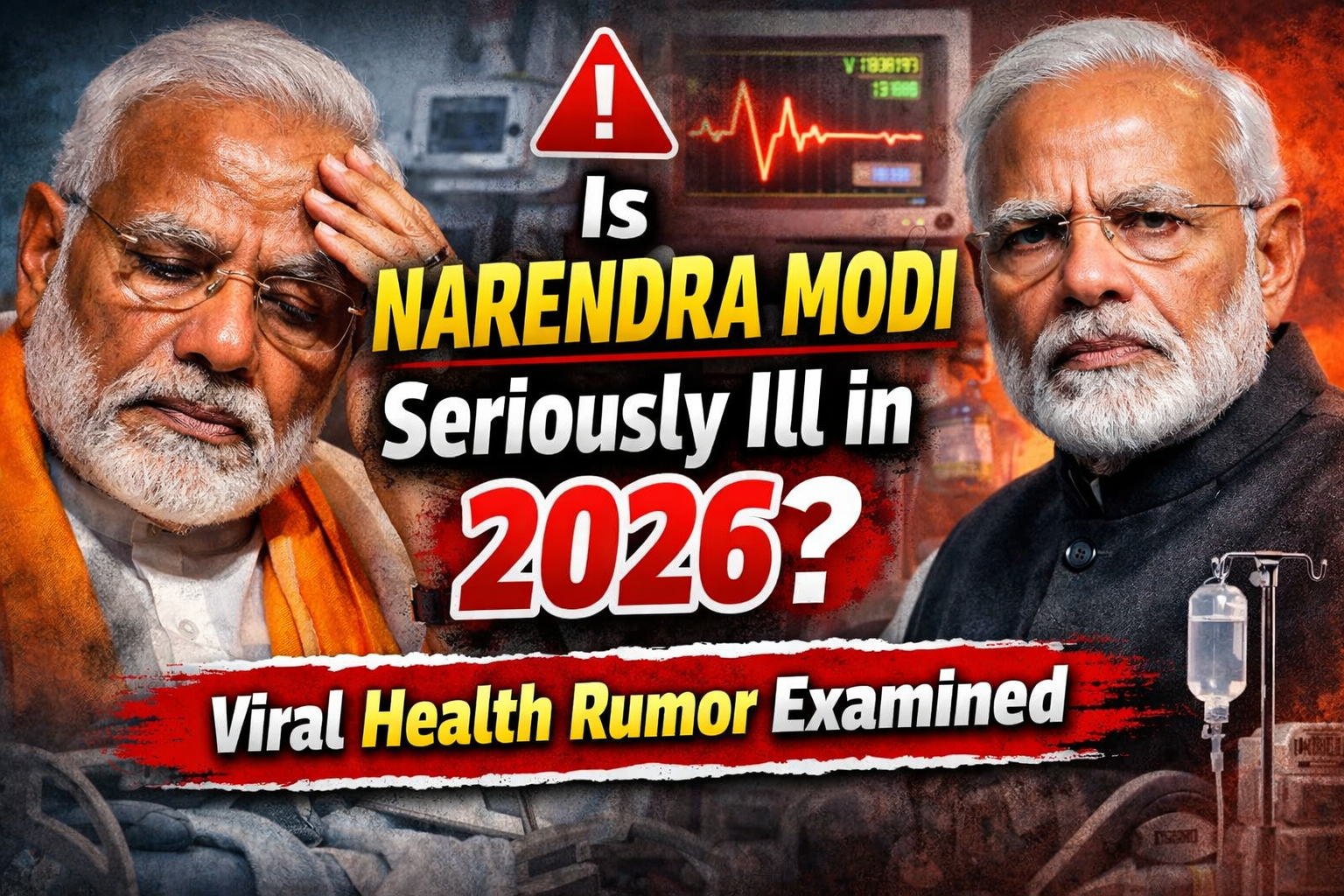
Unlike verified news that typically begins with official briefings or statements, this particular rumor seems to have originated in fragments. It didn’t come from a major press conference, nor was it first reported by established media outlets. Instead, it appeared in scattered forms—short social media posts, vague captions, and selectively edited clips.
Some posts hinted at possible health concerns, often without context. Others took a more dramatic tone, presenting speculation as if it were already confirmed. Within a short span of time, these posts multiplied, shared across platforms and groups, reaching a wider audience.
This is how many viral rumors begin—not with clarity, but with ambiguity.
📲 The Speed of Virality
The internet today moves at a pace where information doesn’t need to be verified before it spreads. Once a few posts gain attention, algorithms begin amplifying them.
On platforms like Twitter and messaging apps, repetition plays a key role. When users repeatedly see the same claim, even in slightly different forms, it starts to feel familiar—and familiarity often gets mistaken for truth.
Soon, questions begin circulating:
- Is this actually real?
- Why isn’t anyone officially confirming it?
- Did something serious happen?
Curiosity fuels clicks. Clicks fuel visibility. And visibility fuels belief.
🧾 Looking for Confirmation
In situations like this, the most effective approach is also the simplest—verify.
Ask a few basic questions:
- Has this been reported by multiple credible news organizations?
- Is there any official statement or announcement?
- Are there consistent details across different sources?
In this case, the answers remain clear:
- There is no formal announcement
- There is no verified report from credible media
- There is no consistent or reliable evidence supporting the claim
When a story of this scale lacks confirmation from trusted sources, it strongly suggests that the narrative is not grounded in verified facts.
🧠 Why These Rumors Catch On So Easily
Health-related rumors tend to spread faster than most types of content. There’s a reason for that.
feel urgent.
feel personal.
feel serious.
When the subject is a high-profile public figure like Narendra Modi, the emotional response becomes even stronger. People don’t just read such news—they react to it instantly.
Concern, curiosity, and sometimes even fear all play a role. And emotional reactions travel much faster than logical verification.
🌐 The Role of Search Trends
Another interesting factor in the spread of such rumors is how search behavior contributes to visibility.
When a rumor begins circulating, people naturally turn to search engines like Google to verify it. They type queries like:
- “Narendra Modi health update”
- “Is Narendra Modi ill?”
- “Narendra Modi latest news today”
As more users search for the same topic, the search engine identifies it as trending. This increases its visibility further, bringing even more attention to the rumor.
It creates a cycle:
Rumor → Searches → Trending → More Searches → Wider Spread
🇮🇳 Public Figures and Constant Scrutiny
Being one of the most recognized political figures in the world, Narendra Modi remains under constant public observation.
Every appearance, speech, or pause is noticed. Every detail is analyzed. In such an environment, even normal variations in behavior or routine can be interpreted in different ways.
This level of scrutiny doesn’t necessarily indicate a problem—it reflects the scale of public attention.
But it also means that speculation can arise from even the smallest observations.
📱 Social Media vs Verified Reality
Social media platforms have made it easier than ever to share information. But they’ve also made it easier to spread misinformation.
A post doesn’t need to be accurate to go viral—it just needs to be engaging.
Content that:
- Feels urgent
- Sounds dramatic
- Creates emotional reactions
is more likely to be shared.
Verified information, on the other hand, often takes time. It requires confirmation, cross-checking, and responsible reporting.
That difference in speed creates a gap—one where rumors often grow faster than facts.
🔍 What Can Actually Be Said Right Now?
Looking at the available information:
- There is no verified confirmation of any serious health issue
- There is no official statement supporting the rumor
- There is no credible evidence backing the claim
What exists instead is a pattern of online speculation, amplified through repetition and visibility.
In simple terms:
👉 There is no solid evidence that Narendra Modi is seriously ill
👉 The viral claim appears to be unverified and misleading
🧩 Understanding the Bigger Picture
This situation is not unique. Similar rumors have surfaced in the past about various public figures—across politics, entertainment, and sports.
The pattern remains the same:
- A vague claim appears
- It spreads rapidly
- It gains attention
- It feels real
- But lacks confirmation
Understanding this pattern makes it easier to approach such stories with caution rather than immediate belief.
💬 A Thought Worth Keeping
Not every trending topic reflects reality.
Sometimes, it reflects curiosity.
Sometimes, it reflects confusion.
And sometimes, it reflects how quickly information—accurate or not—can travel in a connected world.
In a digital environment where speed often comes before verification, the responsibility shifts to the reader.
🧠 Final Reflection
The viral discussion around Narendra Modi’s health appears to be driven more by speculation than by verified facts.
There is no official confirmation.
No credible reporting.
No consistent evidence.
Just a rapidly spreading narrative shaped by online activity.
And in moments like these, the most valuable approach is simple:
Pause.
Verify.
And separate information from assumption.
Because not everything that trends is true—and not everything that spreads is real.
⚠️ Notice
At the time of writing, there is no confirmed or official report stating that Narendra Modi is seriously ill. This article explores a viral online rumor currently circulating across digital platforms. Based on available information, the claim appears unverified and likely misleading, but it’s worth understanding how such narratives emerge, spread, and gain traction so quickly.

The official voice of Insightful Post, providing real-time updates on the stories that shape our world. From breaking global news to essential general reporting, the Admin team is dedicated to delivering accurate, timely, and unbiased information. Our mission is to keep you informed with the facts, ensuring the Insightful Post community never misses a beat in the fast-paced world of news.