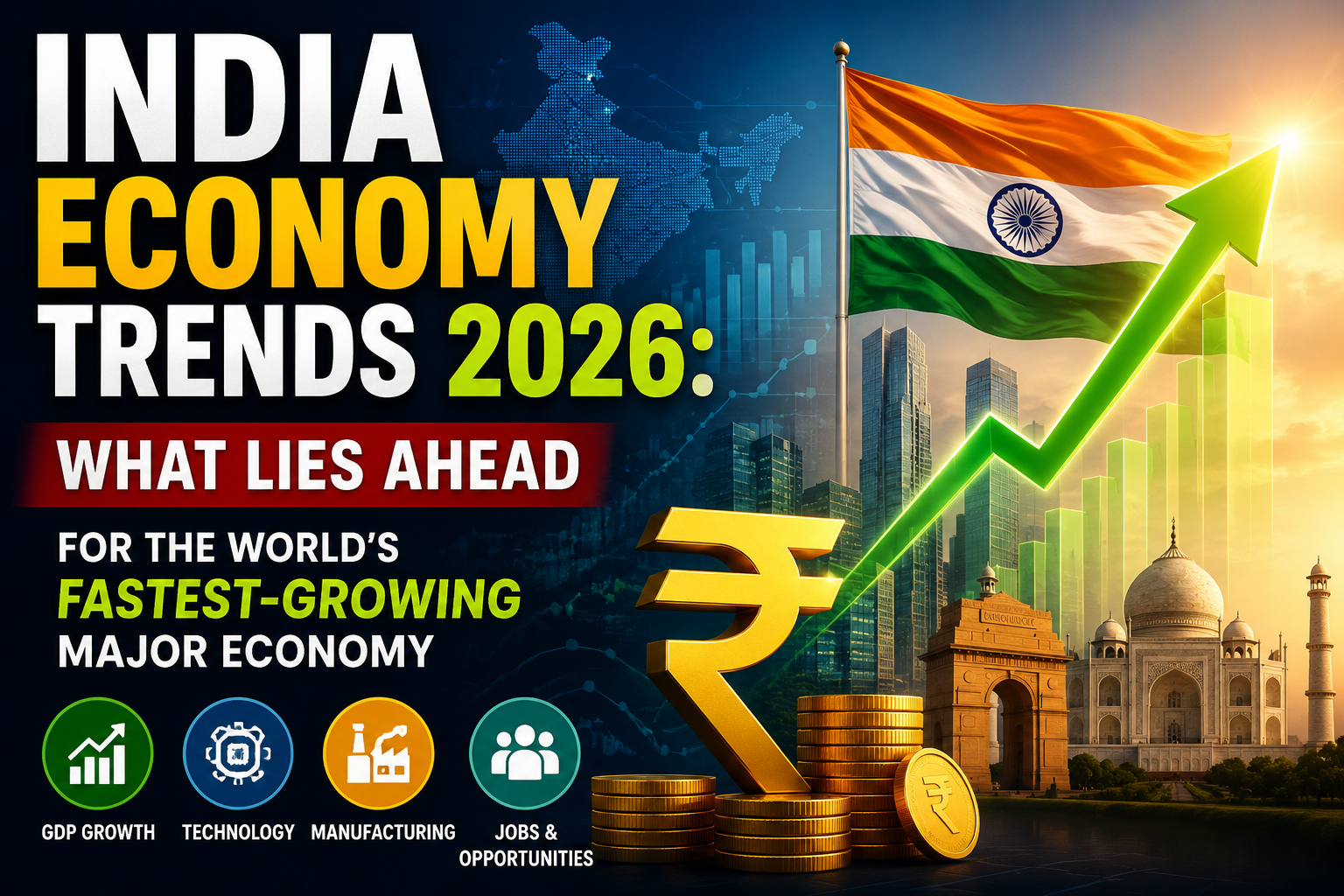
India continues to demonstrate remarkable economic resilience and growth potential. As the world moves deeper into the mid-2020s, several powerful India economy trends 2026 are expected to define the country’s trajectory. From ambitious clean-energy projects to rapid digital transformation, these trends will influence industries, employment, and investment decisions across the nation. This article examines the key India economy trends 2026 in detail, offering a clear roadmap of opportunities and challenges.
Green Hydrogen and the Renewable Energy Shift
One of the most significant India economy trends 2026 is the accelerated development of green hydrogen. The National Green Hydrogen Mission has set ambitious targets, and by 2026 several large-scale production facilities are projected to become operational.
Major Projects and State-Level Initiatives
States such as Rajasthan, Gujarat, and Tamil Nadu are emerging as green hydrogen hubs. These projects will not only help India meet its net-zero commitments but also create substantial export opportunities. Companies involved in electrolyzer manufacturing and hydrogen storage infrastructure stand to benefit the most from this transition.
Economic Impact of Green Hydrogen
The shift toward green hydrogen is expected to generate thousands of skilled jobs while reducing India’s dependence on imported fossil fuels. This trend aligns perfectly with global sustainability goals and positions India as a potential leader in the clean-energy export market.
Semiconductor Manufacturing and Self-Reliance
Another critical component of India economy trends 2026 is the growth of domestic semiconductor manufacturing. The India Semiconductor Mission has already attracted major global players, and 2026 is likely to mark the beginning of commercial chip production within the country.
Reducing Import Dependence
Successful fabrication units will lower India’s reliance on imported chips and strengthen the electronics manufacturing ecosystem. This development will have far-reaching effects on automotive, defense, and consumer electronics sectors.
Job Creation and Skill Development
The semiconductor industry is expected to create high-value employment opportunities. Educational institutions and training programs are already aligning curricula to meet the demand for specialized talent.
Digital Finance and Fintech Expansion
Digital finance remains at the heart of India economy trends 2026. Building on the success of the Unified Payments Interface (UPI), the ecosystem is set to evolve further with central bank digital currency (CBDC) expansion and embedded finance solutions.
Rise of Mutual Funds and Retail Investing
Mutual fund investments through systematic investment plans (SIPs) are projected to reach new record levels by 2026. Greater financial literacy among the middle class will drive this growth, making retail participation in capital markets more widespread.
Regulatory and Technological Advancements
Regulators are expected to introduce frameworks that balance innovation with consumer protection. This balanced approach will foster trust and encourage broader adoption of digital financial services.
Infrastructure Development Under Gati Shakti
Infrastructure continues to be a cornerstone of India economy trends 2026. The Gati Shakti National Master Plan and the National Infrastructure Pipeline are delivering visible results across roads, railways, ports, and airports.
Logistics Efficiency and Cost Reduction
Improved connectivity will reduce logistics costs for businesses and enhance India’s competitiveness in global trade. Manufacturing hubs in states like Uttar Pradesh, Maharashtra, and Tamil Nadu will particularly benefit from better multimodal transport links.
Public-Private Partnerships
Increased participation of private players in infrastructure projects is expected to accelerate project completion timelines and bring in additional capital.
Sustainability, ESG, and the Circular Economy
Sustainability is no longer a peripheral concern but a central theme in India economy trends 2026. Companies across sectors are adopting robust ESG (Environmental, Social, and Governance) frameworks.
Electric Vehicles and Waste Management
The rapid adoption of electric vehicles in both public and private transport, along with waste-to-energy initiatives, reflects this shift. Investors are increasingly favoring companies with strong sustainability credentials.
Policy Support for Green Practices
Government incentives for green manufacturing and circular economy practices will further encourage businesses to align with these trends.
Agriculture Modernization and Export Growth
Agriculture and allied sectors are undergoing significant transformation under India economy trends 2026. Precision farming, drone technology, and improved cold-chain infrastructure are helping boost productivity.
Export Opportunities in Organic Produce
Policy support for organic and natural farming is opening new international markets. Reduced post-harvest losses will improve farmer incomes and contribute to overall economic stability.
Trade Agreements and Foreign Direct Investment
India’s global trade relationships are strengthening. New free trade agreements with regions in Europe, the Middle East, and Southeast Asia are expected to boost exports in pharmaceuticals, textiles, and engineering goods.
Attracting High-Value FDI
Production-linked incentive schemes and improved ease of doing business are attracting foreign direct investment in high-value sectors. This inflow of capital will support technology transfer and skill development.
Challenges and the Way Forward
While the outlook remains positive, several challenges must be addressed. Managing inflation, creating sufficient employment for the youth population, and building climate resilience require focused policy attention. However, strong domestic consumption, a favorable demographic dividend, and proactive reforms provide a solid foundation for sustained growth.
Conclusion: Positioning for Long-Term Success
The India economy trends 2026 discussed above paint a picture of a nation moving confidently toward self-reliance, technological leadership, and sustainable development. Businesses, investors, and policymakers who align their strategies with these emerging trends will best positioned to capitalize on India’s continue rise on the global economic stage.

The official voice of Insightful Post, providing real-time updates on the stories that shape our world. From breaking global news to essential general reporting, the Admin team is dedicated to delivering accurate, timely, and unbiased information. Our mission is to keep you informed with the facts, ensuring the Insightful Post community never misses a beat in the fast-paced world of news.