
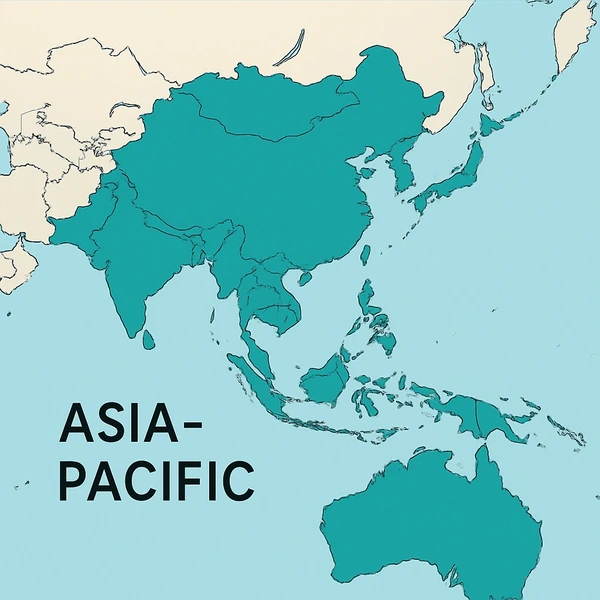
The Asia-Pacific region — encompassing East Asia, Southeast Asia, South Asia, and Oceania — is home to more than half the world’s population, the world’s largest and fastest-growing economies, the most active geopolitical competition of our era, and some of the most consequential technology and climate developments globally. Understanding what is happening here is essential for understanding the world.
China: Economic Transition and Geopolitical Competition
China’s economy — the world’s second-largest by nominal GDP, first by purchasing power parity — is undergoing its most significant structural transition in decades, moving from export and investment-driven growth toward domestic consumption and advanced manufacturing. This transition has been complicated by a severe property sector crisis: Evergrande’s 2021 default and the subsequent broader real estate sector downturn have affected an industry that at its peak contributed approximately 25% of Chinese GDP.
China’s GDP growth has moderated from the 8-10% annual rates of the 2000s and 2010s to the 5% range, which the government has designated as its official target. Structural challenges — demographic decline following decades of the one-child policy, high local government debt, and reduced productivity growth — suggest that China’s era of exceptional growth is ending, though even moderated Chinese growth has enormous global implications.
Geopolitically, China-Taiwan tensions remain the most significant potential flashpoint in the region. Taiwan elected Lai Ching-te as president in January 2024 — a candidate from the independence-leaning Democratic Progressive Party — in an election China described as a “choice between peace and war.” The status quo of Taiwan’s de facto independence and China’s claim of sovereignty is being tested as China’s military capabilities and confidence have grown, and as the United States has sought to strengthen its security commitments in the Indo-Pacific.
India: The World’s Fastest-Growing Large Economy
India overtook China as the world’s most populous country in 2023 and has been the world’s fastest-growing major economy for several years, with GDP growth of 6-7% annually. Prime Minister Narendra Modi’s BJP government was re-elected in June 2024, though with a reduced majority that required coalition partners for the first time, introducing more political complexity than in previous terms.
India’s economic growth is being driven by a combination of infrastructure investment, manufacturing expansion (benefiting from “China plus one” supply chain diversification), a booming technology services industry, and growing domestic consumption. The Production-Linked Incentive (PLI) scheme has attracted significant foreign direct investment in electronics, pharmaceuticals, and other manufacturing sectors.
India’s geopolitical position has become increasingly significant. Its membership in the Quad (with the US, Japan, and Australia), its role as the G20 chair in 2023, and its active pursuit of a “strategic autonomy” foreign policy — maintaining relationships with both the US and Russia, buying discounted Russian oil while strengthening Western economic ties — reflect India’s growing confidence in navigating great power competition on its own terms.
Japan: Economic Revival and Security Transformation
Japan’s economy has shown signs of genuine revival in 2024-2025 that have surprised observers. After three decades of deflation,
Japan has finally seen sustained inflation return — a development the Bank of Japan has managed carefully to avoid precipitating a financial shock while normalising monetary policy from the extreme accommodation of the past decade.
More dramatically, Japan has undergone the most significant transformation of its security and defence policy since the postwar period. The Kishida government’s 2022 National Security Strategy committed Japan to doubling defence spending to 2% of GDP by 2027 (from approximately 1%), acquiring counterstrike capabilities (the ability to strike enemy missile launch sites, previously considered unconstitutional),
and deepening security integration with the United States, Australia, South Korea, and NATO allies. This represents a fundamental departure from Japan’s postwar pacifist security posture driven by
Japan’s assessment of the threat from China’s military buildup and North Korea’s missile programme.
ASEAN: Southeast Asia’s Dynamic Economic Region
Southeast Asia’s ten-country ASEAN bloc — with a combined GDP of approximately $3.6 trillion and a population of 685 million —
has been one of the principal beneficiaries of supply chain diversification away from China. Vietnam, in particular, has attracted enormous manufacturing investment from electronics companies including Samsung, Apple suppliers, and Intel,
becoming a major global electronics exporter.
Indonesia — Southeast Asia’s largest economy and the world’s fourth most populous country — is navigating its own transition. The handover of the presidency from Joko Widodo to Prabowo Subianto in October 2024 represents a significant political shift,
and Indonesia’s management of its nickel reserves — among the world’s largest and essential for electric vehicle batteries —
is increasingly important for global clean energy supply chains Asia-Pacific.
Climate Vulnerability Across the Pacific
Pacific island nations face existential climate threats that are already reshaping their societies and international advocacy. Kiribati, Tuvalu, the Marshall Islands,
and several other low-lying nations face genuine threats to territorial viability from sea level rise. Tuvalu signed a historic agreement with Australia in 2023 providing Tuvaluans
with a pathway to Australian residency — essentially the world’s first bilateral response to climate-driven displacement at the national level.
Australia and New Zealand face intensifying extreme weather events. Australia’s 2019-2020 Black Summer bushfires burned approximately 186,000 square kilometres — an unprecedented scale that climate scientists linked directly to climate change. Subsequent years have brought severe flooding to Queensland and New South Wales,
testing the resilience of infrastructure and emergency systems.
Frequently Asked Questions
What is the Quad and why does it matter?
The Quadrilateral Security Dialogue (Quad) is a strategic security forum involving the United States, Australia, Japan, and India. Revived in 2017 after an earlier iteration in 2007,
it has become increasingly significant as a mechanism for coordinating Indo-Pacific security, technology, and economic policy among like-minded democracies. While not a formal military alliance,
the Quad’s regular summits, joint military exercises, and cooperation on semiconductor supply chains, vaccine distribution,
and cybersecurity reflect its growing strategic importance as a counterweight to Chinese regional influence.
How is the Asia-Pacific technology race shaping global politics?
The competition between China and the United States for leadership in critical technologies — semiconductors, AI, quantum computing, advanced battery technology,
and 5G communications — is one of the defining geopolitical contests of the 2020s. Taiwan is at the centre of this competition: TSMC (Taiwan Semiconductor Manufacturing Company) produces approximately 90% of the world’s most advanced chips,
making Taiwan’s security a matter of global technological supply chain significance. The US export controls on advanced semiconductors to China implemented from 2022 onwards represent one of the most significant economic policy interventions in decades —
an attempt to slow China’s technological catch-up in strategic industries Asia-Pacific.
What is the best way to follow Asia-Pacific news?</h3>
Nikkei Asia (asia.nikkei.com) provides the highest quality English-language coverage of the region with particular strength in Japanese and East Asian business
news. South China Morning Post (scmp.com) provides significant China-focused coverage,
though readers should note its Hong Kong-based perspective. The Diplomat (thediplomat.com) focuses specifically on Asia-Pacific politics and security. Reuters and AP both have strong regional presence. For country-specific coverage, The Hindu (India),
Channel NewsAsia (Singapore), and ABC Australia provide reliable national coverage.
Final Thoughts</h2>
The Asia-Pacific is the region where the most significant contests of the 21st century are playing out: the US-China geopolitical compet
ition,
the race for technological leadership, the management of the world’s most consequential economic transitions,
and the front lines of some of climate change’s most severe impacts. Following this region carefully is not optional for anyone who wants to understand the direction of the world. The guide above provides a framework;
the richness of specific country and regional reporting will fill in the detail that any overview necessarily leaves out.

The official voice of Insightful Post, providing real-time updates on the stories that shape our world. From breaking global news to essential general reporting, the Admin team is dedicated to delivering accurate, timely, and unbiased information. Our mission is to keep you informed with the facts, ensuring the Insightful Post community never misses a beat in the fast-paced world of news.



One thought on “Asia-Pacific News 2026: Key Developments Across the Region”