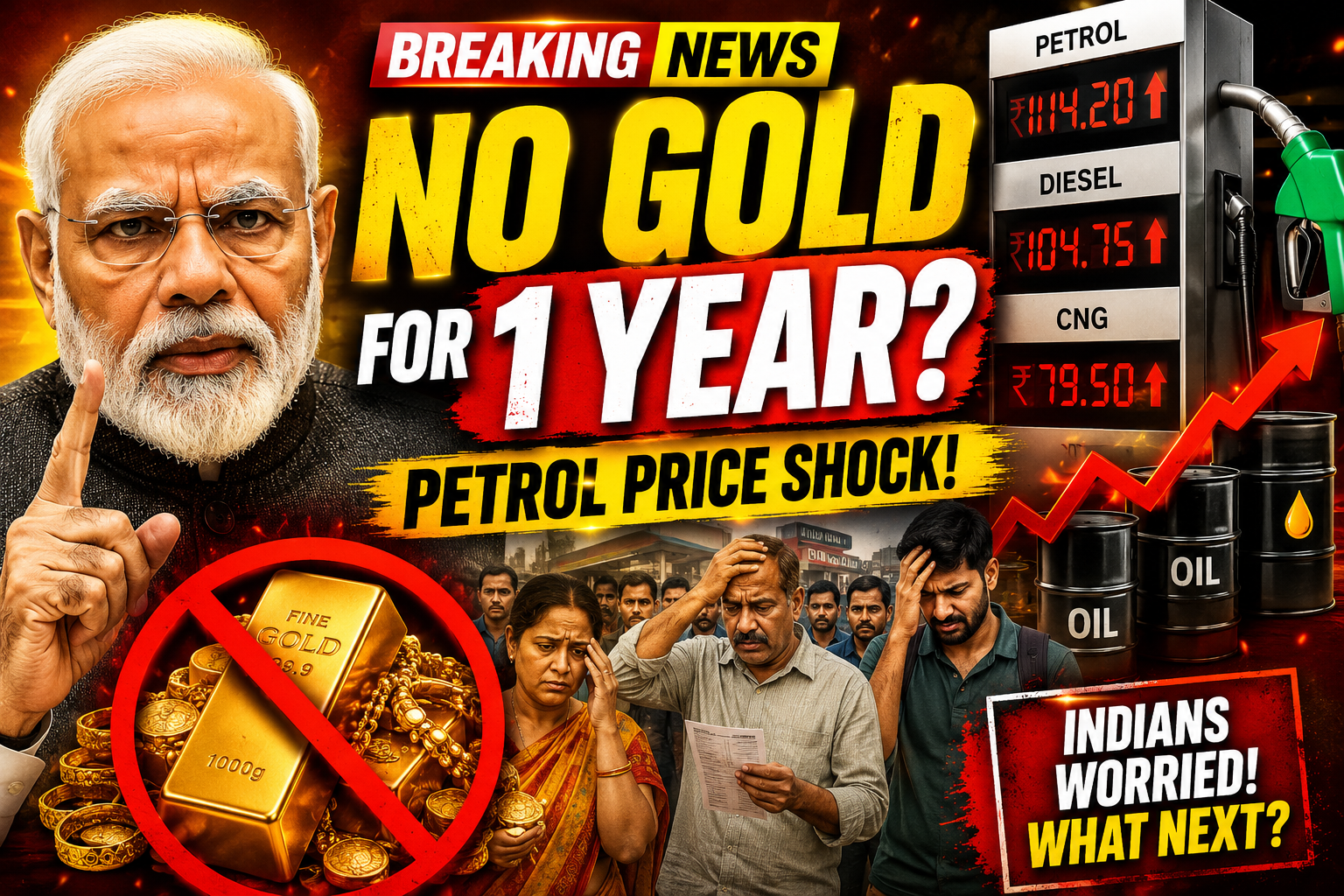
India’s economy is walking through a delicate phase. Rising global tensions, increasing crude oil prices, pressure on foreign exchange reserves, and surging gold imports are all creating fresh challenges for policymakers. In the middle of this economic uncertainty, Prime Minister Narendra Modi made an unusual but powerful appeal to the nation — avoid buying gold for one year unless it is absolutely necessary.
The statement immediately grabbed headlines across financial markets, business circles, and households. After all, gold is deeply woven into Indian culture. From weddings to festivals, Indians buy gold almost instinctively. So why would the Prime Minister ask people to stop purchasing it?
The answer lies in economics, trade deficits, foreign exchange reserves, and even the ongoing global energy crisis. Interestingly, this issue is also directly connected to petrol price news, because rising oil prices and rising gold imports together are putting enormous pressure on India’s economy.
Let’s break down what’s really happening and why this appeal could impact everything from fuel prices to jewellery stocks.
Why PM Modi Asked Indians to Avoid Buying Gold
During a recent public appeal, PM Modi urged citizens to postpone non-essential gold purchases, including wedding-related jewellery shopping, for at least a year. The message was framed as a matter of “national interest.”
India imports almost all the gold it consumes. Unlike food grains or manufactured goods, gold does not generate productive economic output. It simply sits in lockers, homes, and bank vaults. While it holds emotional and financial value for families, large-scale imports drain valuable foreign exchange reserves.
Think of India’s economy like a household budget. If a family keeps spending heavily on luxury items while already paying expensive fuel bills, the savings account eventually starts shrinking. That is exactly what policymakers fear for the nation.
How Gold Imports Are Hurting India’s Economy
According to the Global Trade Research Initiative (GTRI), India’s gold imports have surged dramatically over the past few years.
India’s Gold Import Growth
| Year | Gold Imports (USD Billion) | UAE Share |
|---|---|---|
| 2022 | 36.5 Billion | 7.9% |
| 2023 | 42.6 Billion | 15.7% |
| 2025 | 58.9 Billion | 28.0% |
The numbers paint a worrying picture.
India’s gold imports jumped from $36.5 billion in 2022 to nearly $59 billion by 2025. That’s a massive increase in a short period. Much of this gold comes through the UAE under favorable tariff concessions provided by the India-UAE Free Trade Agreement.
Now here’s where petrol price news becomes closely linked.
India also imports most of its crude oil requirements. So when the country spends huge amounts on both gold and oil imports simultaneously, the trade deficit widens rapidly.
That creates pressure on:
- The Indian rupee
- Foreign exchange reserves
- Inflation levels
- Fuel prices
- Economic stability
The Hidden Link Between Gold Imports and Petrol Price News
At first glance, gold and petrol may seem unrelated. One shines in jewellery stores while the other fuels vehicles. But economically, they are deeply connected.
India pays for both imports using foreign currency, mainly US dollars.
When global crude oil prices rise due to geopolitical tensions, India’s import bill increases sharply. Add soaring gold imports to the mix, and the demand for dollars becomes even higher.
This weakens the rupee against the dollar.
And what happens when the rupee weakens?
Imported fuel becomes more expensive.
That’s why petrol price news has become one of the central economic concerns right now. Higher fuel prices affect transportation costs, food inflation, manufacturing expenses, and household budgets.
In simple terms, excessive gold buying during an international economic crisis indirectly contributes to inflationary pressure at home.
Middle East Conflict Is Making the Situation Worse
The ongoing conflict in the Middle East has added another layer of uncertainty to global markets.
The Strait of Hormuz, one of the world’s most critical oil shipping routes, has already experienced disruptions. Since a large portion of India’s crude oil passes through this route, any instability there immediately affects global oil prices.
Union Minister Ashwini Vaishnaw emphasized that the current situation requires every citizen to contribute toward conserving foreign exchange.
Speaking at the CII Annual Business Summit 2026 in New Delhi, Vaishnaw said people should reduce unnecessary foreign exchange spending and increase earnings wherever possible.
This is where petrol price news once again enters the conversation.
If oil supply disruptions continue:
- Global crude prices may rise further
- Petrol and diesel costs could increase
- Inflation may accelerate
- Economic growth may slow
So the government is trying to reduce pressure from every possible angle — including gold imports.
Why GTRI Backed PM Modi’s Appeal
The Global Trade Research Initiative strongly supported PM Modi’s request.
According to the think tank, gold imports are no longer just a cultural or consumer issue. They have become a macroeconomic challenge.
GTRI believes that reducing gold imports even temporarily could:
- Protect India’s forex reserves
- Reduce trade imbalance
- Stabilize the rupee
- Help control inflation
- Ease economic pressure during geopolitical uncertainty
The organization also suggested reviewing tariff concessions offered under the India-UAE trade deal.
Experts argue that lower import duties on gold from Dubai may have unintentionally encouraged excessive bullion inflows into India.
Jewellery Stocks Crash After PM Modi’s Statement
Markets reacted almost instantly after the Prime Minister’s remarks.
Several jewellery companies witnessed sharp declines in stock prices as investors feared weaker demand.
Major Jewellery Stock Declines
- Senco Gold fell nearly 9%
- Titan dropped over 6%
- Kalyan Jewellers slipped more than 8%
- PC Jeweller also declined significantly
Investors are worried that reduced consumer demand could impact sales growth across the jewellery sector.
Gold buying in India is not just seasonal — it is emotional. Weddings, festivals like Diwali and Akshaya Tritiya, and family investments drive huge demand every year.
So even a temporary slowdown can hit revenues hard.
Why Indians Love Gold So Much
To understand the challenge, you have to understand India’s emotional relationship with gold.
Gold is:
- A status symbol
- A wedding essential
- A financial safety net
- A traditional investment
- A cultural asset
For generations, families have trusted gold more than stock markets or digital assets.
In many Indian households, buying gold is considered safer than keeping money in banks. During uncertain times, demand often increases even more.
Ironically, that’s exactly what the government wants to prevent right now.
Can Reducing Gold Purchases Really Help?
Yes — at least temporarily.
If millions of Indians reduce gold purchases:
- Dollar outflow may decline
- Pressure on forex reserves could reduce
- Trade deficit may narrow
- Rupee stability may improve
- Inflation risks may ease
And ultimately, it may indirectly help stabilize fuel prices, which is why petrol price news remains central to the entire debate.
Economists say that even a moderate reduction in imports can significantly improve short-term macroeconomic conditions.
Fuel Conservation Is Also Part of the Plan
The government is not only targeting gold imports.
Ashwini Vaishnaw also urged citizens to reduce fuel consumption wherever possible.
That includes:
- Using public transport
- Avoiding unnecessary travel
- Conserving diesel and petrol
- Improving energy efficiency
Why?
Because every litre of imported fuel increases India’s import bill.
This means petrol price news is no longer just about daily fuel rates. It has become part of a much larger economic strategy focused on conserving foreign exchange and strengthening national stability.
What This Means for Common Indians
For ordinary citizens, the situation creates a difficult balancing act.
Families planning weddings may delay jewellery purchases. Investors may reconsider buying physical gold. Businesses dependent on bullion demand could face slower sales.
At the same time, rising fuel prices continue affecting everyday life.
From grocery bills to transportation costs, the ripple effects are everywhere.
Here’s the bigger question:
Would Indians be willing to sacrifice short-term traditions to support long-term economic stability?
That remains uncertain.
Could Gold Prices Rise Even Further?
Ironically, reduced domestic buying does not always mean lower gold prices.
Global uncertainty often pushes international investors toward gold as a “safe haven” asset. If geopolitical tensions continue, global gold prices could remain elevated.
So while the Indian government wants reduced consumption, international market forces may still keep prices high.
This creates an interesting paradox:
Gold becomes more expensive precisely when policymakers want people to stop buying it.
The Bigger Economic Picture
India is currently navigating multiple economic pressures simultaneously:
- Rising crude oil prices
- Global geopolitical instability
- Currency volatility
- Inflation risks
- Increasing import bills
The government appears focused on minimizing non-essential imports to preserve economic stability.
And because fuel imports already consume massive foreign exchange reserves, controlling additional import-heavy sectors like gold becomes crucial.
That’s why discussions around petrol price news are now deeply tied to national economic strategy.
Conclusion
Prime Minister Narendra Modi’s appeal to avoid buying gold for a year may sound unusual, but it reflects growing concern over India’s economic vulnerabilities. Surging gold imports, rising crude oil prices, and global geopolitical tensions are creating pressure on the country’s trade balance and foreign exchange reserves.
The connection between gold buying and petrol price news is more important than many people realize. Both gold and fuel imports require enormous dollar outflows, weakening the rupee and increasing inflation risks.
By reducing non-essential imports and conserving fuel consumption, the government hopes to stabilize the economy during a highly uncertain global period.
Whether Indians respond positively to the appeal remains to be seen. But one thing is clear — economic decisions made inside households today could have a much larger impact on the nation’s financial future tomorrow.

The official voice of Insightful Post, providing real-time updates on the stories that shape our world. From breaking global news to essential general reporting, the Admin team is dedicated to delivering accurate, timely, and unbiased information. Our mission is to keep you informed with the facts, ensuring the Insightful Post community never misses a beat in the fast-paced world of news.