Here is what nobody tells you about Why Gas Prices Rise and Fall: the gap between what the experts say and what ordinary people actually need to know is enormous. This guide closes that gap. Instead of theory-heavy explanations and abstract economic jargon, you are going to get fifteen clear, concrete, actionable insights about Why Gas Prices Rise and Fall — the kind of understanding that actually changes how you think about money, policy, and your financial future. Let us get into it.
1. Why Gas Prices Rise And Fall Is More Personal Than You Think
When you hear economists talk about Why Gas Prices Rise and Fall in abstract terms, it is easy to tune out. But here is the thing: every aspect of Why Gas Prices Rise and Fall has a direct, measurable effect on your household budget, your career opportunities, your savings, and your long-term financial security. The interest rate the Federal Reserve sets affects your mortgage rate. The trade policies your government adopts affect the price of goods at the store. The labour market conditions driven by macroeconomic forces affect your job security and your ability to negotiate a raise. None of this is abstract — it is the financial air you breathe every day.
2. The Official Numbers Often Miss the Point
The official economic statistics on Why Gas Prices Rise and Fall — the GDP growth rate, the headline inflation figure, the national unemployment rate — describe the average experience of an entire economy. But you are not an average. If you rent your home in an expensive city, your experience of housing costs is dramatically different from the national average. If you work in a sector facing automation, your labour market experience is different from the aggregate unemployment rate. Always ask: where do I sit relative to the average? In what ways does my specific situation differ from what the headline numbers describe?
3. Supply and Demand Explains More Than You Realise
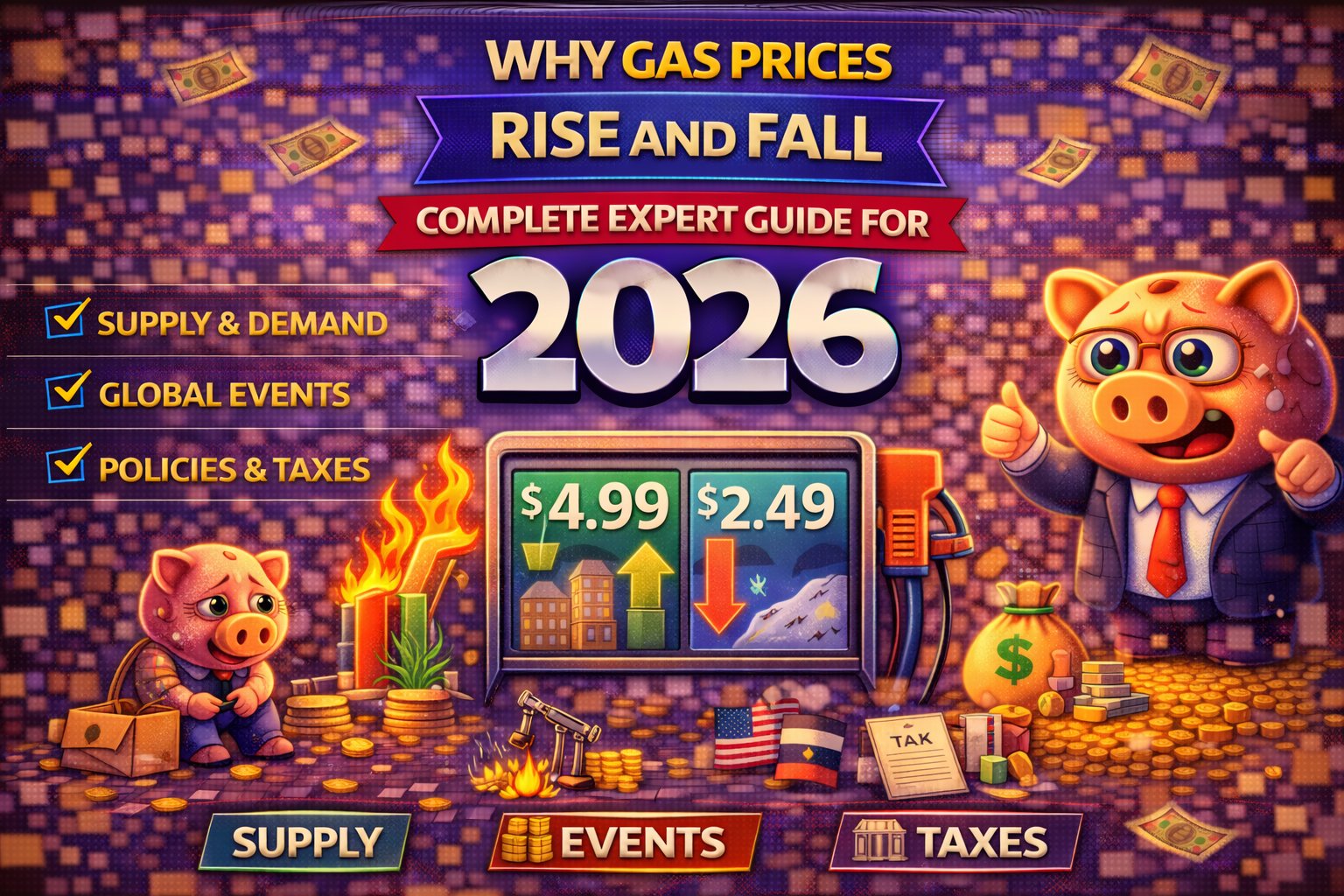
The most powerful analytical tool for understanding Why Gas Prices Rise and Fall is also the most basic: supply and demand. When the supply of something people want is constrained, its price rises. When demand exceeds supply, prices rise. When supply exceeds demand, prices fall. This simple framework explains housing affordability crises (constrained supply, high demand), labour market dynamics (supply and demand for workers), energy price volatility (supply decisions by producing countries meeting volatile demand), and financial market movements (supply and demand for financial assets). Applying this framework consistently to economic news will give you genuine insight that most consumers of economic information lack.
4. Inflation Is a Tax — But Not an Equal One
Inflation is sometimes called a hidden tax, and the metaphor is useful but incomplete. A tax is at least nominally applied according to some principle of ability to pay. Inflation is more regressive than most explicit taxes: it hits hardest those who hold most of their wealth in cash (the poorest households) and those whose incomes are fixed in nominal terms (retirees on fixed pensions, workers with long-term wage agreements). Conversely, those who hold real assets — real estate, equities, commodities — are partially protected because the value of their assets tends to rise with the general price level. Understanding inflation as a regressive economic force helps explain why the policy debate about it is so politically charged.
5. Interest Rates Touch Everything
When central banks change interest rates, they are changing the price of money itself — and since money mediates virtually every economic transaction, the ripple effects are pervasive. Rising interest rates increase mortgage costs, making housing less affordable. They increase the cost of business borrowing, reducing investment and hiring. They make savings accounts more attractive, shifting money from spending to saving. They strengthen the currency, making exports less competitive and imports cheaper. They reduce the present value of future earnings, pressing down equity prices. Every one of these effects ultimately touches the lives of ordinary households — which is why interest rate decisions are among the most consequential economic policy choices made anywhere in the world.
6. The Labour Market Is Where Economics Gets Personal
For most households, the labour market is the primary mechanism through which macroeconomic conditions translate into personal financial reality. When the economy is strong and labour markets are tight, workers have bargaining power: they can negotiate higher wages, resist unreasonable conditions, and move between jobs to improve their situations. When the economy weakens and unemployment rises, this bargaining power evaporates: employers have the upper hand, wages stagnate, and job security deteriorates. This is why macroeconomic conditions matter so profoundly to ordinary people — not through abstract statistical effects but through the very concrete daily experience of work, wages, and employment security.
7. Government Debt Is More Complicated Than You Have Been Told
Politicians of all stripes simplify government debt to a degree that is actively misleading. Deficit hawks treat all government debt as inherently dangerous, analogising government finances to household budgets in ways that economists uniformly reject. Deficit doves sometimes dismiss debt concerns entirely, ignoring the genuine long-term fiscal risks that accumulating debt creates. The honest picture is more nuanced: government debt at moderate levels, used to finance genuinely productive investment, is economically manageable and can be growth-enhancing. Debt at very high levels, used to finance current consumption rather than investment, creates genuine long-term fiscal risks. The relevant question is always not “how much debt?” but “what was the debt used for and what are the long-term fiscal implications?”
8. Trade Creates Winners and Losers — Both Are Real
The economics of international trade is one of the most politically contentious areas of economic policy because it involves genuinely difficult distributional questions. Trade liberalisation — reducing barriers to international commerce — produces aggregate economic gains through specialisation and scale, reducing prices for consumers and increasing efficiency across the economy. But these gains are distributed across millions of consumers in small amounts per person, while the costs are concentrated among specific industries and communities that face competition from lower-cost foreign producers. This concentration of costs versus diffusion of benefits explains why trade policy is so politically charged and why the economic consensus in favour of open trade is consistently challenged by political movements representing the communities that bear the concentrated costs.
9. Technology Is Both the Threat and the Promise
Automation and artificial intelligence are transforming labour markets in ways that will determine the economic landscape for the next several decades. The threat is real: significant categories of employment — in manufacturing, logistics, retail, administrative support, and increasingly professional services — face substantial displacement as machines become capable of performing tasks previously requiring human judgment. The promise is equally real: productivity growth driven by technology ultimately generates the rising real incomes and improved living standards that represent the fundamental goal of economic development. The critical policy question is whether the transition from the existing employment structure to the emerging one can be managed in a way that distributes the gains broadly while limiting the concentrated hardship falling on workers in displaced industries.
10. Your Personal Finance Decisions Are Macroeconomic Decisions
Here is a perspective shift that changes how you think about personal finance: your individual financial decisions are simultaneously contributions to macroeconomic outcomes. When you spend, you support aggregate demand. When you save, you provide capital for investment. When you borrow, you engage with the financial system that mediates economic activity. When you invest in equities, you contribute to the capital formation that drives productive growth. None of this means that your individual decisions matter macroeconomically — they do not, at an individual level. But understanding the connection between personal financial decisions and macroeconomic outcomes changes how you interpret economic news and how you think about the relationship between your individual financial life and the broader economy.
11. Financial Markets Are Not the Economy
One of the most common and consequential confusions in economic discourse is the equation of stock market performance with economic health. Stock markets measure the discounted present value of expected future corporate earnings — which reflects investor sentiment, interest rate levels, corporate profitability, and many other factors that do not map cleanly onto the living standards of ordinary households. A booming stock market is consistent with stagnant wages, deteriorating public services, and declining economic mobility — as the years following the 2008 financial crisis demonstrated clearly. Conversely, a falling stock market does not necessarily indicate broad economic distress — markets sometimes decline in response to policy changes that are economically beneficial in the long run. The stock market is an economic indicator, but it is not a reliable real-time measure of economic conditions for most households.
12. Inequality Has Economic Consequences, Not Just Moral Ones
Economic inequality is often framed primarily as a moral issue — a matter of fairness and social justice. These moral dimensions are real and important. But inequality also has significant economic consequences that make it a concern even from a purely efficiency-focused perspective. High inequality reduces social mobility, concentrating talent and opportunity among those already advantaged rather than efficiently allocating them across the population. It weakens aggregate demand by concentrating income among households with low propensity to consume. It increases political instability, which reduces the investment and long-term planning that drives economic growth. And it undermines the social trust and institutional quality that research consistently links to better long-term economic outcomes. The economic case against extreme inequality is independent of and complementary to the moral case.
13. The Best Economic Education Is Ongoing
Economics is not a subject you learn once and know forever. The economy evolves — sometimes gradually, sometimes with sudden and dramatic discontinuity — and the frameworks that explained earlier economic conditions may provide imperfect guides to understanding new ones. Staying economically literate requires ongoing engagement: reading serious economic analysis regularly, updating your understanding when new evidence challenges previous conclusions, and maintaining the intellectual humility to recognise when your economic framework needs revision. This ongoing education does not require professional training — it requires curiosity, access to quality sources, and the habit of applying economic thinking to the events and decisions you encounter.
14. Local and Global Are Inseparable
The economic forces shaping your local community are inextricably connected to global economic conditions in ways that would have seemed remarkable to earlier generations. The price of the coffee you buy every morning reflects weather patterns in Brazil, shipping costs set in global logistics markets, and commodity trading on international exchanges. The employment conditions in your city reflect global supply chain structures, international investment flows, and the comparative advantages of your regional economy relative to competitors worldwide. Understanding Why Gas Prices Rise and Fall in your own community requires understanding the global forces that shape local conditions — not as abstract geopolitics but as the practical reality of economic interconnection that touches everyday life.
15. Patience Is the Most Underrated Economic Virtue
In personal finance, investing, and economic policy, patience is consistently the most underrated virtue. Economic conditions change gradually over most periods, with occasional rapid shifts punctuating longer periods of slow evolution. The most harmful economic decisions — panic selling during market downturns, abandoning savings habits during temporary income disruptions, demanding immediate policy solutions to structural problems that require years to address — share the common feature of being driven by impatience in the face of genuine economic complexity. The long-term perspective — understanding that economic conditions cycle, that patient investment consistently rewards over time, and that structural economic improvements take years to implement and evaluate — is the most powerful framework available for navigating Why Gas Prices Rise and Fall successfully.
Frequently Asked Questions About Why Gas Prices Rise And Fall
How do I start understanding Why Gas Prices Rise and Fall if I have no economics background?
Start with the supply-and-demand framework and apply it to economic situations you encounter in daily life. When you see a price change, ask: what changed in supply or demand? When you hear about a policy proposal, ask: who does this affect, and through what mechanism? When you read economic news, ask: what does this tell me about the direction of the economy, and how does it affect my specific situation? This analytical habit, applied consistently, builds genuine economic intuition more effectively than memorising economic definitions or theories. Supplement it with accessible economic journalism — Planet Money, The Indicator, Freakonomics — that applies economic thinking to real-world situations in engaging ways.
What are the three most important economic concepts everyone should understand?
The three concepts with the broadest practical application are: first, opportunity cost — every decision to use resources in one way means forgoing their use in alternative ways, and understanding these tradeoffs is the foundation of sound decision-making. Second, compound growth — small differences in growth rates produce enormous differences in outcomes over long periods, which is why even modest improvements in economic growth or investment returns are enormously consequential. Third, distributional effects — economic outcomes are never experienced uniformly across a population, and the aggregate effects of any policy or economic change always conceal substantial variation in how different groups are affected. These three concepts provide a foundation for economic thinking that applies across virtually every situation.
Is the economy better or worse than it was ten years ago?
Better by some measures, worse by others — and the answer depends heavily on your specific circumstances. Aggregate GDP is higher, technology has improved in ways that benefit almost everyone, and in many countries unemployment is near historic lows. But housing affordability has deteriorated significantly in most major metropolitan areas, income inequality has increased, economic mobility has declined, and the costs of essential services like healthcare and higher education have risen faster than incomes for decades. Whether your personal experience of the economy has improved or deteriorated depends on where you sit in the income distribution, what city you live in, whether you own assets, and what industry you work in — there is no single correct answer to a question whose answer varies so dramatically across different households.
What economic metrics should I actually pay attention to?
For a household-level focus, the metrics most worth tracking are: real wage growth (wages adjusted for inflation, which tells you whether purchasing power is improving), housing cost-to-income ratios in your local market, employment conditions in your sector, and the interest rate environment that affects both savings returns and borrowing costs. For a broader economic picture, follow: the unemployment rate trend (direction matters more than level), core inflation excluding food and energy (which better reflects underlying price pressures than headline CPI), and leading indicators like new housing permits, business investment, and consumer confidence surveys. These give you a reasonably complete picture of economic conditions without drowning in data.
What is the most important financial decision I can make given current economic conditions?
The most universally applicable financial priority is ensuring your emergency fund is adequate before making any other financial decisions. In uncertain economic conditions, having three to six months of essential expenses in a liquid, interest-bearing account provides the buffer that prevents short-term disruptions from cascading into long-term financial damage. Beyond this foundation, the specific best decision depends on your individual circumstances — your income stability, debt level, housing situation, and investment horizon all shape what the optimal use of discretionary financial resources looks like for you specifically. A fee-only financial advisor (one who charges a flat fee rather than earning commissions) can provide personalised guidance that generic advice cannot.
The Long View: Why Understanding Why Gas Prices Rise And Fall Matters More Than Ever
We live in an era of extraordinary economic complexity and equally extraordinary access to information about it. The paradox of the information age is that more data and more commentary have not necessarily produced more clarity — if anything, the sheer volume of economic content available has made it harder, not easier, for most people to develop a reliable working understanding of Why Gas Prices Rise and Fall and its implications. The ability to navigate this information landscape thoughtfully — distinguishing signal from noise, evidence from advocacy, genuine uncertainty from false confidence — is an increasingly valuable skill in both personal financial management and civic life.
The study of Why Gas Prices Rise and Fall ultimately reveals something profound about the nature of human societies. Economic systems are, at their core, mechanisms for coordinating the decisions of billions of individuals in ways that produce collective outcomes — outcomes that no individual planned or intended and that emerge from the interaction of countless decisions made independently by people pursuing their own goals. This emergent complexity is what makes Why Gas Prices Rise and Fall simultaneously fascinating and difficult to manage. The economists, policymakers, and institutions responsible for managing it are steering a ship through waters that are continuously changing in ways that are only partially predictable, using tools that work with variable reliability and sometimes produce unintended consequences alongside their intended effects.
This complexity is not a counsel of despair but an argument for intellectual humility and sustained engagement. The societies that manage their economies best are not those that have found perfect answers — no such answers exist — but those that have developed the institutional capacity to learn from experience, adjust their approaches in response to evidence, and maintain broad social agreement about the basic rules and values that economic governance should reflect. Building and maintaining this institutional capacity requires an informed citizenry willing to engage seriously with economic complexity rather than demanding simple answers to complex questions.
Deep Dive: The Mechanisms That Drive Why Gas Prices Rise And Fall
To truly understand Why Gas Prices Rise and Fall, it helps to trace the causal chains that connect individual decisions to aggregate outcomes. Economic phenomena do not emerge from nowhere — they are the cumulative result of millions of individual choices made by households, businesses, financial institutions, and governments, interacting through markets, institutions, and informal social relationships. Understanding these causal mechanisms transforms Why Gas Prices Rise and Fall from an abstract phenomenon into an understandable system — one that can be analysed, anticipated, and responded to intelligently.
The causal chain typically begins with some combination of structural conditions and policy choices that shape the incentives facing economic actors. These incentives then influence the behaviour of households (their spending, saving, borrowing, and work decisions), businesses (their investment, hiring, pricing, and production decisions), and financial institutions (their lending standards, interest rate setting, and risk management). The aggregate of these behaviours produces the macroeconomic outcomes that show up in official statistics — GDP growth rates, inflation figures, unemployment levels, trade balances.
What makes Why Gas Prices Rise and Fall particularly interesting is the feedback loops embedded in these causal chains. Economic outcomes influence expectations, and expectations influence behaviour, creating self-reinforcing dynamics that can amplify economic trends in both directions. Rising confidence produces increased spending, which produces rising employment, which produces rising incomes, which produces further rising confidence — a virtuous cycle that can sustain economic expansion beyond what underlying fundamentals might suggest is justified. Conversely, falling confidence produces reduced spending, rising unemployment, falling incomes, and further falling confidence — the vicious cycle of economic contraction that policymakers work to interrupt before it becomes self-sustaining.
Understanding these feedback dynamics is particularly important for interpreting economic turning points — moments when the direction of economic conditions shifts from expansion to contraction or vice versa. These turning points are difficult to predict in advance precisely because they involve the interaction of multiple feedback loops that can tip in different directions depending on conditions that are not fully visible in real-time data. The post-mortems conducted after major economic turning points — the 2008 financial crisis, the 2020 COVID recession, the post-pandemic inflation surge — consistently reveal that the factors most important for understanding what happened were underweighted in contemporary analysis, precisely because their significance was not apparent until the dynamic had already played out.
Sectoral Analysis: How Why Gas Prices Rise And Fall Plays Out Across Different Industries
The aggregate picture of Why Gas Prices Rise and Fall conceals significant variation in how different sectors of the economy experience and respond to economic conditions. Industries differ in their exposure to domestic versus international demand, in their sensitivity to interest rate changes, in the labour intensity of their production, in the fixed versus variable cost structure of their operations, and in the competitive dynamics that determine how they respond to changing economic conditions. Understanding these sectoral differences is essential for anyone seeking to understand the specific economic conditions facing their industry or their investment portfolio.
Consumer discretionary sectors — retail, entertainment, travel, hospitality — are typically the most sensitive to changes in household income and consumer confidence. When economic conditions tighten and household budgets come under pressure, spending on non-essential goods and services declines first and most sharply. This makes consumer discretionary a leading indicator of broader economic conditions in both directions: these sectors typically deteriorate before the broader economy and recover before the broader economy. The experience of sectors like tourism and hospitality during the COVID-19 pandemic illustrated both the severity of this cyclical exposure and the resilience that businesses and workers in these sectors can demonstrate when supported by appropriate policy responses.
Consumer staples — food, pharmaceuticals, household products, utilities — show a very different sensitivity profile. Demand for these products is relatively inelastic: people continue buying food and medicine even when their budgets are under pressure, cutting back on quality and quantity at the margins but maintaining overall consumption levels. This defensive characteristic makes consumer staples relatively resilient during economic downturns, which is why they feature prominently in investment portfolios designed to weather economic cycles.
The financial sector occupies a unique position in relation to Why Gas Prices Rise and Fall: it is simultaneously one of the most important transmitters of economic conditions (through its credit allocation, risk management, and payment system functions) and one of the most exposed to economic volatility. Financial institutions profit when the economy is growing, credit quality is good, and financial markets are active. They face their most acute stress during economic downturns, when credit losses mount, market volatility rises, and the systemic importance of major institutions creates risks that extend far beyond the institutions themselves — as the 2008 crisis demonstrated with devastating clarity.
The Human Side of Why Gas Prices Rise And Fall: Stories Behind the Statistics
Economic statistics are abstractions of human experience. Behind every percentage point of unemployment is a person without a job. Behind every basis point of inflation is a household with less purchasing power. Behind every point of GDP growth is economic activity produced by the labour, creativity, and enterprise of real people. Keeping these human realities in mind while engaging with the statistical abstractions of economic analysis is essential for maintaining a grounded understanding of what Why Gas Prices Rise and Fall actually means in the world.
The personal finance dimension of Why Gas Prices Rise and Fall is ultimately about people making the best decisions they can within the economic conditions they face — conditions they did not choose and can influence only at the margins. The household that carefully budgets, saves diligently, manages debt prudently, and invests thoughtfully is doing everything within its power to navigate Why Gas Prices Rise and Fall effectively. But individual financial prudence cannot fully insulate households from macroeconomic conditions that affect income opportunities, asset prices, and cost of living in ways that individual decisions cannot fully offset.
This is why the policy dimension of Why Gas Prices Rise and Fall matters alongside the personal finance dimension. The economic conditions that households navigate are substantially shaped by policy choices made through democratic processes. Citizens who understand Why Gas Prices Rise and Fall are better positioned to evaluate those policy choices, hold elected officials accountable for the economic outcomes their decisions produce, and advocate for policies that address the structural economic challenges that individual financial management cannot resolve. The combination of informed personal financial management and engaged democratic citizenship is the most powerful response available to the economic challenges that Why Gas Prices Rise and Fall creates.
Future Trends: What Will Shape Why Gas Prices Rise And Fall Over the Next Decade
While economic forecasting over long horizons is inherently uncertain, several structural trends are sufficiently well-established that they will almost certainly shape Why Gas Prices Rise and Fall over the next decade regardless of how other variables evolve. Understanding these trends provides a framework for longer-term planning — both personal financial planning and broader thinking about economic policy priorities.
Demographic change is the most certain of the long-run economic forces. The aging of the large baby boom cohort through retirement age in most advanced economies is already producing measurable effects on labour supply, consumer spending patterns, healthcare demand, and fiscal pressures on public pension and healthcare systems. These effects will intensify over the next decade as the remaining boomer cohort ages further and the relatively smaller successor cohorts take their place in the workforce. Managing the fiscal implications of demographic aging while maintaining economic dynamism and intergenerational equity is one of the central economic policy challenges of the coming decade.
Artificial intelligence and automation will continue to reshape labour markets in ways that are uncertain in their specific manifestations but whose general direction is fairly clear: increasing productivity in tasks that can be standardised and automated, shifting demand toward skills involving creativity, judgment, social intelligence, and adaptability, and creating new categories of work while displacing existing ones. The distributional consequences of this transformation depend heavily on the policy frameworks through which it unfolds — the education and training systems that prepare workers for changing demands, the social safety net that supports those displaced by technological change, and the regulatory frameworks that shape how the productivity gains from automation are distributed between capital and labour.
Climate change and the energy transition will impose substantial economic costs — through both the physical damages of climate impacts and the transition costs of restructuring energy and industrial systems — while also creating significant economic opportunities in clean energy, energy efficiency, climate-resilient infrastructure, and related services. The net economic effect of climate change is almost certainly negative in the aggregate, but the distribution of costs and opportunities varies enormously across sectors, regions, and time horizons, creating very different economic experiences for different communities depending on their exposure to physical climate risks and their positioning relative to the opportunities of the clean energy transition.
Geopolitical fragmentation — the partial reversal of the globalisation trend through the reshoring of supply chains, the use of economic tools for geopolitical purposes, and the development of competing economic and technological blocs — will reshape the international economic environment in ways that increase costs and reduce efficiency but may improve resilience. The specific economic consequences of this fragmentation depend on its speed and extent, the specific sectors most affected, and the policy responses of individual countries and blocs to the changing international economic landscape.
These trends do not determine a single inevitable future for Why Gas Prices Rise and Fall. They define the parameters within which human decisions — about policy, technology, investment, and values — will shape the economic outcomes of the coming decade. The economic future is genuinely open, shaped by choices that have not yet been made and events that cannot be fully anticipated. What is not open is the importance of understanding Why Gas Prices Rise and Fall for navigating whatever that future holds — which is precisely why the investment in economic literacy represented by this article is one of the most valuable returns available to anyone seeking to understand and engage with the economic world they live in.
Practical Guide: Navigating Why Gas Prices Rise And Fall in Your Daily Financial Life
Abstract understanding of Why Gas Prices Rise and Fall is valuable, but what most people ultimately want is practical guidance they can apply to their own financial lives. This section translates the conceptual framework developed throughout this article into concrete, actionable steps that anyone can take — regardless of income level, financial sophistication, or current economic circumstances — to navigate Why Gas Prices Rise and Fall more effectively.
The first practical priority is financial awareness. Most people have a rough sense of their income but a surprisingly imprecise understanding of their spending. Spending categories that grow gradually through inertia — subscription services accumulated over years, dining habits that expanded with income and contracted insufficiently when income declined, insurance and utility costs not reviewed since initial setup — collectively represent significant sums that precise tracking reveals. The simple act of knowing exactly where your money goes is the prerequisite for making intelligent decisions about changing how it flows. Modern budgeting apps like Mint, YNAB, or even a simple spreadsheet make this tracking more accessible than it has ever been.
The second practical priority is building financial resilience. Economic conditions are inherently uncertain, and households that have built financial buffers are dramatically better positioned to weather adverse conditions than those without them. The emergency fund — three to six months of essential expenses in a liquid, interest-bearing account — is the foundation of financial resilience, preventing the need to take on expensive debt or make forced asset sales when income is disrupted or unexpected expenses arise. Building this buffer should take priority over most investment activities, because the effective return on avoiding high-interest debt or forced selling during downturns dramatically exceeds the returns available from almost any investment.
The third practical priority is strategic debt management. In the current economic environment, the cost of debt — particularly high-interest consumer debt — represents the single most reliably addressable drag on household financial health. Credit card debt carrying interest rates of 20-25% represents a guaranteed negative return that no investment strategy can consistently overcome. Prioritising elimination of this debt above other financial goals is almost always the correct financial decision, with the possible exception of capturing any employer match on retirement contributions (which represents an immediate 50-100% return on the contributed amount). Once high-interest debt is eliminated, the financial capacity freed up becomes a powerful resource for building wealth through investment and savings.
Investing consistently over time, even in modest amounts, is among the most powerful financial decisions available to most households. The mathematics of compound growth means that time in the market is the single most important variable in investment outcomes — more important than investment selection, timing decisions, or the specific vehicles used. A household that begins investing modestly in its twenties and maintains consistent contributions through its working life will typically accumulate dramatically more wealth than one that waits for the “right time” to invest but starts a decade later. The behavioural challenge is maintaining investment consistency during periods of market turbulence — when the emotional impulse is to stop or reverse investment, but when history consistently shows that maintaining or increasing investment is the strategically superior choice.
Expert Perspectives: How Economists View Why Gas Prices Rise And Fall
The economics profession has spent decades studying Why Gas Prices Rise and Fall, and while there is more uncertainty and disagreement than popular economic commentary suggests, there are also areas of genuine professional consensus that deserve to be understood and taken seriously. This section summarises the key areas of expert consensus alongside the areas of genuine ongoing debate.
Economists broadly agree that sustained, moderate economic growth — driven by productivity improvement through technological progress, capital accumulation, and human capital development — is the most reliable path to broad improvements in living standards over time. There is also broad consensus that price stability (not zero inflation, but low and stable inflation) provides important benefits for long-term economic planning and financial system functioning. And there is substantial agreement that well-functioning labour markets — where workers can match with employers that value their skills, and where mobility between jobs and regions is not excessively impeded — are fundamental to economic efficiency and individual economic wellbeing.
The areas of genuine ongoing professional debate are worth acknowledging honestly. Economists disagree meaningfully about the optimal level of government involvement in markets, about the most effective approaches to addressing economic inequality, about the long-run effects of various trade and industrial policies, and about the appropriate response to the distributional challenges created by technological change. These disagreements are not primarily about economic ignorance — they reflect genuine empirical uncertainty and legitimate differences in values about the appropriate tradeoffs between competing economic goals. Understanding that these debates are real and unresolved helps calibrate appropriate confidence when evaluating economic policy arguments.
One area where the economics profession has genuinely evolved its consensus in recent years is the relationship between inequality and growth. Earlier economic thinking often treated inequality as a necessary byproduct of growth-enhancing policies, assuming that the benefits would eventually “trickle down” to lower-income groups. More recent research — including influential work by IMF economists — has challenged this view, finding that extreme inequality can actually reduce long-run growth by limiting human capital development, reducing economic mobility, weakening aggregate demand, and increasing political instability. This evolving consensus has significant implications for how Why Gas Prices Rise and Fall should be managed and what policy priorities deserve greater emphasis.
The economics of Why Gas Prices Rise and Fall ultimately reflects the economics of human wellbeing — the study of how societies organise their productive activities to meet human needs and aspirations. At its best, this field of knowledge illuminates the mechanisms through which policy choices and economic conditions affect the lives of real people, providing the analytical foundation for making those choices more wisely. Engaging with it seriously — maintaining both appropriate confidence in what research does establish and appropriate humility about the limits of economic knowledge — is one of the most worthwhile intellectual investments available to anyone trying to understand and navigate the world we share.