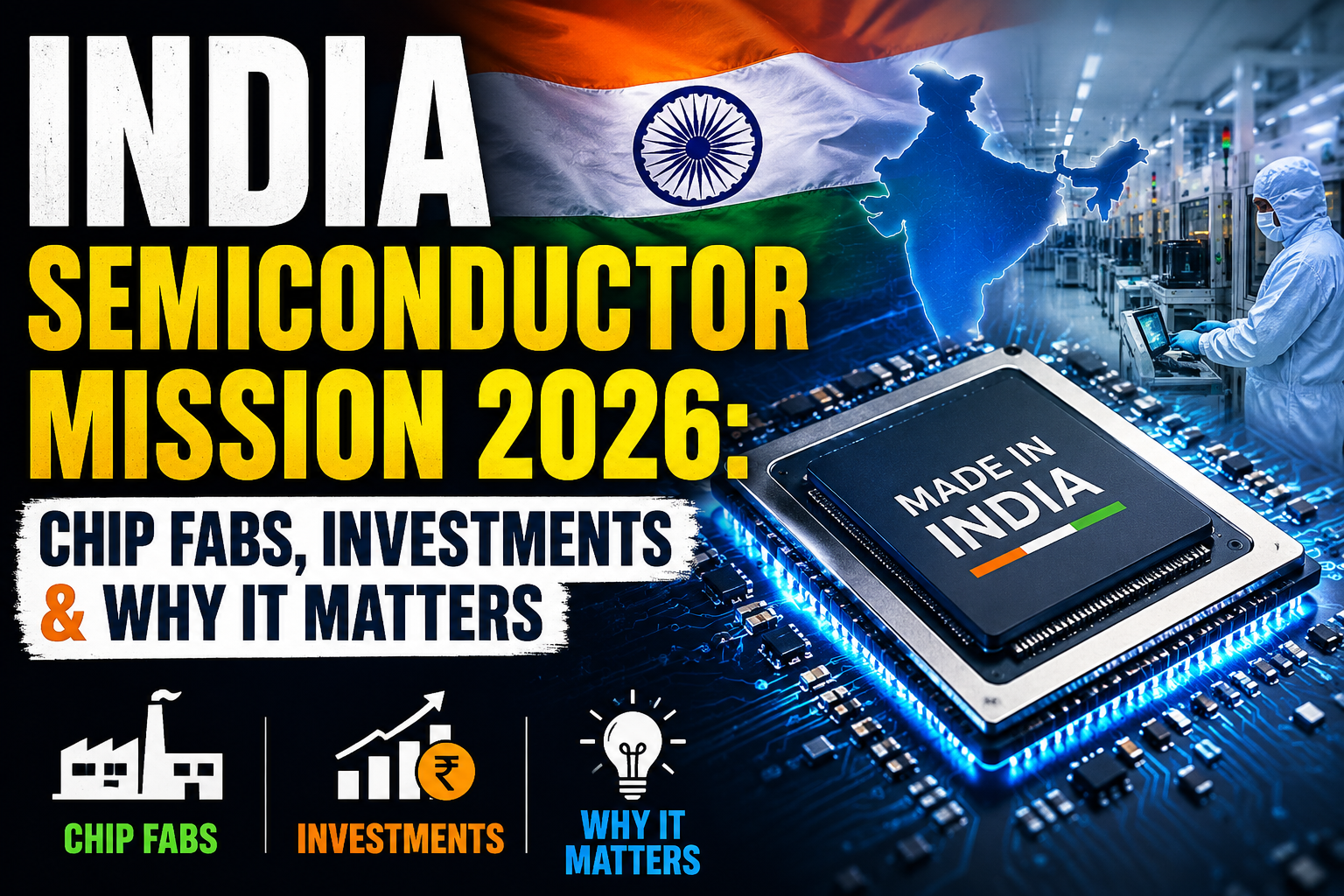
India is building its semiconductor future — from scratch. In 2026, the India Semiconductor Mission has crossed critical milestones, and the country is closer than ever to chip self-reliance.
Why Semiconductors Matter
38 Semiconductors have become critical to the functioning of modern economies. Though rarely visible in everyday life, microprocessors quietly power systems that keep societies running. As highlighted in the Economic Survey 2025–26, they form the backbone of energy networks, financial markets and telecommunications.
ISM 2.0: The New Phase
38 India Semiconductor Mission 2.0 marks a decisive shift from ecosystem creation to ecosystem consolidation and global integration. By deepening support for manufacturing, design, and advanced skills, ISM 2.0 positions semiconductors as a strategic national capability—central to economic resilience, digital infrastructure, and technological sovereignty. 43 Budget 2026-27 allocated Rs 8,000 crore to the semiconductor mission, the largest single-year outlay since the programme launched.
Key Milestones in 2026
Micron ATMP — India’s First Operational Chip Facility
43 Tata Electronics, partnered with Taiwan’s Powerchip Semiconductor Manufacturing Corporation (PSMC), is targeting first silicon at its Dholera fab by late 2026. Micron Technology’s Semiconductor Assembly, Test and Packaging (ATMP) facility in Sanand, Gujarat was inaugurated by Prime Minister Modi on February 28, 2026 — the first operational semiconductor facility of the current mission cycle.
Kaynes Semicon OSAT
39 Sanand has consolidated its role as a key semiconductor hub with the inauguration of Kaynes Semicon’s OSAT facility on March 31, 2026. Approved under the India Semiconductor Mission,
the project involved an investment of INR 33 billion (US$347.9 million) and focuses on chip testing and packaging,
with a production capacity of around 6 million chips per day.
HCL-Foxconn Joint Venture
37 Groundbreaking of India Chip (An HCL–Foxconn Group JV) at YEIDA, Jewar, Uttar Pradesh.
The Pipeline
43 Union Electronics Minister Ashwini Vaishnaw stated four plants will be operational by end 2026, two more in 2027, and India’s first full fabrication unit will be ready in Dholera by 2028. 39 As of May 18, 2026,
the central government has approved 13 semiconductor projects across seven states under ISM and SPECS. These include one large logic/power fab,
multiple OSAT/ATMP units, and new silicon carbide and substrate-focused projects.
The Tata-PSMC Fab: The Centrepiece
43 The Tata-PSMC partnership at Dholera in Gujarat is the centrepiece of India Semiconductor Mission 2.0. The facility is targeting 28nm and below process nodes — not 2nm frontier chips,
but the mature-to-advanced range that covers automotive chips, industrial microcontrollers, display drivers, and IoT devices. First silicon (the first wafers produced on the line) is targeted for late 2026.
Design Ecosystem
42 Semiconductor design accounts for up to 50% of value addition, 20–40% of bill-of-materials costs, and more than 30% of global semiconductor revenues, making fabless design a strategic priority for long-term self-reliance. As of January 2026, 24 chip design projects have been supported under DLI,
covering applications ranging from microprocessors and satellite communication to energy metering, surveillance, and IoT.
Global Context: Why India’s Timing Is Perfect
43 The same export controls that restrict SMIC and Huawei from accessing TSMC and ASML are pushing US chipmakers and fabless companies to build design and packaging capacity outside China and Taiwan. India offers English-language engineering talent, a non-China geopolitical alignment,
and a government actively subsidising semiconductor investment.
Long-Term Vision
44 India is emerging as a global semiconductor hub, targeting 70–75% self-sufficiency in domestic chip demand by 2029 and aiming to become a leading semiconductor nation with 3 nm and 2 nm manufacturing capabilities by 2035.
Conclusion
38 ISM 2.0 lays the foundation for India to emerge as a trusted hub for semiconductor design, manufacturing,
and innovation. With a clear roadmap for advanced nodes, strong design incentives, and a growing talent pipeline,
India is poise to progressively reduce external dependencies while contributing to more resilient global supply chains.

The official voice of Insightful Post, providing real-time updates on the stories that shape our world. From breaking global news to essential general reporting, the Admin team is dedicated to delivering accurate, timely, and unbiased information. Our mission is to keep you informed with the facts, ensuring the Insightful Post community never misses a beat in the fast-paced world of news.