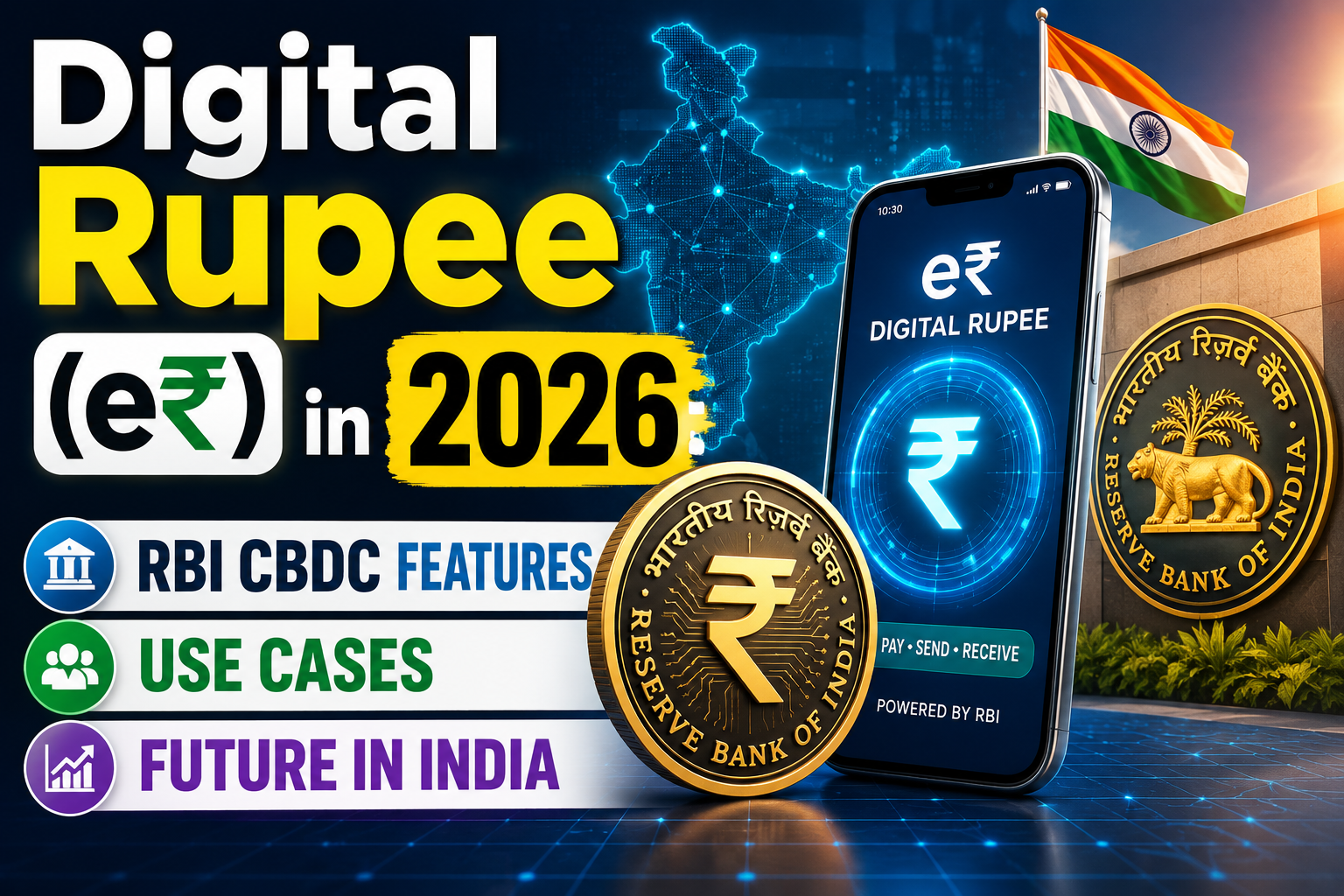
The Digital Rupee is the Reserve Bank of India’s Central Bank Digital Currency, abbreviated as CBDC. It is a digital form of the Indian Rupee issued directly by the RBI, just as paper currency notes are issued by the RBI. The key difference is that the Digital Rupee exists only in digital form and is stored in a digital wallet rather than a physical wallet or a bank account. 20 To be precise: a Rs 100 Digital Rupee note is the same as a Rs 100 physical note in terms of value and legal tender status. The RBI backs both with equal authority. The difference is entirely in the form and the technology used to hold and transfer it digital rupee 2026.
How Is It Different from UPI?
20 The Digital Rupee is a direct liability of the RBI. Holding Digital Rupees is equivalent to holding physical cash in terms of who backs it. You do not need a bank account to hold Digital Rupees. The Digital Rupee wallet is separate from your bank account and can theoretically work without internet connectivity using near-field communication technology for offline transactions.
In simple terms: 26the e-Rupee is money. UPI moves money.
How Is It Different from Cryptocurrency?
20 Cryptocurrencies like Bitcoin or Ethereum are decentralised, meaning no single authority controls them. Their value fluctuates based on market sentiment and has no government backing. The Digital Rupee is the exact opposite. It is centralised, issued and controlled by the RBI, and has a fixed value of one Digital Rupee equal to one Rupee always. It is not an investment asset. Its does not fluctuate in value. It is simply digital cash.
Launch History & Current Status
21 The digital rupee (e₹), eINR, or e-rupee is a tokenised digital version of the Indian rupee, issued by the Reserve Bank of India (RBI) as a central bank digital currency (CBDC). The digital rupee was propose in January 2017 and launch on 1 December 2022. 21 RBI launched the Digital Rupee for Wholesale (e₹-W) catering to financial institutions for interbank settlements and the Digital Rupee for Retail (e₹-R) for consumer and business transactions.
What’s New in 2026?
Welfare & Subsidy Delivery
22 During the 2025-26 fiscal year, the RBI conducted welfare-linked CBDC pilots in several states and union territories. These included Gujarat, Puducherry and Chandigarh, where beneficiaries received food subsidies through the digital rupee. “At the institutional level, multiple government agencies commenced pilots in various direct benefit transfer (DBT) schemes leveraging programmability feature of CBDC to ensure productive utilisation of public funds.”
Cross-Border Payments
22 On cross-border payments, the RBI said it has signed a digital assets pact with Singapore’s monetary authority. It is also in discussions on pilot projects with Singapore and the United Arab Emirates (UAE). Additionally, it is participating in multilateral initiatives led by the Bank for International Settlements.
BRICS CBDC Integration
25 The Reserve Bank of India (RBI) has submitted a proposal to the Union government to place the linking of Central Bank Digital Currencies (CBDCs) of BRICS countries on the agenda for the 2026 BRICS summit, which India is set to host later this year.
Asset Tokenization
24 RBI plans to introduce a framework under its CBDC and Asset Tokenisation Sandbox for testing products and services built around CBDC infrastructure.
Challenges Ahead
26 The retail pilot has seen modest adoption. With UPI already dominant (400+ million users, 14+ billion monthly transactions), convincing users and merchants to adopt a parallel system is difficult. As of early 2026, e-Rupee retail transactions remain a tiny fraction of UPI volumes.
The Roadmap
26 Short-term (2026-2028): Pilot expansion, interbank settlement using wholesale CBDC, limited retail adoption in government payments (subsidies, scholarships). Medium-term (2028-2032): Offline capability matured, cross-border CBDC corridors operational, programmable money used for targeted subsidies. Integration with fiscal policy instruments. Long-term (2032+): Significant share of low-value transactions on CBDC.
Conclusion
The Digital Rupee is still in its early innings, but 2026 marks a crucial turning point. With welfare delivery, cross-border pilots, BRICS integration, and asset tokenization on the horizon, the e₹ is poise to become a fundamental part of India’s financial infrastructure. 20For most Indians, the Digital Rupee currently operates as a government-backed alternative to cash and UPI for specific use cases. Its offline transaction capability is potentially its most significant feature for people in areas with unreliable internet connectivity.

The official voice of Insightful Post, providing real-time updates on the stories that shape our world. From breaking global news to essential general reporting, the Admin team is dedicated to delivering accurate, timely, and unbiased information. Our mission is to keep you informed with the facts, ensuring the Insightful Post community never misses a beat in the fast-paced world of news.