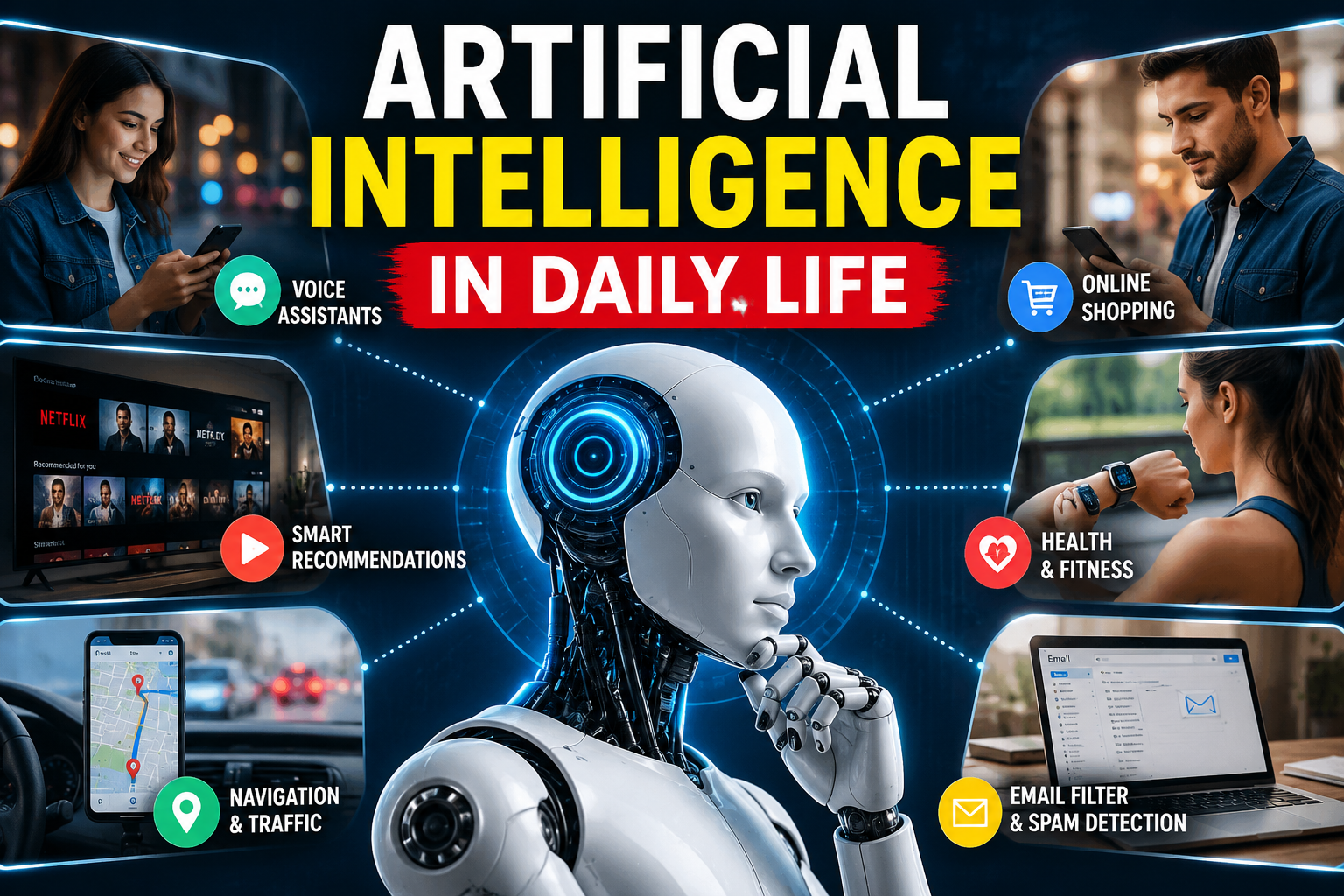
Artificial intelligence is no longer just a futuristic idea seen in movies or science fiction books. Today, it has become a part of our normal routine. From unlocking a smartphone with face recognition to getting product recommendations while shopping online, artificial intelligence is quietly working in the background. Many people use AI every day without even realizing it.
Artificial intelligence in daily life is helping people save time, make better decisions, and complete tasks more easily. It is used in mobile phones, healthcare, education, banking, transportation, entertainment, customer service, and even home appliances. As technology continues to grow, AI is becoming more advanced and more useful for individuals, students, businesses, and families.
In simple words, artificial intelligence allows machines and software to perform tasks that usually require human intelligence. These tasks may include learning, understanding language, recognizing images, solving problems, and making predictions.
What Is Artificial Intelligence?
Artificial intelligence, commonly called AI, is a technology that enables computers and machines to think, learn, and act in a smart way. AI systems use data to understand patterns and make decisions. For example, when a shopping app recommends products based on your previous searches, it is using AI.
AI does not work exactly like the human brain, but it can process large amounts of information very quickly. It can identify trends, recognize voices, translate languages, detect fraud, and suggest useful actions. Some common examples of AI include voice assistants, chatbots, recommendation systems, navigation apps, smart cameras, and automated customer support.
The main purpose of AI is to make tasks faster, easier, and more accurate.
AI in Smartphones and Personal Devices
One of the most common examples of artificial intelligence in daily life is the smartphone. Modern smartphones use AI in many ways. Face unlock, fingerprint recognition, voice typing, camera filters, predictive text, and app suggestions are all powered by AI.
When you type a message and your phone suggests the next word, AI is analyzing your writing pattern. When your camera automatically improves brightness, color, and focus, AI is helping to create a better photo. Voice assistants like Siri, Google Assistant, and Alexa also use AI to understand commands and provide answers.
Smartphones have become more personal because of AI. They learn from user behavior and provide a customized experience.
AI in Online Shopping
Online shopping platforms use artificial intelligence to understand customer interests. When you search for a product, the platform studies your preferences and shows similar products. This is why you often see recommendations such as “You may also like” or “Customers also bought.”
AI also helps online stores manage inventory, predict demand, set prices, and improve customer support. Chatbots can answer basic questions about orders, returns, payments, and delivery status. This helps customers get quick replies without waiting for a human support agent.
For businesses, AI improves sales and customer experience. For users, it makes shopping faster and more convenient.
AI in Healthcare
Artificial intelligence is also making a big difference in healthcare. Doctors and hospitals use AI-based tools to analyze medical reports, detect diseases, manage patient records, and improve treatment planning.
For example, AI can help identify problems in X-rays, scans, and medical images. Health apps can track heart rate, sleep, exercise, and calories. Some apps also provide reminders for medicine, water intake, or physical activity.
AI does not replace doctors, but it supports them by providing useful information. It can help reduce errors, save time, and improve early detection of health problems. However, people should always consult qualified medical professionals instead of depending only on apps or online tools.
AI in Education
Education has changed a lot because of digital technology, and AI is playing a major role in this change. Students now use online learning platforms, smart study apps, grammar checkers, language tools, and AI-based doubt-solving systems.
AI can help students learn at their own speed. If a student is weak in a topic, an AI-powered learning app can suggest extra lessons or practice questions. Teachers can also use AI tools to check assignments, create quizzes, and understand student performance.
Artificial intelligence in education makes learning more personalized. It can help students improve their skills, prepare for exams, and access knowledge from anywhere.
AI in Banking and Finance
Banking has become faster and safer with the help of AI. Banks use artificial intelligence to detect fraud, monitor suspicious transactions, provide customer support, and improve digital services.
When a bank sends an alert about unusual account activity, AI may be involved in detecting that risk. Chatbots on banking websites and apps also use AI to answer questions about account balance, transactions, cards, and loans.
AI is also used in personal finance apps. These apps can track spending, categorize expenses, and help users understand their financial habits. For businesses and banks, AI helps reduce risk and improve security. For customers, it makes banking more convenient.
AI in Entertainment
Entertainment platforms use AI to understand what people like to watch, listen to, or read. Streaming platforms recommend movies, shows, songs, and videos based on user behavior.
For example, if you watch many technology videos, a video platform may suggest more content related to gadgets, AI, or software. Music apps also create personalized playlists based on listening history.
AI is also used in gaming. Many modern games use AI to create smarter opponents, realistic characters, and better gameplay. This makes entertainment more interactive and enjoyable.
AI in Smart Homes
Smart home technology is another growing area where AI is useful. Devices such as smart speakers, smart lights, smart cameras, thermostats, and robotic vacuum cleaners use AI to understand commands and automate tasks.
For example, a smart speaker can play music, set alarms, answer questions, and control other home devices. Smart security cameras can detect motion and send alerts. Smart appliances can adjust settings based on user habits.
AI-powered smart homes can improve comfort, safety, and energy efficiency. They are especially helpful for busy families, elderly people, and people who want more convenience in daily life.
Benefits of Artificial Intelligence in Daily Life
AI offers many benefits. It saves time by automating repeated tasks. It improves accuracy by analyzing data quickly. It provides personalized experiences in shopping, education, entertainment, and communication.
AI also helps businesses serve customers better. It can answer questions, process information, and support decision-making. In healthcare and security, AI can help detect risks early.
For ordinary users, the biggest benefit of AI is convenience. It makes technology easier to use and helps people complete tasks with less effort.
Challenges and Risks of AI
Although AI has many benefits, it also has some risks. Privacy is one of the biggest concerns because AI systems often use personal data. Users should be careful about what information they share online.
Another challenge is overdependence on technology. If people rely too much on AI tools, they may stop developing their own problem-solving and decision-making skills. AI can also make mistakes if it is trained on incorrect or biased data.
Job changes are another concern. Some repetitive jobs may be affected by automation. At the same time, AI is also creating new career opportunities in technology, data science, cybersecurity, digital marketing, and automation.
Future of Artificial Intelligence
The future of AI looks very powerful. In the coming years, AI may become even more common in education, healthcare, transportation, agriculture, business, and personal life. More tools will become automated, smarter, and easier to use.
However, responsible use of AI is very important. People should understand how AI works, where it is useful, and where human judgment is still necessary. AI should be used as a helper, not as a complete replacement for human thinking.
Governments, companies, schools, and individuals must work together to use AI safely and ethically.
Conclusion
Artificial intelligence in daily life is already changing the way people live, work, study, shop, travel, and communicate. From smartphones and online shopping to healthcare, banking, education, and entertainment, AI is everywhere.
The main advantage of AI is that it makes life easier, faster, and more personalized. However, users should also be aware of privacy, security, and ethical concerns. When used responsibly, artificial intelligence can become one of the most useful technologies of modern life.
AI is not just the future; it is already part of the present. Understanding it today can help people prepare for a smarter tomorrow.
FAQs
1. What is artificial intelligence in simple words?
Artificial intelligence is technology that allows machines or software to perform smart tasks such as learning, recognizing speech, understanding images, and making decisions.
2. Where do we use AI in daily life?
AI is used in smartphones, online shopping, banking apps, healthcare tools, social media, navigation apps, entertainment platforms, and smart home devices.
3. Is artificial intelligence good or bad?
AI can be very useful when used responsibly. It saves time and improves services, but it also has risks such as privacy issues, misinformation, and overdependence.
4. Can AI replace humans?
AI can automate some tasks, but it cannot fully replace human creativity, emotions, judgment, and personal experience.
5. Why is AI important for the future?
AI is important because it can improve healthcare, education, business, transportation, security, and many other areas of life.

The official voice of Insightful Post, providing real-time updates on the stories that shape our world. From breaking global news to essential general reporting, the Admin team is dedicated to delivering accurate, timely, and unbiased information. Our mission is to keep you informed with the facts, ensuring the Insightful Post community never misses a beat in the fast-paced world of news.