The numbers tell a story that most economic reporting misses. Behind the headline figures on Best Ways to Save Money During Inflation lies a more complex, more troubling, and ultimately more important reality than the official statistics alone reveal. This analysis goes beyond the surface data to examine what is actually happening in the economy, who is being affected and how, what the policy responses have achieved and failed to achieve, and what the evidence genuinely supports about the path forward.
Economic analysis that does its job properly is necessarily uncomfortable at times. It challenges convenient narratives from all sides of the political spectrum. It insists on distinguishing between what we know with reasonable confidence and what remains genuinely uncertain. It requires honest engagement with data that sometimes contradicts received wisdom — including received wisdom that has become politically entrenched. This is that kind of analysis.
What the Data Actually Shows About Best Ways To Save Money During Inflation
The official data on Best Ways to Save Money During Inflation is a starting point, not a conclusion. Understanding what it actually shows requires examining both what is measured and what is not — the systematic gaps in economic statistics that create genuine blind spots in our understanding of economic conditions.
Official economic indicators are designed to measure aggregate phenomena at the national level. This design reflects both the history of how economic statistics developed — primarily during the mid-twentieth century, when aggregate national output was the central policy concern — and the practical constraints of what is measurable at scale. What these aggregates systematically miss is the distribution of economic outcomes: who specifically is benefiting and who is being harmed by the conditions the aggregates describe.
Consider the aggregate unemployment rate — one of the most watched economic indicators. The official rate counts only those actively seeking work but unable to find it. It excludes discouraged workers who have stopped searching, involuntary part-time workers who want full-time employment, and gig workers earning below sustainable income levels. The “real” unemployment rate — which includes these categories — typically runs two to three percentage points above the official figure, painting a significantly more challenging picture of labour market conditions than the headline number suggests.
Similar issues affect the measurement of Best Ways to Save Money During Inflation. The official indicators reflect certain methodological choices that are defensible on technical grounds but produce results that diverge meaningfully from the lived experience of many households. The CPI basket of goods, for example, is designed to reflect the average consumption pattern — but the consumption patterns of low-income households, which allocate much larger shares of spending to food, housing, and energy, differ substantially from the average. For these households, inflation has consistently run above the official headline figure, a systematic understatement of the actual economic pressure they face.
The Structural Roots: Why Best Ways To Save Money During Inflation Is Harder to Fix Than Politicians Suggest
Political discourse about Best Ways to Save Money During Inflation consistently overstates the extent to which policy can address it quickly and cleanly. This overpromising serves electoral purposes but produces chronic disappointment when the promised improvements fail to materialise on the promised timelines. Understanding why Best Ways to Save Money During Inflation is genuinely difficult to address requires engaging with the structural dimensions that political rhetoric typically glosses over.
Structural economic problems are distinguished from cyclical ones by their root causes. Cyclical problems — demand shortfalls during recessions, supply disruptions from temporary shocks — respond to the standard tools of monetary and fiscal policy. Stimulate demand, restore supply, and the economy returns to its prior trajectory. Structural problems — inadequate housing supply, deteriorating infrastructure, skills mismatches in labour markets, regulatory barriers to competition — do not respond to these standard tools because they reflect deep institutional and systemic failures that require correspondingly deep institutional and systemic responses.
The housing affordability crisis that affects major metropolitan areas throughout the advanced economies is a canonical example of a structural problem masquerading as a cyclical one in policy discussions. The immediate manifestation — rising rents and home prices — looks like a price inflation problem. But the underlying cause — decades of restrictive zoning, NIMBYism, inadequate infrastructure investment, and building regulation that has suppressed housing supply far below demand — is a structural failure that interest rate changes and fiscal stimulus cannot address. Only reforms to land use regulation, planning processes, and construction economics can address it at the root. These reforms are politically difficult and slow-moving — which is precisely why they have not been made despite decades of evidence that the housing supply constraint is the core problem.
The same structural analysis applies to many of the economic challenges associated with Best Ways to Save Money During Inflation. The skills gaps that produce labour market mismatches — workers concentrated in declining industries while growing industries face talent shortages — are not addressable by short-term policy. The infrastructure deficits that reduce economic productivity and drive up logistics and energy costs are not addressable by interest rate changes. The regulatory barriers that protect incumbents from competition and suppress productivity growth in major service sectors are not addressable by fiscal stimulus. Addressing these structural roots requires sustained political will over long periods — the kind of sustained will that democratic political systems, operating on electoral cycles and responding to immediate concerns, find genuinely difficult to maintain.
The International Dimension: How Global Forces Shape Best Ways To Save Money During Inflation
No major economy operates in isolation from global forces, and the domestic manifestations of Best Ways to Save Money During Inflation are substantially shaped by international dynamics that national policies can influence only at the margins. Understanding the international dimension is essential for any serious analysis of Best Ways to Save Money During Inflation in the current period.
The post-pandemic period has seen a significant rethinking of the global supply chain structures that developed over the previous three decades of accelerating economic globalisation. The concentrated production of critical goods — semiconductor chips, pharmaceutical active ingredients, solar panels, critical minerals — in a small number of countries (primarily China) created vulnerabilities that the COVID-19 disruption and subsequent geopolitical tensions rendered impossible to ignore. The reshoring and friend-shoring strategies adopted by major economies in response to these vulnerabilities will restructure supply chains in ways that improve resilience but increase costs — a fundamental tradeoff between efficiency and security that will affect prices across a wide range of goods categories for years to come.
The energy transition adds another layer of international complexity. The shift from fossil fuels to renewable energy involves a fundamental restructuring of the most important commodity market in the global economy. Countries heavily dependent on fossil fuel exports face potentially severe economic disruption as the energy transition accelerates. Countries at the forefront of renewable technology and critical mineral production face significant strategic opportunities. The transition itself creates short-to-medium term cost pressures as new energy infrastructure is built while existing fossil fuel infrastructure continues to be used — a transition period that is likely to be characterised by energy price volatility and economic disruption for several more years.
What the Research Actually Says: Separating Evidence from Ideology
Economic research has something genuine to say about Best Ways to Save Money During Inflation — but what it says is often more nuanced, more qualified, and more uncertain than the confident claims made by advocates across the political spectrum. Distinguishing between what research robustly supports, what remains contested, and what is primarily ideological assertion is essential for honest economic analysis.
On the mechanisms of Best Ways to Save Money During Inflation, there is substantial professional consensus on basic points. Sustained excessive money supply growth produces inflation. Insufficient aggregate demand produces unemployment and slow growth. Supply constraints produce price increases that cannot be resolved by demand management alone. Long-run economic growth is driven primarily by productivity improvement, which in turn depends on capital accumulation, human capital development, and technological progress. These are not controversial claims but broadly accepted foundations of modern economics.
On the policy implications of these mechanisms, the research base is considerably thinner and more contested. The precise size of fiscal multipliers — how much economic activity is generated per dollar of government spending — is debated, with evidence suggesting it varies substantially based on economic conditions and the specific type of spending. The optimal inflation target — whether two percent represents the right balance between the costs of inflation and the benefits of monetary policy space — is an active area of research without settled consensus. The effects of specific regulatory changes on economic dynamism and productivity are consistently difficult to identify cleanly in empirical work because of the complexity of isolating the effects of specific policy changes from the many other factors simultaneously at work.
Acknowledging this genuine uncertainty is not a counsel of despair — it is intellectual honesty. Policymakers must make decisions under uncertainty, and the research base, while imperfect, provides genuine guidance about which approaches are more likely to achieve desired outcomes and which are likely to backfire. What it does not provide is the confident certainty that advocacy positions require — and consuming economic analysis with appropriate awareness of this uncertainty is the mark of genuine economic sophistication.
The Winners and Losers: A Clear-Eyed Distribution Analysis
Every economic condition creates winners and losers. Honest analysis of Best Ways to Save Money During Inflation requires identifying both clearly, rather than focusing only on the aggregate or only on the most sympathetic losers. This distributional analysis is where economic discussion most commonly falls short — because identifying winners challenges narratives that prefer to frame economic problems as purely external forces rather than outcomes of specific structures and decisions that benefit some at the expense of others.
The winners in the current economic environment are those with substantial asset holdings — particularly real estate and financial assets — whose value has been supported by the low-interest-rate policies of the post-2008 era, even as those policies have contributed to the affordability challenges facing asset-poor households. They are those with strong educational credentials and skills in high-demand fields, whose labour market power has increased as the premium on human capital has grown. They are those in established industries with significant regulatory moats that protect them from the competitive pressures that would otherwise compress their margins. Understanding who benefits from current economic structures is essential for honest evaluation of policy proposals, many of which are designed more to protect current winners than to address the structural problems that harm everyone else.
The losers are most clearly identified among renters in supply-constrained cities, workers in industries facing automation and offshoring, younger households attempting to accumulate assets at prices elevated by decades of low interest rates and supply constraints, and communities outside the major metropolitan economic centres that have lost their industrial base without developing sufficient alternative economic activity. The policy responses most clearly in their interest — housing supply reform, investment in place-based economic development, educational reform aligned with labour market needs, portable benefits that follow workers across employment relationships — are politically difficult precisely because they threaten the interests of currently powerful constituencies who benefit from the status quo.
Policy Recommendations: What Would Actually Help
Given the analysis above, what would actually address the challenges associated with Best Ways to Save Money During Inflation most effectively? This section presents evidence-based policy directions, acknowledging the political constraints while being honest about what the evidence suggests would work.
On the supply side, the priority interventions are well-identified even if politically difficult. Reform of land use regulation and planning processes to allow substantially increased housing supply in high-demand areas would address the most acute affordability crisis facing working households in major cities. Infrastructure investment — particularly in transport, energy, and digital infrastructure — would reduce logistics costs, improve labour market matching, and support productivity growth that ultimately raises living standards. Education and training reform aligned with actual labour market needs would reduce the skills mismatches that simultaneously produce high unemployment among workers in declining fields and talent shortages in growing ones.
On the demand side, the evidence base for specific fiscal interventions is more mixed. Targeted income support for the lowest-income households — particularly during acute economic stress — produces clear welfare gains with limited macroeconomic distortion. Broad-based stimulus spending is most effective when the economy is clearly below capacity and least effective when it is near or above capacity, creating inflationary pressure rather than output growth. The challenge for fiscal policy is making these distinctions in real time, with incomplete information, in a political environment that systematically favours stimulus over fiscal discipline regardless of economic conditions.
Institutional reforms — to competition policy, financial regulation, tax structure, and the safety net — would address many of the distributional failures that current economic structures produce. These reforms are chronically neglected in economic policy discussion because they are politically difficult and produce benefits that are diffuse and gradual rather than concentrated and immediate. But the evidence base for their importance is substantial, and the failure to pursue them represents one of the most significant policy failures of the past several decades.
Frequently Asked Questions About Best Ways To Save Money During Inflation
Why does economic data on Best Ways to Save Money During Inflation sometimes seem to contradict what people experience?
The divergence between official economic data and lived experience reflects several genuine methodological limitations in how economic statistics are constructed. Official statistics measure averages across heterogeneous populations, use standardised consumption baskets that may not reflect individual spending patterns, apply hedonic adjustments that can understate price increases for physical goods, and face genuine lags in capturing rapid changes in economic conditions. These are not minor quibbles but substantial limitations that produce systematic divergences between the official picture and the experience of specific population subgroups. Taking both the official data and the reported experience of households seriously — rather than privileging one over the other — provides a more complete picture of economic reality.
Is the political debate about Best Ways to Save Money During Inflation producing more heat than light?
In most cases, yes. The political framing of economic debates consistently prioritises electoral positioning over honest analysis, producing partisan arguments that selectively deploy evidence to support predetermined conclusions rather than genuinely engaging with complexity. This does not mean that all political positions on economic policy are equally valid or that the underlying substantive disagreements are unimportant. It means that the political forum is a poor place to develop accurate understanding of economic conditions — which requires seeking out sources that prioritise analytical rigour over advocacy, acknowledge uncertainty, and engage honestly with evidence that challenges their preferred conclusions.
What would success look like in addressing Best Ways to Save Money During Inflation challenges?
Success would look like an economy where the benefits of economic growth are broadly shared across income levels, where housing costs absorb a sustainable share of household incomes across a range of metropolitan areas, where labour markets offer genuine opportunity for workers displaced by technological and structural change, and where the social safety net provides genuine security without creating destructive dependency or fiscal unsustainability. These are not utopian standards — they describe conditions that were more closely approximated in earlier periods of the post-war era and that other advanced economies have achieved to varying degrees. They are achievable with sustained political will and policy coherence of a kind that has been conspicuously absent in recent decades.
How should citizens evaluate candidates’ claims about Best Ways to Save Money During Inflation?
The most useful evaluative standard is specificity. Vague promises to make the economy better, grow faster, or be fairer deserve no credence without specific policy proposals, credible mechanisms by which those proposals would achieve the promised outcomes, honest accounting of the tradeoffs involved, and realistic acknowledgment of what government can and cannot control. Candidates who make specific, mechanistically coherent proposals with honest tradeoff acknowledgment are demonstrating both economic competence and political honesty — rare but not impossible combinations that deserve to be rewarded by voters willing to evaluate economic claims carefully.
What is the most underreported dimension of Best Ways to Save Money During Inflation in mainstream media coverage?
The distributional dimension is consistently the most underreported. Mainstream economic coverage focuses heavily on aggregate indicators — headline GDP, unemployment, and inflation — and relatively little on the variation in how different groups experience economic conditions. The experience of the bottom quintile during periods of aggregate growth, the geographic variation in economic outcomes within countries, and the intergenerational distribution of economic opportunity are all systematically underreported relative to their importance for understanding what is actually happening in the economy. Seeking out economic journalism that specifically focuses on distributional questions — who is benefiting and who is being left behind — provides a more complete picture than aggregate-focused coverage alone.
The Long View: Why Understanding Best Ways To Save Money During Inflation Matters More Than Ever
We live in an era of extraordinary economic complexity and equally extraordinary access to information about it. The paradox of the information age is that more data and more commentary have not necessarily produced more clarity — if anything, the sheer volume of economic content available has made it harder, not easier, for most people to develop a reliable working understanding of Best Ways to Save Money During Inflation and its implications. The ability to navigate this information landscape thoughtfully — distinguishing signal from noise, evidence from advocacy, genuine uncertainty from false confidence — is an increasingly valuable skill in both personal financial management and civic life.
The study of Best Ways to Save Money During Inflation ultimately reveals something profound about the nature of human societies. Economic systems are, at their core, mechanisms for coordinating the decisions of billions of individuals in ways that produce collective outcomes — outcomes that no individual planned or intended and that emerge from the interaction of countless decisions made independently by people pursuing their own goals. This emergent complexity is what makes Best Ways to Save Money During Inflation simultaneously fascinating and difficult to manage. The economists, policymakers, and institutions responsible for managing it are steering a ship through waters that are continuously changing in ways that are only partially predictable, using tools that work with variable reliability and sometimes produce unintended consequences alongside their intended effects.
This complexity is not a counsel of despair but an argument for intellectual humility and sustained engagement. The societies that manage their economies best are not those that have found perfect answers — no such answers exist — but those that have developed the institutional capacity to learn from experience, adjust their approaches in response to evidence, and maintain broad social agreement about the basic rules and values that economic governance should reflect. Building and maintaining this institutional capacity requires an informed citizenry willing to engage seriously with economic complexity rather than demanding simple answers to complex questions.
Deep Dive: The Mechanisms That Drive Best Ways To Save Money During Inflation
To truly understand Best Ways to Save Money During Inflation, it helps to trace the causal chains that connect individual decisions to aggregate outcomes. Economic phenomena do not emerge from nowhere — they are the cumulative result of millions of individual choices made by households, businesses, financial institutions, and governments, interacting through markets, institutions, and informal social relationships. Understanding these causal mechanisms transforms Best Ways to Save Money During Inflation from an abstract phenomenon into an understandable system — one that can be analysed, anticipated, and responded to intelligently.
The causal chain typically begins with some combination of structural conditions and policy choices that shape the incentives facing economic actors. These incentives then influence the behaviour of households (their spending, saving, borrowing, and work decisions), businesses (their investment, hiring, pricing, and production decisions), and financial institutions (their lending standards, interest rate setting, and risk management). The aggregate of these behaviours produces the macroeconomic outcomes that show up in official statistics — GDP growth rates, inflation figures, unemployment levels, trade balances.
What makes Best Ways to Save Money During Inflation particularly interesting is the feedback loops embedded in these causal chains. Economic outcomes influence expectations, and expectations influence behaviour, creating self-reinforcing dynamics that can amplify economic trends in both directions. Rising confidence produces increased spending, which produces rising employment, which produces rising incomes, which produces further rising confidence — a virtuous cycle that can sustain economic expansion beyond what underlying fundamentals might suggest is justified. Conversely, falling confidence produces reduced spending, rising unemployment, falling incomes, and further falling confidence — the vicious cycle of economic contraction that policymakers work to interrupt before it becomes self-sustaining.
Understanding these feedback dynamics is particularly important for interpreting economic turning points — moments when the direction of economic conditions shifts from expansion to contraction or vice versa. These turning points are difficult to predict in advance precisely because they involve the interaction of multiple feedback loops that can tip in different directions depending on conditions that are not fully visible in real-time data. The post-mortems conducted after major economic turning points — the 2008 financial crisis, the 2020 COVID recession, the post-pandemic inflation surge — consistently reveal that the factors most important for understanding what happened were underweighted in contemporary analysis, precisely because their significance was not apparent until the dynamic had already played out.
Sectoral Analysis: How Best Ways To Save Money During Inflation Plays Out Across Different Industries
The aggregate picture of Best Ways to Save Money During Inflation conceals significant variation in how different sectors of the economy experience and respond to economic conditions. Industries differ in their exposure to domestic versus international demand, in their sensitivity to interest rate changes, in the labour intensity of their production, in the fixed versus variable cost structure of their operations, and in the competitive dynamics that determine how they respond to changing economic conditions. Understanding these sectoral differences is essential for anyone seeking to understand the specific economic conditions facing their industry or their investment portfolio.
Consumer discretionary sectors — retail, entertainment, travel, hospitality — are typically the most sensitive to changes in household income and consumer confidence. When economic conditions tighten and household budgets come under pressure, spending on non-essential goods and services declines first and most sharply. This makes consumer discretionary a leading indicator of broader economic conditions in both directions: these sectors typically deteriorate before the broader economy and recover before the broader economy. The experience of sectors like tourism and hospitality during the COVID-19 pandemic illustrated both the severity of this cyclical exposure and the resilience that businesses and workers in these sectors can demonstrate when supported by appropriate policy responses.
Consumer staples — food, pharmaceuticals, household products, utilities — show a very different sensitivity profile. Demand for these products is relatively inelastic: people continue buying food and medicine even when their budgets are under pressure, cutting back on quality and quantity at the margins but maintaining overall consumption levels. This defensive characteristic makes consumer staples relatively resilient during economic downturns, which is why they feature prominently in investment portfolios designed to weather economic cycles.
The financial sector occupies a unique position in relation to Best Ways to Save Money During Inflation: it is simultaneously one of the most important transmitters of economic conditions (through its credit allocation, risk management, and payment system functions) and one of the most exposed to economic volatility. Financial institutions profit when the economy is growing, credit quality is good, and financial markets are active. They face their most acute stress during economic downturns, when credit losses mount, market volatility rises, and the systemic importance of major institutions creates risks that extend far beyond the institutions themselves — as the 2008 crisis demonstrated with devastating clarity.
The Human Side of Best Ways To Save Money During Inflation: Stories Behind the Statistics
Economic statistics are abstractions of human experience. Behind every percentage point of unemployment is a person without a job. Behind every basis point of inflation is a household with less purchasing power. Behind every point of GDP growth is economic activity produced by the labour, creativity, and enterprise of real people. Keeping these human realities in mind while engaging with the statistical abstractions of economic analysis is essential for maintaining a grounded understanding of what Best Ways to Save Money During Inflation actually means in the world.
The personal finance dimension of Best Ways to Save Money During Inflation is ultimately about people making the best decisions they can within the economic conditions they face — conditions they did not choose and can influence only at the margins. The household that carefully budgets, saves diligently, manages debt prudently, and invests thoughtfully is doing everything within its power to navigate Best Ways to Save Money During Inflation effectively. But individual financial prudence cannot fully insulate households from macroeconomic conditions that affect income opportunities, asset prices, and cost of living in ways that individual decisions cannot fully offset.
This is why the policy dimension of Best Ways to Save Money During Inflation matters alongside the personal finance dimension. The economic conditions that households navigate are substantially shaped by policy choices made through democratic processes. Citizens who understand Best Ways to Save Money During Inflation are better positioned to evaluate those policy choices, hold elected officials accountable for the economic outcomes their decisions produce, and advocate for policies that address the structural economic challenges that individual financial management cannot resolve. The combination of informed personal financial management and engaged democratic citizenship is the most powerful response available to the economic challenges that Best Ways to Save Money During Inflation creates.
Future Trends: What Will Shape Best Ways To Save Money During Inflation Over the Next Decade
While economic forecasting over long horizons is inherently uncertain, several structural trends are sufficiently well-established that they will almost certainly shape Best Ways to Save Money During Inflation over the next decade regardless of how other variables evolve. Understanding these trends provides a framework for longer-term planning — both personal financial planning and broader thinking about economic policy priorities.
Demographic change is the most certain of the long-run economic forces. The aging of the large baby boom cohort through retirement age in most advanced economies is already producing measurable effects on labour supply, consumer spending patterns, healthcare demand, and fiscal pressures on public pension and healthcare systems. These effects will intensify over the next decade as the remaining boomer cohort ages further and the relatively smaller successor cohorts take their place in the workforce. Managing the fiscal implications of demographic aging while maintaining economic dynamism and intergenerational equity is one of the central economic policy challenges of the coming decade.
Artificial intelligence and automation will continue to reshape labour markets in ways that are uncertain in their specific manifestations but whose general direction is fairly clear: increasing productivity in tasks that can be standardised and automated, shifting demand toward skills involving creativity, judgment, social intelligence, and adaptability, and creating new categories of work while displacing existing ones. The distributional consequences of this transformation depend heavily on the policy frameworks through which it unfolds — the education and training systems that prepare workers for changing demands, the social safety net that supports those displaced by technological change, and the regulatory frameworks that shape how the productivity gains from automation are distributed between capital and labour.
Climate change and the energy transition will impose substantial economic costs — through both the physical damages of climate impacts and the transition costs of restructuring energy and industrial systems — while also creating significant economic opportunities in clean energy, energy efficiency, climate-resilient infrastructure, and related services. The net economic effect of climate change is almost certainly negative in the aggregate, but the distribution of costs and opportunities varies enormously across sectors, regions, and time horizons, creating very different economic experiences for different communities depending on their exposure to physical climate risks and their positioning relative to the opportunities of the clean energy transition.
Geopolitical fragmentation — the partial reversal of the globalisation trend through the reshoring of supply chains, the use of economic tools for geopolitical purposes, and the development of competing economic and technological blocs — will reshape the international economic environment in ways that increase costs and reduce efficiency but may improve resilience. The specific economic consequences of this fragmentation depend on its speed and extent, the specific sectors most affected, and the policy responses of individual countries and blocs to the changing international economic landscape.
These trends do not determine a single inevitable future for Best Ways to Save Money During Inflation. They define the parameters within which human decisions — about policy, technology, investment, and values — will shape the economic outcomes of the coming decade. The economic future is genuinely open, shaped by choices that have not yet been made and events that cannot be fully anticipated. What is not open is the importance of understanding Best Ways to Save Money During Inflation for navigating whatever that future holds — which is precisely why the investment in economic literacy represented by this article is one of the most valuable returns available to anyone seeking to understand and engage with the economic world they live in.
Practical Guide: Navigating Best Ways To Save Money During Inflation in Your Daily Financial Life
Abstract understanding of Best Ways to Save Money During Inflation is valuable, but what most people ultimately want is practical guidance they can apply to their own financial lives. This section translates the conceptual framework developed throughout this article into concrete, actionable steps that anyone can take — regardless of income level, financial sophistication, or current economic circumstances — to navigate Best Ways to Save Money During Inflation more effectively.
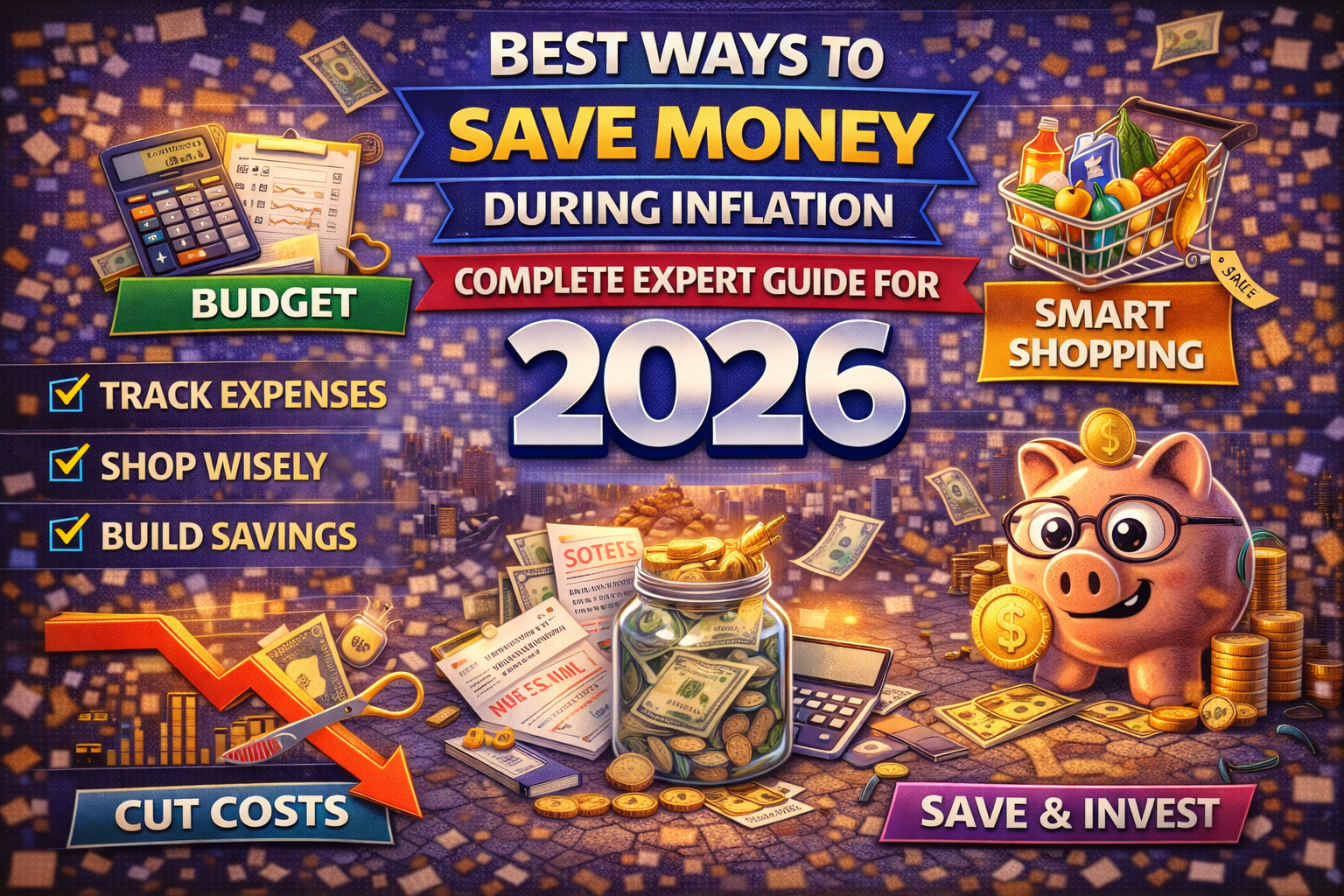
The first practical priority is financial awareness. Most people have a rough sense of their income but a surprisingly imprecise understanding of their spending. Spending categories that grow gradually through inertia — subscription services accumulated over years, dining habits that expanded with income and contracted insufficiently when income declined, insurance and utility costs not reviewed since initial setup — collectively represent significant sums that precise tracking reveals. The simple act of knowing exactly where your money goes is the prerequisite for making intelligent decisions about changing how it flows. Modern budgeting apps like Mint, YNAB, or even a simple spreadsheet make this tracking more accessible than it has ever been.
The second practical priority is building financial resilience. Economic conditions are inherently uncertain, and households that have built financial buffers are dramatically better positioned to weather adverse conditions than those without them. The emergency fund — three to six months of essential expenses in a liquid, interest-bearing account — is the foundation of financial resilience, preventing the need to take on expensive debt or make forced asset sales when income is disrupted or unexpected expenses arise. Building this buffer should take priority over most investment activities, because the effective return on avoiding high-interest debt or forced selling during downturns dramatically exceeds the returns available from almost any investment.
The third practical priority is strategic debt management. In the current economic environment, the cost of debt — particularly high-interest consumer debt — represents the single most reliably addressable drag on household financial health. Credit card debt carrying interest rates of 20-25% represents a guaranteed negative return that no investment strategy can consistently overcome. Prioritising elimination of this debt above other financial goals is almost always the correct financial decision, with the possible exception of capturing any employer match on retirement contributions (which represents an immediate 50-100% return on the contributed amount). Once high-interest debt is eliminated, the financial capacity freed up becomes a powerful resource for building wealth through investment and savings.
Investing consistently over time, even in modest amounts, is among the most powerful financial decisions available to most households. The mathematics of compound growth means that time in the market is the single most important variable in investment outcomes — more important than investment selection, timing decisions, or the specific vehicles used. A household that begins investing modestly in its twenties and maintains consistent contributions through its working life will typically accumulate dramatically more wealth than one that waits for the “right time” to invest but starts a decade later. The behavioural challenge is maintaining investment consistency during periods of market turbulence — when the emotional impulse is to stop or reverse investment, but when history consistently shows that maintaining or increasing investment is the strategically superior choice.
Expert Perspectives: How Economists View Best Ways To Save Money During Inflation
The economics profession has spent decades studying Best Ways to Save Money During Inflation, and while there is more uncertainty and disagreement than popular economic commentary suggests, there are also areas of genuine professional consensus that deserve to be understood and taken seriously. This section summarises the key areas of expert consensus alongside the areas of genuine ongoing debate.
Economists broadly agree that sustained, moderate economic growth — driven by productivity improvement through technological progress, capital accumulation, and human capital development — is the most reliable path to broad improvements in living standards over time. There is also broad consensus that price stability (not zero inflation, but low and stable inflation) provides important benefits for long-term economic planning and financial system functioning. And there is substantial agreement that well-functioning labour markets — where workers can match with employers that value their skills, and where mobility between jobs and regions is not excessively impeded — are fundamental to economic efficiency and individual economic wellbeing.
The areas of genuine ongoing professional debate are worth acknowledging honestly. Economists disagree meaningfully about the optimal level of government involvement in markets, about the most effective approaches to addressing economic inequality, about the long-run effects of various trade and industrial policies, and about the appropriate response to the distributional challenges created by technological change. These disagreements are not primarily about economic ignorance — they reflect genuine empirical uncertainty and legitimate differences in values about the appropriate tradeoffs between competing economic goals. Understanding that these debates are real and unresolved helps calibrate appropriate confidence when evaluating economic policy arguments.
One area where the economics profession has genuinely evolved its consensus in recent years is the relationship between inequality and growth. Earlier economic thinking often treated inequality as a necessary byproduct of growth-enhancing policies, assuming that the benefits would eventually “trickle down” to lower-income groups. More recent research — including influential work by IMF economists — has challenged this view, finding that extreme inequality can actually reduce long-run growth by limiting human capital development, reducing economic mobility, weakening aggregate demand, and increasing political instability. This evolving consensus has significant implications for how Best Ways to Save Money During Inflation should be managed and what policy priorities deserve greater emphasis.
The economics of Best Ways to Save Money During Inflation ultimately reflects the economics of human wellbeing — the study of how societies organise their productive activities to meet human needs and aspirations. At its best, this field of knowledge illuminates the mechanisms through which policy choices and economic conditions affect the lives of real people, providing the analytical foundation for making those choices more wisely. Engaging with it seriously — maintaining both appropriate confidence in what research does establish and appropriate humility about the limits of economic knowledge — is one of the most worthwhile intellectual investments available to anyone trying to understand and navigate the world we share.

3 thoughts on “Best Ways To Save Money During Inflation: Complete Expert Guide for 2026”