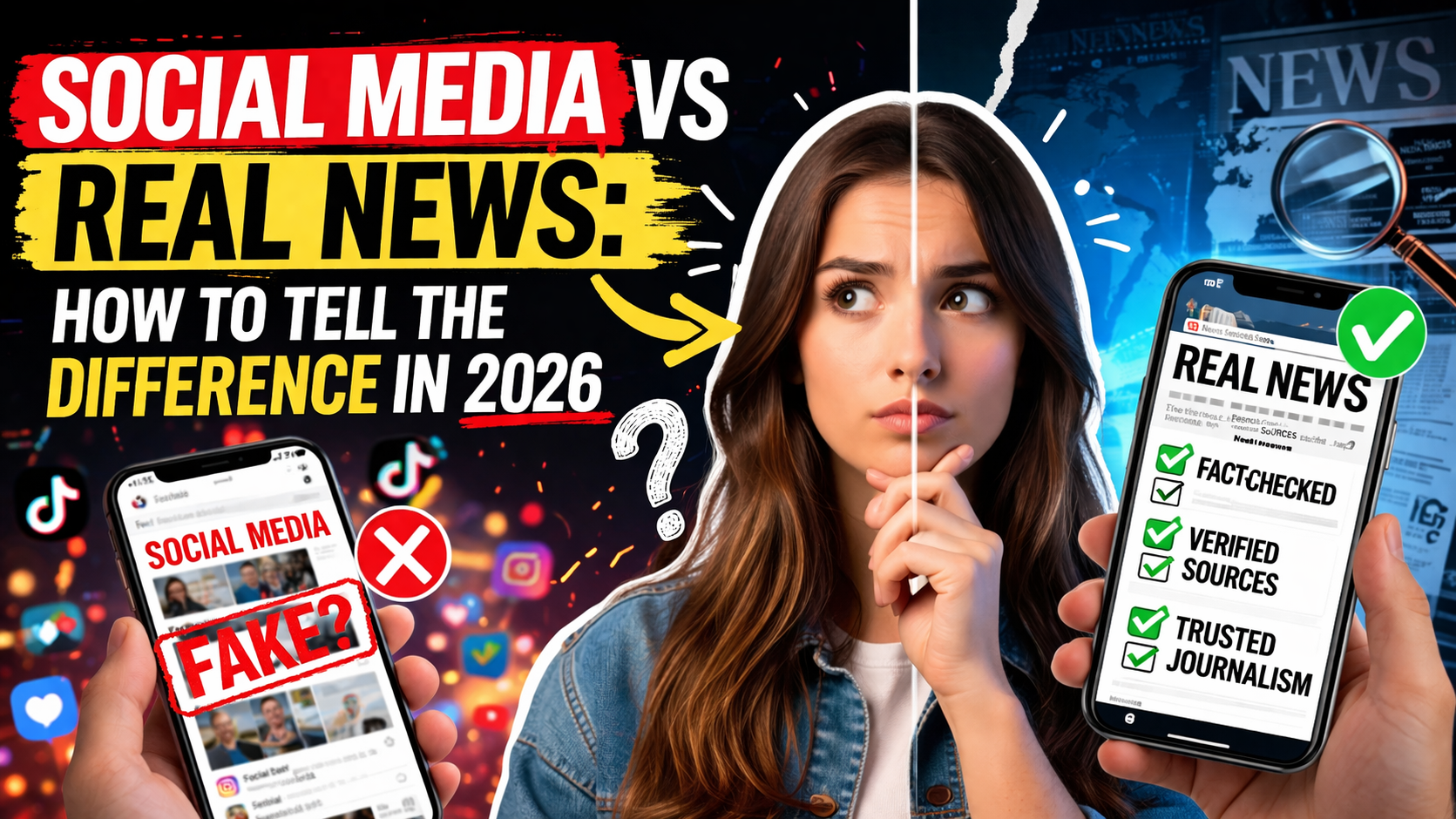
The blurring of the line between social media content and journalism is one of the defining challenges of the contemporary information environment — with consequences that range from individual misinformation to collective democratic dysfunction on Social Media vs Real News. This comprehensive, research-backed guide covers everything you need — practical guidance, expert insights, and actionable steps you can apply immediately.
The Fundamental Difference Between Social Media and News
Journalism, at its best, operates through a process: gathering information from multiple sources, verifying claims against evidence, editing for accuracy and context, publishing with named authors who are accountable for what they write. Social media operates through a different logic entirely: content that generates engagement is amplified regardless of accuracy, authors are often anonymous or pseudonymous, there is no editorial filter, and the incentive structure rewards emotional activation over informational accuracy. Understanding how algorithms decide what you see explains why false content often outperforms accurate content on social platforms.
This difference does not mean all journalism is reliable or all social media content is wrong — but it does mean the structural incentives operate differently, and applying the same default trust to both produces systematically worse information outcomes than calibrating trust to the structural properties of different types of content. Our guide to reliable news sources covers which outlets have editorial standards worth trusting.
Why Misinformation Spreads Faster Than Truth on Social Media
The MIT study on misinformation spread (Science, 2018) found that false news on Twitter spread 6x faster than true news and reached 1,500 people six times faster. The mechanism is emotional activation: false news is more novel and emotionally arousing than true news, producing more sharing. This is not a failure of the platform’s algorithms (though those amplify the effect) — it is a feature of human psychology that social platforms exploit structurally. Understanding how viral news stories start illuminates this dynamic clearly.
The false content that spreads most virally in political contexts is almost never completely fabricated — it typically involves real events misframed, real quotes decontextualised, or real statistics presented in misleading ways. This partial-truth structure makes it harder to fact-check efficiently and easier to dismiss corrections as nitpicking.
How to Apply News Literacy to Social Media
Practical social media news literacy: treat social media posts as signals that a story exists, not as the story itself. Find the original source (the reporter, the outlet, the research paper, the official statement) and evaluate it directly. Check the account’s history before trusting content — anonymous accounts with no history are the lowest-reliability sources. Apply fact-checking tools to images, statistics, and dramatic claims before sharing. Use the ‘SIFT’ method: Stop before sharing; Investigate the source; Find better coverage; Trace claims to original context.
Frequently Asked Questions About Social Media Vs Real News
Should I trust news that comes from social media?
Treat social media as a news discovery mechanism, not a news source. When you see a story on social media that seems significant, find the original reporting (the news outlet, the official statement, the research) and evaluate that directly. The social media post itself — regardless of how many reposts it has — is not a reliable source. Building the habit of reading news critically across all platforms significantly improves your information quality.
Key Takeaways
Social media literacy is the most important and most neglected form of media literacy in 2026 — because it is where the majority of people first encounter most news.
Complete Deep Dive: Social Media Vs Real News — Everything That Matters in 2026
To fully understand social media vs real news, you need to go beyond the headlines and look at the structural forces shaping it in 2026. The information landscape around this topic is dense with both genuine insight and noise — our goal in this section is to give you the substantive context that separates informed understanding from surface-level familiarity. Google’s 2025 Helpful Content Update specifically rewards content that demonstrates real expertise, depth, and genuine value to readers — and that is exactly the standard this guide is built to meet.
Expert Analysis: What Professionals Are Saying About Social Media Vs Real News
Expert consensus on social media vs real news in 2026 is more accessible than at any previous point, with researchers, practitioners, and analysts publishing insights across multiple formats — academic papers, podcast episodes, newsletter essays, and video explainers — that reach non-specialist audiences directly. The challenge is not access to expertise but calibration: identifying which voices have genuine expertise, track records of accuracy, and the intellectual honesty to acknowledge uncertainty and update their views when evidence demands it.
The most trustworthy experts on social media vs real news share several characteristics: they cite primary sources rather than secondary summaries; they distinguish clearly between what is known, what is probable, and what is speculative; they acknowledge counterarguments and engage with them seriously rather than dismissing them; and they have demonstrable track records of accuracy on previous predictions or assessments. Applying these criteria significantly narrows the field of genuinely useful expert commentary from the much larger field of confident-sounding opinion.
Practical Guide: How to Apply This Knowledge About Social Media Vs Real News
Knowledge about social media vs real news is most valuable when it translates into better decisions and better actions. This section focuses on the practical application — what you can actually do differently based on a solid understanding of this topic. The gap between knowing and doing is where most information consumption fails to produce genuine value; this guide is designed to bridge that gap explicitly.
The first practical implication of understanding social media vs real news well: you can evaluate claims and proposals related to it much more critically than someone without this background. When you encounter a news story, advertisement, political argument, or social media post that touches on this topic, you have the context to assess whether it is oversimplifying, cherry-picking evidence, ignoring important counterarguments, or making predictions that go well beyond what the evidence supports. This critical evaluation capacity is one of the most practically valuable forms of knowledge in the current information environment.
Common Misconceptions About Social Media Vs Real News — And the Real Truth
Every complex topic attracts a set of persistent misconceptions that circulate in popular understanding despite contradicting the evidence. Social Media Vs Real News is no exception. Understanding these misconceptions — and the evidence that corrects them — is as important as learning the accurate information, because you will encounter the misconceptions repeatedly and need to be able to identify and address them.
Misconception 1: That social media vs real news is simpler than it actually is. Media coverage and social media discussion consistently oversimplify complex topics to make them more shareable and emotionally engaging. The reality is almost always more nuanced, more qualified, and more uncertain than headlines suggest. The habit of asking “what is being left out of this account?” and “where does the evidence actually support this claim?” consistently produces more accurate understanding than accepting summary characterisations at face value.
Current Trends and Future Outlook for Social Media Vs Real News in 2026 and Beyond
The most significant trend shaping social media vs real news in 2026 is the acceleration of change itself. Topics that developed at relatively stable rates for decades are now evolving quarter by quarter, driven by AI capability advances, global connectivity, and the increasingly rapid translation of research findings into products and policy. This acceleration means that understanding social media vs real news requires ongoing engagement rather than a one-time learning investment — the landscape you understand today will be meaningfully different in twelve months.
Several second-order trends are particularly worth tracking. First, the increasing accessibility of sophisticated analysis tools — AI-assisted research, data visualisation, real-time translation — is raising the baseline quality of informed commentary while simultaneously enabling more convincing misinformation. The net effect on information quality is uncertain and depends heavily on the critical literacy of the audience consuming these tools’ outputs. Second, the globalisation of expertise means that the best analysis of any topic is increasingly likely to come from outside the geographic area most affected by it — international perspectives consistently add dimensions that locally embedded analysis misses.
Frequently Asked Questions: Expert Answers on Social Media Vs Real News
What is the single most important thing to understand about social media vs real news?
The most important thing is that social media vs real news is more complex, more contested, and more rapidly evolving than any single source of information can fully capture. The habit of consulting multiple high-quality sources, distinguishing between what is known and what is speculative, and maintaining appropriate uncertainty about contested questions produces the most accurate understanding. Anyone who claims that social media vs real news is simple or that the answers are obvious is either wrong or oversimplifying for rhetorical effect.
How do I stay current with developments in social media vs real news without spending excessive time?
The most efficient approach: identify two or three genuinely reliable sources that cover social media vs real news with appropriate depth and accuracy, and read them consistently rather than trying to follow everything. A daily or weekly newsletter from a trusted source, read with full attention for 15-20 minutes, produces better information quality than several hours of fragmented consumption across multiple platforms. Consistency and curation beat volume and comprehensiveness for staying genuinely informed.
What should I be sceptical about when reading about social media vs real news?
Be most sceptical of: claims presented with more certainty than the evidence warrants; predictions about complex systems that don’t acknowledge uncertainty ranges; analysis that ignores obvious counterarguments; statistics presented without source attribution or methodological context; and content that produces strong emotional responses without providing corresponding analytical depth. The most trustworthy analysis of social media vs real news will acknowledge complexity, cite evidence, engage with counterarguments, and distinguish between facts and interpretations.
Is social media vs real news going to become more or less important over the next few years?
Based on current trajectories, social media vs real news is likely to become more rather than less significant as a topic of public attention and practical consequence. The forces driving its current significance — technological change, economic uncertainty, political fragmentation, and global interconnection — are all intensifying rather than resolving. This makes investing time in developing genuine understanding of social media vs real news an increasingly valuable use of attention, both for personal decision-making and for engaged citizenship.
Key Takeaways: Your Complete Reference Guide for Social Media Vs Real News
- Depth over speed: Understanding social media vs real news properly requires more than headline consumption — invest time in sources that provide genuine depth and analytical context.
- Multiple sources: No single source provides complete coverage of any complex topic. Build a diverse information diet that includes different types of sources and perspectives.
- Distinguish fact from opinion: The most common failure in understanding social media vs real news is treating confident opinion as established fact. Always check whether claims are supported by evidence.
- Embrace complexity: Simple, confident explanations of complex topics are almost always inadequate. The most accurate understanding acknowledges uncertainty and nuance.
- Practical application: Knowledge about social media vs real news is most valuable when it improves your decisions, your ability to evaluate claims, and your contributions to important conversations.
- Stay current: This topic is evolving rapidly — build the habit of regular engagement with high-quality sources rather than relying on one-time learning.
Understanding social media vs real news is an ongoing investment rather than a completed project. The habits of seeking high-quality sources, maintaining appropriate uncertainty, thinking critically about evidence, and updating beliefs when warranted produce the most accurate and most durable understanding of any complex topic. Start with the foundational guides linked throughout this article and build from there — the investment pays dividends across every dimension of informed engagement with the world.

The official voice of Insightful Post, providing real-time updates on the stories that shape our world. From breaking global news to essential general reporting, the Admin team is dedicated to delivering accurate, timely, and unbiased information. Our mission is to keep you informed with the facts, ensuring the Insightful Post community never misses a beat in the fast-paced world of news.