
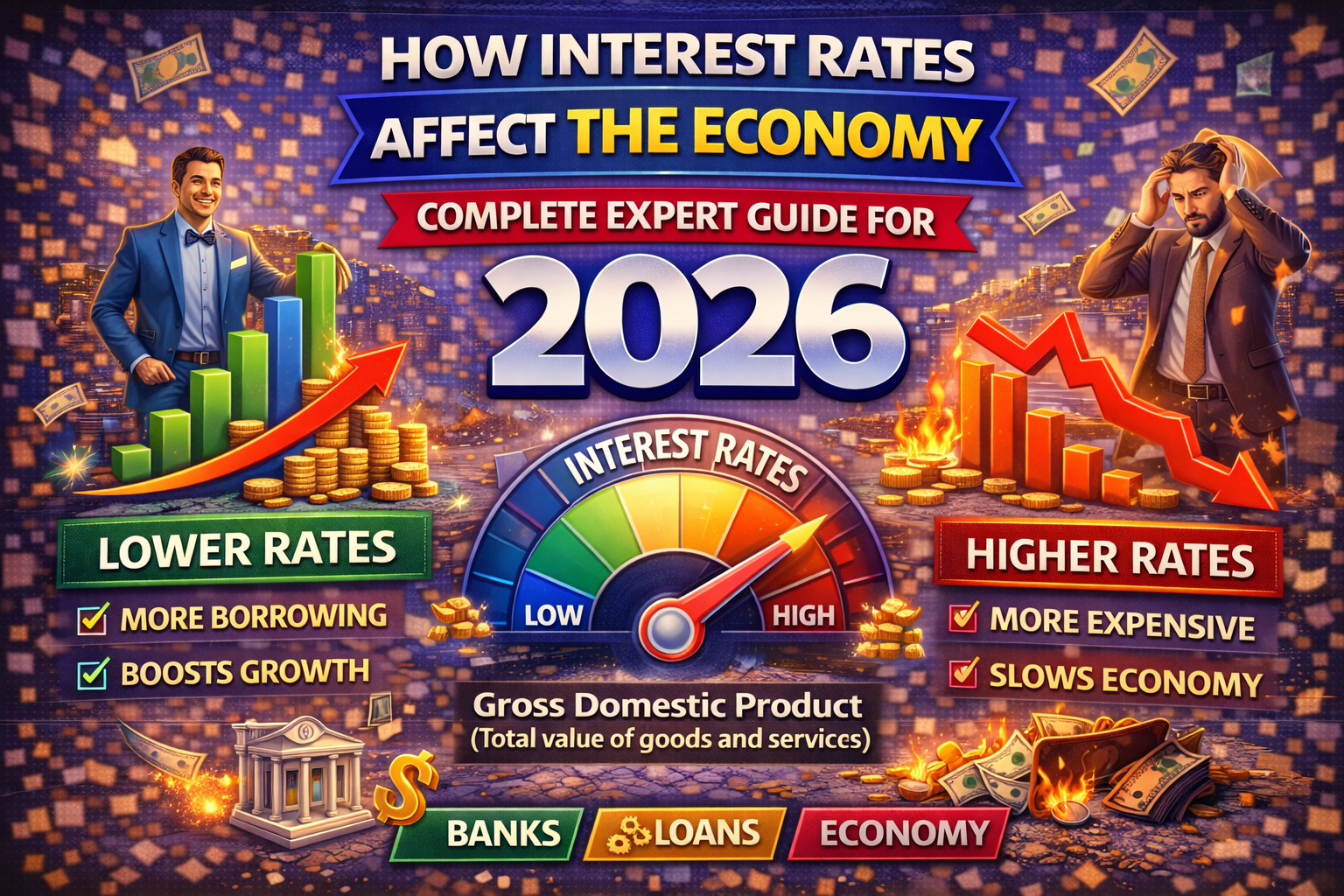
The way different countries experience and respond to How Interest Rates Affect the Economy tells us something profound about the relationship between economics, politics, culture, and institutions. No two economies are identical, and the variation in how similar economic challenges produce different outcomes across different societies is one of the most informative data sets available for understanding what economic policies actually work — and for which populations, under which conditions. This comparative analysis examines How Interest Rates Affect the Economy through a global lens, drawing on evidence from diverse economies to identify what the cross-country experience teaches us.
The comparative approach to economics has a distinguished intellectual heritage. When economists want to understand the effects of specific policies — labour market regulations, housing rules, trade agreements, social safety net designs — the variation in policy across countries provides something close to a natural experiment. Countries that adopted different approaches to the same underlying economic challenge and achieved different outcomes provide evidence about what the differing approaches actually produce. This evidence is imperfect — countries differ in many ways simultaneously, making clean causal inference difficult — but it is far more informative than the alternative of treating any single country’s experience as universally applicable.
How Different Countries Experience How Interest Rates Affect The Economy
The global landscape of How Interest Rates Affect the Economy in 2026 is one of remarkable variation. Advanced economies in North America, Europe, and East Asia share many structural characteristics but differ significantly in their specific economic conditions, institutional arrangements, and policy responses. Emerging markets face How Interest Rates Affect the Economy challenges that have both common elements and features specific to their stage of development, institutional capacity, and global economic position. Frontier economies — the least developed countries — face a fundamentally different economic reality that makes direct comparison with advanced economy experience often misleading.
Among advanced economies, the United States and European approaches to How Interest Rates Affect the Economy illustrate a fundamental tension between the American preference for market-led solutions with minimal institutional intervention and the European tradition of stronger institutional frameworks, more robust social safety nets, and greater acceptance of government’s role in shaping economic outcomes. The outcomes of these different approaches are visible in the data: European countries generally show lower income inequality, lower poverty rates, and better social mobility outcomes than the United States, but often at the cost of lower aggregate economic dynamism, higher structural unemployment, and more restricted opportunities for high-growth entrepreneurship.
The East Asian developmental model — as exemplified by Japan, South Korea, Taiwan, and Singapore — offers a third distinctive approach to How Interest Rates Affect the Economy, characterised by strong state guidance of economic development, high savings rates, emphasis on manufacturing and export competitiveness, and significant investment in education and human capital. This model produced remarkable economic development over the post-war decades but faces new challenges as the initial catch-up growth that the model was designed to achieve is exhausted and more complex forms of innovation-driven growth become necessary.
Case Study: Nordic Countries and the High-Road Economic Model
The Nordic economies — Denmark, Sweden, Norway, Finland, and Iceland — have attracted sustained international attention as apparent demonstrations that high economic equality, strong social protection, and robust economic performance are not mutually exclusive. Their experience with How Interest Rates Affect the Economy challenges offers valuable lessons, though these lessons require careful interpretation to be applicable beyond the specific Nordic context.
The Nordic model’s approach to How Interest Rates Affect the Economy combines several distinctive elements. High levels of investment in education and training maintain workforce skills aligned with labour market needs, reducing the structural unemployment that skill mismatches produce elsewhere. Centralised wage bargaining arrangements coordinate wages across the economy, reducing inequality without the rigidity of statutory minimum wage floors. Generous but conditional social insurance — requiring active job search and participation in training programmes — maintains the income security that allows workers to adapt to structural economic changes without the fear of destitution. And high levels of trust in institutions — government, employers, labour unions — reduces the transaction costs of economic interaction and supports the cooperative norms that make complex institutional arrangements function.
The Nordic experience suggests that many of the tensions in economic policy — between equality and efficiency, between social protection and economic dynamism, between institutional stability and adaptability — are less fundamental than they appear in political debate. But it also highlights the importance of specific institutional prerequisites — high social trust, broad political consensus, capable and relatively uncorrupt public institutions, small and ethnically relatively homogeneous populations — that may be difficult to replicate in larger and more diverse societies.
Case Study: Emerging Market Experiences With How Interest Rates Affect The Economy
The experience of major emerging market economies with How Interest Rates Affect the Economy provides a different and equally important set of lessons. Countries like India, Brazil, Indonesia, Mexico, and Nigeria are at different stages of economic development, have different institutional frameworks, and face How Interest Rates Affect the Economy challenges that have both structural and cyclical dimensions — often simultaneously.
India’s experience with How Interest Rates Affect the Economy illustrates the challenges of rapid economic development in a large, diverse, and institutionally complex society. India has achieved remarkable aggregate economic growth over the past three decades, lifting hundreds of millions of people out of absolute poverty. But this growth has been uneven — concentrated in specific sectors (technology services, manufacturing) and regions (urban centres, certain states) while leaving large portions of the rural population and the informal sector less transformed. Managing How Interest Rates Affect the Economy in this context requires both the macroeconomic tools applicable across all economies and specific institutional reforms addressing the structural barriers — inadequate infrastructure, regulatory complexity, land market dysfunction, skills gaps — that constrain more broadly distributed growth.
Brazil’s economic trajectory illustrates a different set of How Interest Rates Affect the Economy challenges: the “middle-income trap” that affects economies that have successfully industrialised and raised average incomes to middle levels but struggle to make the transition to high-income status. Brazil’s experience with high inequality, commodity export dependence, and periodic macroeconomic instability illustrates the structural vulnerabilities that can prevent sustained development even in large economies with abundant natural resources and significant human capital.
The Policy Toolkit: What Works Where
Cross-country comparison reveals that no single policy approach to How Interest Rates Affect the Economy works universally — the effectiveness of specific policies depends heavily on institutional context, cultural factors, and the specific economic conditions of each country. What the comparative evidence does suggest is a set of principles that appear to support better economic outcomes across a range of different contexts.
Strong, independent institutions — central banks with clear mandates and genuine independence from political pressure, rule of law that protects property rights and enforces contracts reliably, regulatory frameworks that provide clear and consistent rules for economic activity — consistently appear in the economic histories of successful economies. These institutional foundations are not sufficient for economic success — they must be accompanied by sound policy choices — but they appear to be necessary prerequisites. Economies lacking strong institutions consistently struggle to sustain economic development regardless of their natural resource endowments or the soundness of their stated economic policies.
Investment in human capital — education, health, and skills development — appears consistently among the drivers of long-run economic success across diverse contexts. Economies that maintain high-quality, broadly accessible education and healthcare systems produce workforce capabilities that support productivity growth and broad-based prosperity in ways that narrow technical economic interventions cannot replicate. This investment requires long time horizons — the returns to early childhood education, for example, materialise over decades — which creates political challenges in systems that respond primarily to short electoral cycles.
Open trade and international economic integration, managed with adequate attention to distributional consequences and transition support for affected workers and communities, appears in the economic histories of most successful development trajectories. The sustained growth of East Asian economies was built substantially on export-led development strategies that leveraged international markets to achieve scale economies impossible in domestic markets alone. The challenge has been managing the distributional consequences of trade — particularly for workers in import-competing sectors — in ways that prevent the political backlash against trade openness that has characterised recent politics in many advanced economies.
Global Economic Interconnection: The New Reality for How Interest Rates Affect The Economy
The globalisation of finance, trade, and production over the past three decades has created a degree of international economic interconnection that fundamentally changes the context for national economic management. Individual countries have less capacity to independently manage How Interest Rates Affect the Economy than they did in an era of more nationally contained economic activity — the international transmission of economic conditions, through trade, financial flows, commodity prices, and supply chain linkages, means that no economy is an island.
This interconnection creates both risks and opportunities. The risks are most visible in financial crises: the 2008 US subprime mortgage crisis transmitted globally through complex financial linkages within months, producing the deepest global recession since the 1930s. COVID-19 disrupted globally integrated supply chains in ways that no individual country could fully insulate itself from. Geopolitical conflicts in one region affect commodity prices, shipping routes, and financial conditions globally.
The opportunities of interconnection are equally significant: access to global markets allows specialisation and scale economies impossible in domestic markets alone; access to global capital markets allows investments that domestic savings alone could not finance; access to global technology and knowledge allows faster productivity growth than domestically generated innovation could produce. Managing How Interest Rates Affect the Economy in this interconnected environment requires both effective national policy and effective international economic cooperation — the latter of which remains chronically underdeveloped relative to the scale of the challenges requiring it.
Frequently Asked Questions About How Interest Rates Affect The Economy
Which country handles How Interest Rates Affect the Economy best?
The answer depends entirely on what dimensions of economic performance you most value. If you prioritise low inequality and strong social protection, Nordic countries and several continental European economies perform best. If you prioritise aggregate economic dynamism and opportunity for high-growth entrepreneurship, the United States and Singapore rank highly. If you prioritise rapid economic development from a low base, the East Asian developmental states offer the most instructive models. If you prioritise macroeconomic stability and sound institutional management, small open economies like Switzerland, New Zealand, and Canada often rank highly. No country optimises all dimensions simultaneously, and the tradeoffs between them reflect genuine value differences about what economic success means.
Why can’t richer countries simply share their economic knowledge with developing ones?
The transfer of economic knowledge and policy approaches from advanced to developing economies has a mixed track record that has produced important lessons about why simple transplantation of policies rarely works. Economic policies are deeply embedded in institutional, cultural, and historical contexts that shape whether they are enforceable, whether they produce the intended incentives, and whether they are politically sustainable. What works in Denmark may not work in Nigeria — not because Nigerians are less capable of sound economic management but because the institutional context, historical legacies, and specific economic challenges differ fundamentally. The most useful international economic knowledge transfer focuses on principles and mechanisms rather than specific policies, and on building institutional capacity rather than implementing imported policy templates.
How does globalisation affect How Interest Rates Affect the Economy in developing countries?
The effects of globalisation on developing countries are mixed and context-dependent in ways that resist simple generalisation. Trade integration has clearly supported economic growth and poverty reduction in countries that have successfully positioned themselves in global supply chains — most notably China and other East Asian economies. But the benefits of integration have been distributed very unevenly within developing countries, and the distributional consequences — including the displacement of informal sector workers and the deterioration of terms of trade for commodity exporters — have been substantial. The governance of globalisation — the rules of the international trading and financial system — also reflects the interests of advanced economies in ways that can constrain the policy options available to developing countries trying to manage their own development trajectories.
What can the United States learn from other countries about managing How Interest Rates Affect the Economy?
The most important lessons the United States could draw from international experience relate to areas where comparative evidence is most clear. From Nordic countries: the value of active labour market policies that help workers adapt to structural economic changes rather than simply providing passive income support. From Germany: the potential of apprenticeship systems and vocational training to maintain manufacturing competitiveness while providing good wages for workers without university degrees. From Canada and Australia: approaches to housing supply that have kept affordability somewhat better than US levels. From most other advanced economies: healthcare financing systems that achieve better average health outcomes at lower total cost than the US system. None of these lessons require wholesale adoption of foreign models — but the evidence they provide is relevant to the specific challenges the US economy faces.
Is there a global economic governance structure capable of managing How Interest Rates Affect the Economy at the international level?
The existing international economic governance architecture — the IMF, World Bank, WTO, G7, G20, and various regional institutions — provides a partial and imperfect framework for international economic cooperation. It has been consequential in specific crises — the coordinated global response to the 2008 financial crisis prevented a repeat of the Great Depression through unprecedented international policy coordination. But it is chronically inadequate for the proactive management of How Interest Rates Affect the Economy at a global level, for several reasons: the primacy of national sovereignty that limits binding international commitments; the under-representation of developing economies in decision-making despite representing the majority of the world’s population; and the difficulty of achieving binding international agreements on inherently political questions about the distribution of economic costs and benefits. Strengthening international economic governance is one of the most important and most difficult challenges in global economic management.
The Long View: Why Understanding How Interest Rates Affect The Economy Matters More Than Ever
We live in an era of extraordinary economic complexity and equally extraordinary access to information about it. The paradox of the information age is that more data and more commentary have not necessarily produced more clarity — if anything, the sheer volume of economic content available has made it harder, not easier, for most people to develop a reliable working understanding of How Interest Rates Affect the Economy and its implications. The ability to navigate this information landscape thoughtfully — distinguishing signal from noise, evidence from advocacy, genuine uncertainty from false confidence — is an increasingly valuable skill in both personal financial management and civic life.
The study of How Interest Rates Affect the Economy ultimately reveals something profound about the nature of human societies. Economic systems are, at their core, mechanisms for coordinating the decisions of billions of individuals in ways that produce collective outcomes — outcomes that no individual planned or intended and that emerge from the interaction of countless decisions made independently by people pursuing their own goals. This emergent complexity is what makes How Interest Rates Affect the Economy simultaneously fascinating and difficult to manage. The economists, policymakers, and institutions responsible for managing it are steering a ship through waters that are continuously changing in ways that are only partially predictable, using tools that work with variable reliability and sometimes produce unintended consequences alongside their intended effects.
This complexity is not a counsel of despair but an argument for intellectual humility and sustained engagement. The societies that manage their economies best are not those that have found perfect answers — no such answers exist — but those that have developed the institutional capacity to learn from experience, adjust their approaches in response to evidence, and maintain broad social agreement about the basic rules and values that economic governance should reflect. Building and maintaining this institutional capacity requires an informed citizenry willing to engage seriously with economic complexity rather than demanding simple answers to complex questions.
Deep Dive: The Mechanisms That Drive How Interest Rates Affect The Economy
To truly understand How Interest Rates Affect the Economy, it helps to trace the causal chains that connect individual decisions to aggregate outcomes. Economic phenomena do not emerge from nowhere — they are the cumulative result of millions of individual choices made by households, businesses, financial institutions, and governments, interacting through markets, institutions, and informal social relationships. Understanding these causal mechanisms transforms How Interest Rates Affect the Economy from an abstract phenomenon into an understandable system — one that can be analysed, anticipated, and responded to intelligently.
The causal chain typically begins with some combination of structural conditions and policy choices that shape the incentives facing economic actors. These incentives then influence the behaviour of households (their spending, saving, borrowing, and work decisions), businesses (their investment, hiring, pricing, and production decisions), and financial institutions (their lending standards, interest rate setting, and risk management). The aggregate of these behaviours produces the macroeconomic outcomes that show up in official statistics — GDP growth rates, inflation figures, unemployment levels, trade balances.
What makes How Interest Rates Affect the Economy particularly interesting is the feedback loops embedded in these causal chains. Economic outcomes influence expectations, and expectations influence behaviour, creating self-reinforcing dynamics that can amplify economic trends in both directions. Rising confidence produces increased spending, which produces rising employment, which produces rising incomes, which produces further rising confidence — a virtuous cycle that can sustain economic expansion beyond what underlying fundamentals might suggest is justified. Conversely, falling confidence produces reduced spending, rising unemployment, falling incomes, and further falling confidence — the vicious cycle of economic contraction that policymakers work to interrupt before it becomes self-sustaining.
Understanding these feedback dynamics is particularly important for interpreting economic turning points — moments when the direction of economic conditions shifts from expansion to contraction or vice versa. These turning points are difficult to predict in advance precisely because they involve the interaction of multiple feedback loops that can tip in different directions depending on conditions that are not fully visible in real-time data. The post-mortems conducted after major economic turning points — the 2008 financial crisis, the 2020 COVID recession, the post-pandemic inflation surge — consistently reveal that the factors most important for understanding what happened were underweighted in contemporary analysis, precisely because their significance was not apparent until the dynamic had already played out.
Sectoral Analysis: How How Interest Rates Affect The Economy Plays Out Across Different Industries
The aggregate picture of How Interest Rates Affect the Economy conceals significant variation in how different sectors of the economy experience and respond to economic conditions. Industries differ in their exposure to domestic versus international demand, in their sensitivity to interest rate changes, in the labour intensity of their production, in the fixed versus variable cost structure of their operations, and in the competitive dynamics that determine how they respond to changing economic conditions. Understanding these sectoral differences is essential for anyone seeking to understand the specific economic conditions facing their industry or their investment portfolio.
Consumer discretionary sectors — retail, entertainment, travel, hospitality — are typically the most sensitive to changes in household income and consumer confidence. When economic conditions tighten and household budgets come under pressure, spending on non-essential goods and services declines first and most sharply. This makes consumer discretionary a leading indicator of broader economic conditions in both directions: these sectors typically deteriorate before the broader economy and recover before the broader economy. The experience of sectors like tourism and hospitality during the COVID-19 pandemic illustrated both the severity of this cyclical exposure and the resilience that businesses and workers in these sectors can demonstrate when supported by appropriate policy responses.
Consumer staples — food, pharmaceuticals, household products, utilities — show a very different sensitivity profile. Demand for these products is relatively inelastic: people continue buying food and medicine even when their budgets are under pressure, cutting back on quality and quantity at the margins but maintaining overall consumption levels. This defensive characteristic makes consumer staples relatively resilient during economic downturns, which is why they feature prominently in investment portfolios designed to weather economic cycles.
The financial sector occupies a unique position in relation to How Interest Rates Affect the Economy: it is simultaneously one of the most important transmitters of economic conditions (through its credit allocation, risk management, and payment system functions) and one of the most exposed to economic volatility. Financial institutions profit when the economy is growing, credit quality is good, and financial markets are active. They face their most acute stress during economic downturns, when credit losses mount, market volatility rises, and the systemic importance of major institutions creates risks that extend far beyond the institutions themselves — as the 2008 crisis demonstrated with devastating clarity.
The Human Side of How Interest Rates Affect The Economy: Stories Behind the Statistics
Economic statistics are abstractions of human experience. Behind every percentage point of unemployment is a person without a job. Behind every basis point of inflation is a household with less purchasing power. Behind every point of GDP growth is economic activity produced by the labour, creativity, and enterprise of real people. Keeping these human realities in mind while engaging with the statistical abstractions of economic analysis is essential for maintaining a grounded understanding of what How Interest Rates Affect the Economy actually means in the world.
The personal finance dimension of How Interest Rates Affect the Economy is ultimately about people making the best decisions they can within the economic conditions they face — conditions they did not choose and can influence only at the margins. The household that carefully budgets, saves diligently, manages debt prudently, and invests thoughtfully is doing everything within its power to navigate How Interest Rates Affect the Economy effectively. But individual financial prudence cannot fully insulate households from macroeconomic conditions that affect income opportunities, asset prices, and cost of living in ways that individual decisions cannot fully offset.
This is why the policy dimension of How Interest Rates Affect the Economy matters alongside the personal finance dimension. The economic conditions that households navigate are substantially shaped by policy choices made through democratic processes. Citizens who understand How Interest Rates Affect the Economy are better positioned to evaluate those policy choices, hold elected officials accountable for the economic outcomes their decisions produce, and advocate for policies that address the structural economic challenges that individual financial management cannot resolve. The combination of informed personal financial management and engaged democratic citizenship is the most powerful response available to the economic challenges that How Interest Rates Affect the Economy creates.
Future Trends: What Will Shape How Interest Rates Affect The Economy Over the Next Decade
While economic forecasting over long horizons is inherently uncertain, several structural trends are sufficiently well-established that they will almost certainly shape How Interest Rates Affect the Economy over the next decade regardless of how other variables evolve. Understanding these trends provides a framework for longer-term planning — both personal financial planning and broader thinking about economic policy priorities.
Demographic change is the most certain of the long-run economic forces. The aging of the large baby boom cohort through retirement age in most advanced economies is already producing measurable effects on labour supply, consumer spending patterns, healthcare demand, and fiscal pressures on public pension and healthcare systems. These effects will intensify over the next decade as the remaining boomer cohort ages further and the relatively smaller successor cohorts take their place in the workforce. Managing the fiscal implications of demographic aging while maintaining economic dynamism and intergenerational equity is one of the central economic policy challenges of the coming decade.
Artificial intelligence and automation will continue to reshape labour markets in ways that are uncertain in their specific manifestations but whose general direction is fairly clear: increasing productivity in tasks that can be standardised and automated, shifting demand toward skills involving creativity, judgment, social intelligence, and adaptability, and creating new categories of work while displacing existing ones. The distributional consequences of this transformation depend heavily on the policy frameworks through which it unfolds — the education and training systems that prepare workers for changing demands, the social safety net that supports those displaced by technological change, and the regulatory frameworks that shape how the productivity gains from automation are distributed between capital and labour.
Climate change and the energy transition will impose substantial economic costs — through both the physical damages of climate impacts and the transition costs of restructuring energy and industrial systems — while also creating significant economic opportunities in clean energy, energy efficiency, climate-resilient infrastructure, and related services. The net economic effect of climate change is almost certainly negative in the aggregate, but the distribution of costs and opportunities varies enormously across sectors, regions, and time horizons, creating very different economic experiences for different communities depending on their exposure to physical climate risks and their positioning relative to the opportunities of the clean energy transition.
Geopolitical fragmentation — the partial reversal of the globalisation trend through the reshoring of supply chains, the use of economic tools for geopolitical purposes, and the development of competing economic and technological blocs — will reshape the international economic environment in ways that increase costs and reduce efficiency but may improve resilience. The specific economic consequences of this fragmentation depend on its speed and extent, the specific sectors most affected, and the policy responses of individual countries and blocs to the changing international economic landscape.
These trends do not determine a single inevitable future for How Interest Rates Affect the Economy. They define the parameters within which human decisions — about policy, technology, investment, and values — will shape the economic outcomes of the coming decade. The economic future is genuinely open, shaped by choices that have not yet been made and events that cannot be fully anticipated. What is not open is the importance of understanding How Interest Rates Affect the Economy for navigating whatever that future holds — which is precisely why the investment in economic literacy represented by this article is one of the most valuable returns available to anyone seeking to understand and engage with the economic world they live in.
Practical Guide: Navigating How Interest Rates Affect The Economy in Your Daily Financial Life
Abstract understanding of How Interest Rates Affect the Economy is valuable, but what most people ultimately want is practical guidance they can apply to their own financial lives. This section translates the conceptual framework developed throughout this article into concrete, actionable steps that anyone can take — regardless of income level, financial sophistication, or current economic circumstances — to navigate How Interest Rates Affect the Economy more effectively.
The first practical priority is financial awareness. Most people have a rough sense of their income but a surprisingly imprecise understanding of their spending. Spending categories that grow gradually through inertia — subscription services accumulated over years, dining habits that expanded with income and contracted insufficiently when income declined, insurance and utility costs not reviewed since initial setup — collectively represent significant sums that precise tracking reveals. The simple act of knowing exactly where your money goes is the prerequisite for making intelligent decisions about changing how it flows. Modern budgeting apps like Mint, YNAB, or even a simple spreadsheet make this tracking more accessible than it has ever been.
The second practical priority is building financial resilience. Economic conditions are inherently uncertain, and households that have built financial buffers are dramatically better positioned to weather adverse conditions than those without them. The emergency fund — three to six months of essential expenses in a liquid, interest-bearing account — is the foundation of financial resilience, preventing the need to take on expensive debt or make forced asset sales when income is disrupted or unexpected expenses arise. Building this buffer should take priority over most investment activities, because the effective return on avoiding high-interest debt or forced selling during downturns dramatically exceeds the returns available from almost any investment.
The third practical priority is strategic debt management. In the current economic environment, the cost of debt — particularly high-interest consumer debt — represents the single most reliably addressable drag on household financial health. Credit card debt carrying interest rates of 20-25% represents a guaranteed negative return that no investment strategy can consistently overcome. Prioritising elimination of this debt above other financial goals is almost always the correct financial decision, with the possible exception of capturing any employer match on retirement contributions (which represents an immediate 50-100% return on the contributed amount). Once high-interest debt is eliminated, the financial capacity freed up becomes a powerful resource for building wealth through investment and savings.
Investing consistently over time, even in modest amounts, is among the most powerful financial decisions available to most households. The mathematics of compound growth means that time in the market is the single most important variable in investment outcomes — more important than investment selection, timing decisions, or the specific vehicles used. A household that begins investing modestly in its twenties and maintains consistent contributions through its working life will typically accumulate dramatically more wealth than one that waits for the “right time” to invest but starts a decade later. The behavioural challenge is maintaining investment consistency during periods of market turbulence — when the emotional impulse is to stop or reverse investment, but when history consistently shows that maintaining or increasing investment is the strategically superior choice.
Expert Perspectives: How Economists View How Interest Rates Affect The Economy
The economics profession has spent decades studying How Interest Rates Affect the Economy, and while there is more uncertainty and disagreement than popular economic commentary suggests, there are also areas of genuine professional consensus that deserve to be understood and taken seriously. This section summarises the key areas of expert consensus alongside the areas of genuine ongoing debate.
Economists broadly agree that sustained, moderate economic growth — driven by productivity improvement through technological progress, capital accumulation, and human capital development — is the most reliable path to broad improvements in living standards over time. There is also broad consensus that price stability (not zero inflation, but low and stable inflation) provides important benefits for long-term economic planning and financial system functioning. And there is substantial agreement that well-functioning labour markets — where workers can match with employers that value their skills, and where mobility between jobs and regions is not excessively impeded — are fundamental to economic efficiency and individual economic wellbeing.
The areas of genuine ongoing professional debate are worth acknowledging honestly. Economists disagree meaningfully about the optimal level of government involvement in markets, about the most effective approaches to addressing economic inequality, about the long-run effects of various trade and industrial policies, and about the appropriate response to the distributional challenges created by technological change. These disagreements are not primarily about economic ignorance — they reflect genuine empirical uncertainty and legitimate differences in values about the appropriate tradeoffs between competing economic goals. Understanding that these debates are real and unresolved helps calibrate appropriate confidence when evaluating economic policy arguments.
One area where the economics profession has genuinely evolved its consensus in recent years is the relationship between inequality and growth. Earlier economic thinking often treated inequality as a necessary byproduct of growth-enhancing policies, assuming that the benefits would eventually “trickle down” to lower-income groups. More recent research — including influential work by IMF economists — has challenged this view, finding that extreme inequality can actually reduce long-run growth by limiting human capital development, reducing economic mobility, weakening aggregate demand, and increasing political instability. This evolving consensus has significant implications for how How Interest Rates Affect the Economy should be managed and what policy priorities deserve greater emphasis.
The economics of How Interest Rates Affect the Economy ultimately reflects the economics of human wellbeing — the study of how societies organise their productive activities to meet human needs and aspirations. At its best, this field of knowledge illuminates the mechanisms through which policy choices and economic conditions affect the lives of real people, providing the analytical foundation for making those choices more wisely. Engaging with it seriously — maintaining both appropriate confidence in what research does establish and appropriate humility about the limits of economic knowledge — is one of the most worthwhile intellectual investments available to anyone trying to understand and navigate the world we share.
One thought on “How Interest Rates Affect The Economy: Complete Expert Guide for 2026”