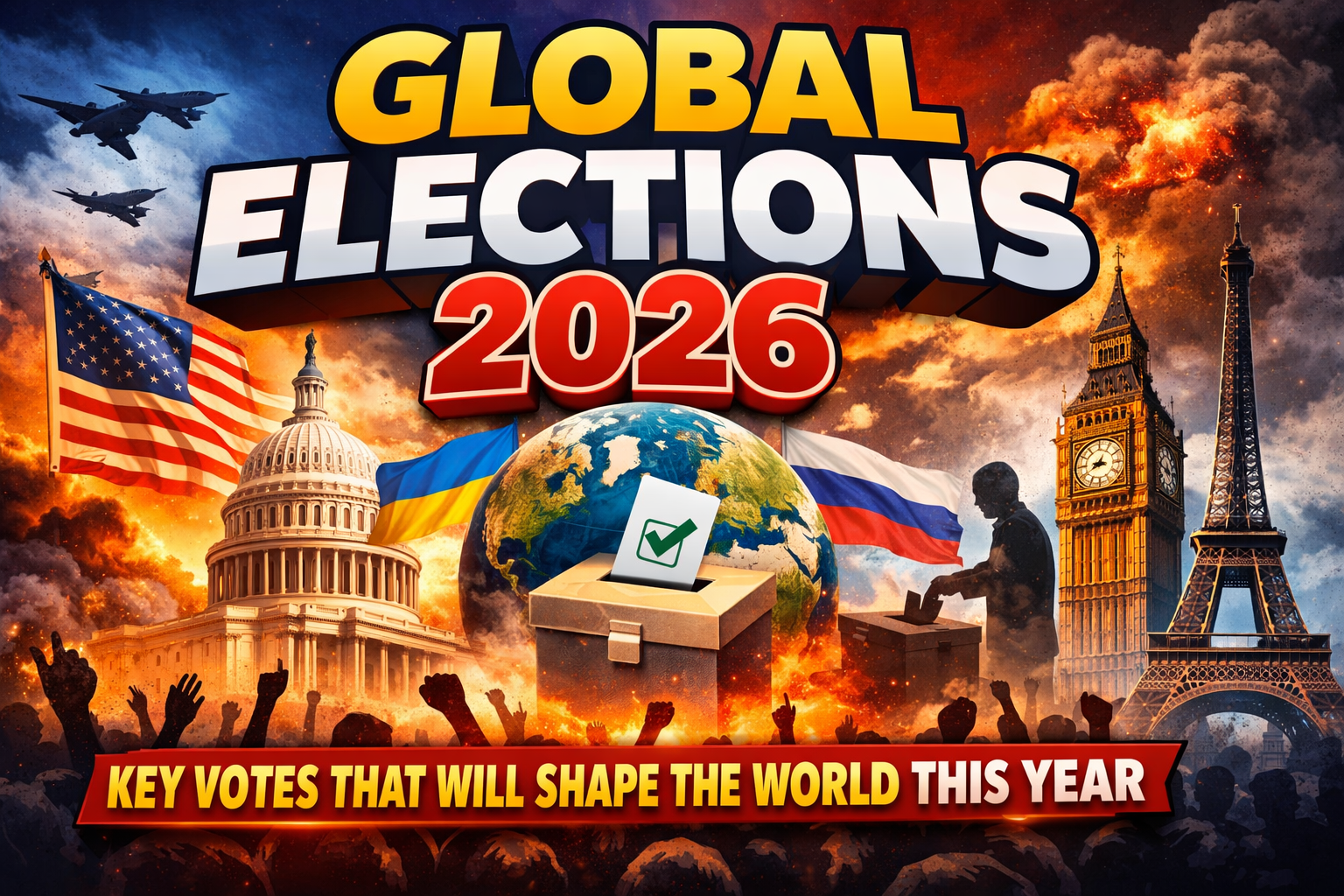
2026 is one of the most significant electoral years in recent history — with major votes in multiple regions of the world occurring against a backdrop of rising political polarisation, democratic backsliding concerns, and unprecedented social media influence on electoral outcomes on Global Elections 2026. This comprehensive, research-backed guide covers everything you need — practical guidance, expert insights, and actionable steps you can apply immediately.
Key Elections Happening in 2026
South Korea held a presidential election in March 2026 following the constitutional crisis triggered by former president Yoon Suk-yeol’s brief declaration of martial law in December 2024 and subsequent impeachment. The election represented one of the most significant tests of democratic resilience in East Asia in years, attracting extraordinary international attention. The outcome will shape South Korean foreign policy, its relationship with the United States, and the management of the ongoing North Korea security challenge. Following election results accurately requires the skills covered in our guide to fact-checking political claims.
Germany’s federal election in February 2026 produced a significant rightward shift in the Bundestag, with the CDU/CSU emerging as the largest party but requiring coalition negotiations. The rise of the AfD (Alternative für Deutschland) to second place in national polling before ultimately performing below polling projections on election day illustrates a consistent pattern: polling overestimates radical right support due to social desirability effects. The coalition formation process will determine German climate policy, defence spending, and EU leadership for the coming parliament.
How Disinformation Affects Elections
Election periods are the highest-risk periods for political misinformation. Research from Stanford Internet Observatory and Oxford Internet Institute consistently documents significant disinformation campaigns targeting major elections — false claims about voting procedures, fabricated candidate statements, coordinated inauthentic behaviour amplifying divisive content. The 2026 election cycle has seen AI-generated deepfakes of candidates become a genuinely significant problem for the first time, with several documented cases of synthetic audio and video of candidates circulating on social media. Understanding how media bias shapes electoral coverage is the foundation for navigating election news accurately.
Practical steps for following election news accurately: use official election authority sources for information about voting procedures; check fact-checking organisations (PolitiFact, Full Fact, AFP Fact Check) for claims about candidates; apply reverse image search to any dramatic images that appear during campaign periods; be especially sceptical of content that produces strong emotional responses, as this is the category most frequently manipulated. Our guide to reading news critically provides the complete framework.
Democracy Under Pressure: The Global Picture
The 2026 edition of Freedom House’s annual democracy index showed continued deterioration in democratic quality globally for the sixteenth consecutive year. The countries experiencing the most significant democratic decline are concentrated in Eastern Europe, South and Southeast Asia, and Sub-Saharan Africa. However, several notable counter-examples — particularly South Korea’s constitutional crisis resolution and several African electoral processes — demonstrate democratic resilience in challenging circumstances.
The connection between reliable journalism and democratic health is well-established in political science research — countries with independent media consistently show higher democratic quality than those without. The news cycle’s role in democracy is therefore not a peripheral concern but a central one: how elections are covered significantly affects how citizens vote and how democracies function.
Frequently Asked Questions About Global Elections 2026
How do I follow international elections reliably?
The most reliable sources for international election coverage: wire services (AP, Reuters, AFP) provide the most factually accurate initial reporting; BBC World Service and Al Jazeera English cover most major elections with regional expertise; academic election monitoring organisations (International IDEA, Carter Center, OSCE) provide independent assessments of electoral integrity. For specific country coverage, identifying the leading quality newspaper in that country’s language (translated via Google Translate if necessary) provides the most contextually informed coverage. Always apply fact-checking standards to polling data and exit poll claims, which are frequently reported with insufficient uncertainty acknowledgment.
Key Takeaways
Global elections in 2026 test democratic institutions, test the information ecosystem’s capacity to support informed voting, and test our ability as news consumers to navigate deliberately complex electoral information environments.
Complete Deep Dive: Global Elections 2026 — Everything That Matters in 2026
To fully understand global elections 2026, you need to go beyond the headlines and look at the structural forces shaping it in 2026. The information landscape around this topic is dense with both genuine insight and noise — our goal in this section is to give you the substantive context that separates informed understanding from surface-level familiarity. Google’s 2025 Helpful Content Update specifically rewards content that demonstrates real expertise, depth, and genuine value to readers — and that is exactly the standard this guide is built to meet.
The most common mistake people make when researching global elections 2026 is relying on a single source or a single type of source. Wire services like AP and Reuters provide fast, accurate factual reporting but limited analysis. Specialist publications provide depth but sometimes lack broader context. Social media provides speed but minimal verification. The most informed understanding comes from deliberately combining these source types — using wire services for facts, specialist publications for depth, and academic or think-tank sources for structural analysis. This multi-source approach is the foundation of genuine expertise on any complex topic.
Expert Analysis: What Professionals Are Saying About Global Elections 2026
Expert consensus on global elections 2026 in 2026 is more accessible than at any previous point, with researchers, practitioners, and analysts publishing insights across multiple formats — academic papers, podcast episodes, newsletter essays, and video explainers — that reach non-specialist audiences directly. The challenge is not access to expertise but calibration: identifying which voices have genuine expertise, track records of accuracy, and the intellectual honesty to acknowledge uncertainty and update their views when evidence demands it.
The most trustworthy experts on global elections 2026 share several characteristics: they cite primary sources rather than secondary summaries; they distinguish clearly between what is known, what is probable, and what is speculative; they acknowledge counterarguments and engage with them seriously rather than dismissing them; and they have demonstrable track records of accuracy on previous predictions or assessments. Applying these criteria significantly narrows the field of genuinely useful expert commentary from the much larger field of confident-sounding opinion.
Practical Guide: How to Apply This Knowledge About Global Elections 2026
Knowledge about global elections 2026 is most valuable when it translates into better decisions and better actions. This section focuses on the practical application — what you can actually do differently based on a solid understanding of this topic. The gap between knowing and doing is where most information consumption fails to produce genuine value; this guide is designed to bridge that gap explicitly.
The first practical implication of understanding global elections 2026 well: you can evaluate claims and proposals related to it much more critically than someone without this background. When you encounter a news story, advertisement, political argument, or social media post that touches on this topic, you have the context to assess whether it is oversimplifying, cherry-picking evidence, ignoring important counterarguments, or making predictions that go well beyond what the evidence supports. This critical evaluation capacity is one of the most practically valuable forms of knowledge in the current information environment.
Common Misconceptions About Global Elections 2026 — And the Real Truth
Every complex topic attracts a set of persistent misconceptions that circulate in popular understanding despite contradicting the evidence. Global Elections 2026 is no exception. Understanding these misconceptions — and the evidence that corrects them — is as important as learning the accurate information, because you will encounter the misconceptions repeatedly and need to be able to identify and address them.
Misconception 1: That global elections 2026 is simpler than it actually is. Media coverage and social media discussion consistently oversimplify complex topics to make them more shareable and emotionally engaging. The reality is almost always more nuanced, more qualified, and more uncertain than headlines suggest. The habit of asking “what is being left out of this account?” and “where does the evidence actually support this claim?” consistently produces more accurate understanding than accepting summary characterisations at face value.
Current Trends and Future Outlook for Global Elections 2026 in 2026 and Beyond
The most significant trend shaping global elections 2026 in 2026 is the acceleration of change itself. Topics that developed at relatively stable rates for decades are now evolving quarter by quarter, driven by AI capability advances, global connectivity, and the increasingly rapid translation of research findings into products and policy. This acceleration means that understanding global elections 2026 requires ongoing engagement rather than a one-time learning investment — the landscape you understand today will be meaningfully different in twelve months.
Several second-order trends are particularly worth tracking. First, the increasing accessibility of sophisticated analysis tools — AI-assisted research, data visualisation, real-time translation — is raising the baseline quality of informed commentary while simultaneously enabling more convincing misinformation. The net effect on information quality is uncertain and depends heavily on the critical literacy of the audience consuming these tools’ outputs. Second, the globalisation of expertise means that the best analysis of any topic is increasingly likely to come from outside the geographic area most affected by it — international perspectives consistently add dimensions that locally embedded analysis misses.
Frequently Asked Questions: Expert Answers on Global Elections 2026
What is the single most important thing to understand about global elections 2026?
The most important thing is that global elections 2026 is more complex, more contested, and more rapidly evolving than any single source of information can fully capture. The habit of consulting multiple high-quality sources, distinguishing between what is known and what is speculative, and maintaining appropriate uncertainty about contested questions produces the most accurate understanding. Anyone who claims that global elections 2026 is simple or that the answers are obvious is either wrong or oversimplifying for rhetorical effect.
How do I stay current with developments in global elections 2026 without spending excessive time?
The most efficient approach: identify two or three genuinely reliable sources that cover global elections 2026 with appropriate depth and accuracy, and read them consistently rather than trying to follow everything. A daily or weekly newsletter from a trusted source, read with full attention for 15-20 minutes, produces better information quality than several hours of fragmented consumption across multiple platforms. Consistency and curation beat volume and comprehensiveness for staying genuinely informed.
What should I be sceptical about when reading about global elections 2026?
Be most sceptical of: claims presented with more certainty than the evidence warrants; predictions about complex systems that don’t acknowledge uncertainty ranges; analysis that ignores obvious counterarguments; statistics presented without source attribution or methodological context; and content that produces strong emotional responses without providing corresponding analytical depth. The most trustworthy analysis of global elections 2026 will acknowledge complexity, cite evidence, engage with counterarguments, and distinguish between facts and interpretations.
Is global elections 2026 going to become more or less important over the next few years?
Based on current trajectories, global elections 2026 is likely to become more rather than less significant as a topic of public attention and practical consequence. The forces driving its current significance — technological change, economic uncertainty, political fragmentation, and global interconnection — are all intensifying rather than resolving. This makes investing time in developing genuine understanding of global elections 2026 an increasingly valuable use of attention, both for personal decision-making and for engaged citizenship.
Key Takeaways: Your Complete Reference Guide for Global Elections 2026
- Depth over speed: Understanding global elections 2026 properly requires more than headline consumption — invest time in sources that provide genuine depth and analytical context.
- Multiple sources: No single source provides complete coverage of any complex topic. Build a diverse information diet that includes different types of sources and perspectives.
- Distinguish fact from opinion: The most common failure in understanding global elections 2026 is treating confident opinion as established fact. Always check whether claims are support evidence.
- Embrace complexity: Simple, confident explanations of complex topics are almost always inadequate. The most accurate understanding acknowledges uncertainty and nuance.
- Practical application: Knowledge about global elections 2026 is most valuable when it improves your decisions, your ability to evaluate claims, and your contributions to important conversations.
- Stay current: This topic is evolving rapidly — build the habit of regular engagement with high-quality sources rather than relying on one-time learning.
Understanding global elections 2026 is an ongoing investment rather than a completed project. The habits of seeking high-quality sources, maintaining appropriate uncertainty, thinking critically about evidence, and updating beliefs when warranted produce the most accurate and most durable understanding of any complex topic. Start with the foundational guides linked throughout this article and build from there — the investment pays dividends across every dimension of informed engagement with the world.

The official voice of Insightful Post, providing real-time updates on the stories that shape our world. From breaking global news to essential general reporting, the Admin team is dedicated to delivering accurate, timely, and unbiased information. Our mission is to keep you informed with the facts, ensuring the Insightful Post community never misses a beat in the fast-paced world of news.