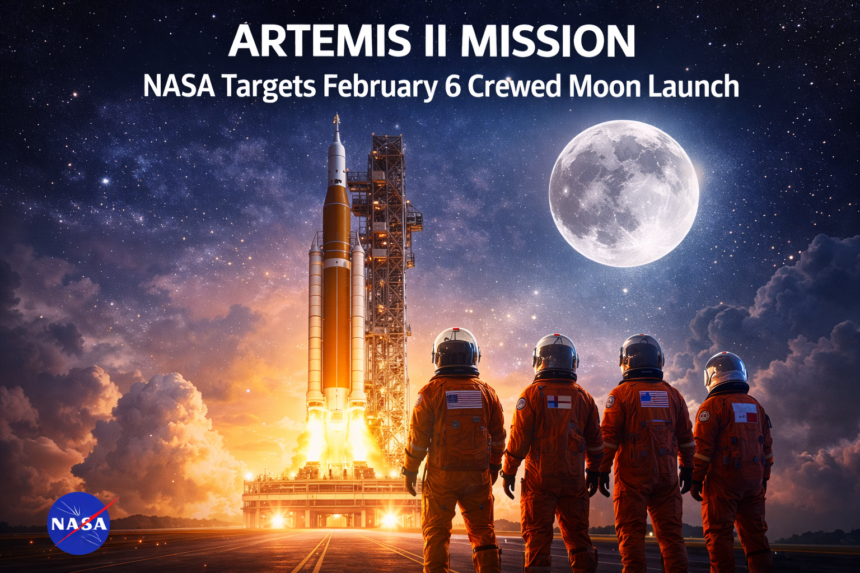
For the first time in more than half a century, humanity is preparing to venture back toward the Moon—not with robots, but with astronauts aboard. Artemis II mission, NASA highly anticipated crewed lunar mission, is shaping up to be one of the most historic spaceflights of the 21st century. If everything aligns perfectly, the mission could lift off as early as February 6, marking a bold new chapter in human space exploration.
This isn’t just another rocket launch. Artemis II mission represents NASA return to deep space, a bridge between the legendary Apollo missions and a future where humans live and work around the Moon—and eventually beyond it. With four astronauts onboard, a massive rocket on the launch pad, and years of planning behind it, Artemis II is more than a test flight. It’s a statement of intent.
So, what exactly is Artemis II? Who’s going, what will they do, and why does this mission matter so much? Let’s break it all down.
What Is Artemis II and Why Is It So Important?
At its core, Artemis II mission is NASA’s first crewed lunar Artemis II mission under the Artemis program. While the Artemis II mission will not land astronauts on the Moon, it plays a critical role in preparing for future landings, including Artemis II mission , which aims to put humans back on the lunar surface.
Think of Artemis II as a full dress rehearsal—but in space.
This mission will test every major system needed for deep-space human travel:
-
The Space Launch System (SLS) rocket
-
The Orion crew spacecraft
-
Life-support systems
-
Navigation and communication beyond low Earth orbit
In short, Artemis II mission is about proving that NASA can safely send humans around the Moon and bring them back home.
A Giant Leap After Five Decades
The last time humans travel beyond low Earth orbit was during the Apollo missions in the early 1970s. Since then, astronauts have remained closer to Earth, primarily aboard the International Space Station.
With Artemis II, that changes.
This mission will make its crew the first humans in the 21st century to journey into deep space, venturing farther from Earth than any astronaut has in more than 50 years. It’s a reminder that space exploration isn’t just about technology—it’s about courage, curiosity, and pushing boundaries.
Artemis II Launch Date: When Will It Take Off?
NASA is currently targeting February 6 as the earliest possible launch date for Artemis II. However, space missions are famously unpredictable, and the agency has made it clear that safety comes first.
The official launch window stretches from early February through April, giving engineers flexibility if weather conditions or technical issues arise.
In spaceflight, patience isn’t a delay—it’s a necessity.
Final Preparations at Kennedy Space Center
Right now, all eyes are on Kennedy Space Center in Florida, where final preparations are in full swing.
NASA plans to roll out the towering Space Launch System rocket along with the Orion spacecraft to Launch Pad 39B no earlier than January 17. While the pad is only about four miles away, the journey is slow and deliberate, often taking up to 12 hours.
Why so slow? Because when you’re moving a rocket taller than the Statue of Liberty, precision matters.
Meet the Artemis II Crew: Four Astronauts, One Historic Mission
Every great mission needs a great crew—and Artemis II delivers.
The Artemis II Astronauts
-
Reid Wiseman (NASA) – Mission Commander
-
Victor Glover (NASA) – Pilot
-
Christina Koch (NASA) – Mission Specialist
-
Jeremy Hansen (Canadian Space Agency) – Mission Specialist
This diverse and highly experienced team represents not just NASA, but international cooperation in space. Jeremy Hansen’s inclusion marks a historic moment for Canada, making him the first Canadian astronaut to travel to the Moon.
Together, these four astronauts will carry the hopes of millions as they venture into deep space.
What Will Happen During the 10-Day Artemis II Mission?
Artemis II will last approximately 10 days, during which the crew will:
-
Orbit Earth
-
Travel toward the Moon
-
Perform a lunar flyby
-
Test onboard systems
-
Return safely to Earth
The mission’s trajectory will take the spacecraft thousands of kilometers beyond the Moon, pushing Orion to its limits and ensuring it’s ready for future lunar landings.
No moonwalks this time—but every maneuver counts.
The Wet Dress Rehearsal: A Critical Test Before Launch
One of the most important milestones before liftoff is the wet dress rehearsal, scheduled for later this month.
During this test, NASA will:
-
Simulate the entire launch countdown
-
Fully fuel the rocket with over 700,000 gallons of supercooled propellants
-
Practice emergency procedures
-
Drain the fuel safely after the test
If something goes wrong here, engineers will fix it. No shortcuts. No compromises.
Safety First: NASA’s Top Priority
NASA officials have repeatedly emphasized one thing: crew safety is non-negotiable.
Engineers have been carefully addressing technical issues, including improvements to ground systems that supply oxygen to the Orion spacecraft. If weather conditions or hardware concerns arise, NASA is fully prepared to delay the mission.
As Lori Glaze, acting assistant administrator for NASA’s Exploration Systems Development Mission Directorate, explained:
“We have important steps remaining on our path to launch, and crew safety will remain our top priority at every turn.”
In space exploration, caution isn’t weakness—it’s wisdom.
The Space Launch System: NASA Most Powerful Rocket Ever
The Space Launch System (SLS) is the most powerful rocket NASA has ever built, designed specifically for deep-space missions.
Standing taller than a 30-story building, SLS is capable of generating enough thrust to send Orion—and its crew—beyond Earth’s orbit and toward the Moon.
This rocket isn’t just impressive. It’s essential.
Orion Spacecraft: The Astronauts’ Home in Deep Space
While SLS gets the spotlight, the Orion spacecraft is where the astronauts will live, work, and travel.
Orion features:
-
Advanced life-support systems
-
Deep-space communication capabilities
-
Heat shields capable of surviving reentry speeds faster than any previous crewed spacecraft
Artemis II will be the first time humans fly inside Orion—making this mission the ultimate test of its design.
Why Artemis II mission Matters for the Future of Space Exploration
Artemis II is more than a single mission. It’s the foundation for what comes next.
Successful completion will:
-
Pave the way for Artemis III, a lunar landing mission
-
Support plans for the Lunar Gateway, a space station orbiting the Moon
-
Enable long-term human presence on the lunar surface
-
Lay groundwork for future Mars missions
In other words, Artemis II is the stepping stone to humanity’s next giant leap.
International Cooperation: Space Is a Global Effort
The inclusion of the Canadian Space Agency highlights how space exploration has become a shared global mission.
Future Artemis II mission will involve partners from Europe, Japan, and beyond. Together, these nations are building a roadmap for sustainable exploration—not just visits, but long-term presence.
Space belongs to all of us.
What Happens After the Wet Dress Rehearsal?
Once the rehearsal is complete, NASA will conduct a flight readiness review. This final assessment determines whether all systems—and the crew—are ready for launch.
Only after this review will NASA confirm the final launch date.
Until then, every checklist matters.
Conclusion
The Artemis II mission is more than a countdown to launch—it’s a countdown to a new era. With a powerful rocket, a state-of-the-art spacecraft, and a fearless crew, NASA is preparing to send humans back toward the Moon for the first time in generations.
This mission reminds us that exploration is part of who we are. It’s not about how far we’ve gone—it’s about how far we’re willing to go next.
In a world filled with challenges on Earth, Artemis II mission offers something rare: a shared sense of wonder. It reminds us that progress is possible, that cooperation matters, and that the sky is not the limit—it’s just the beginning.
As February approaches and the rocket stands ready, one thing is clear: humanity is heading back to the Moon, and Artemis II mission is leading the way.