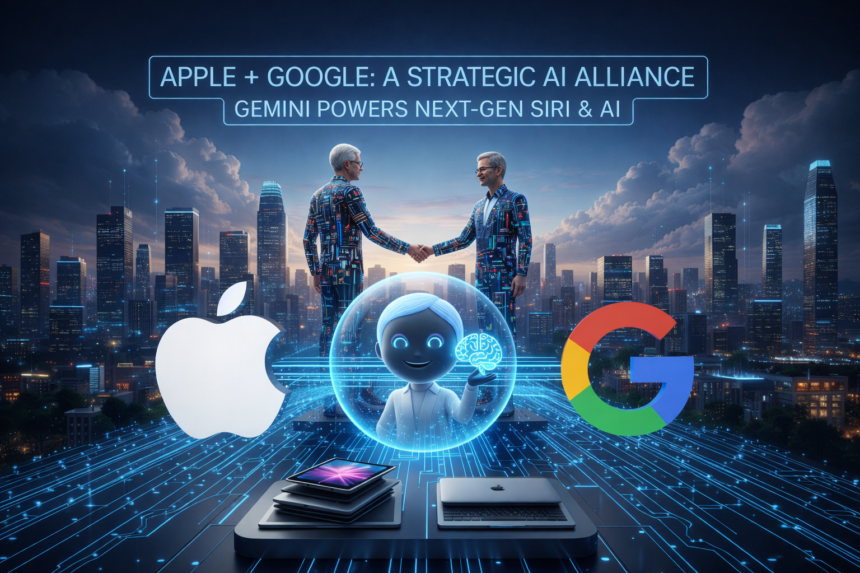
Apple Google Gemini AI Siri Upgrade is reshaping the tech industry as Apple partners with Google’s Gemini platform to reinvent Siri and power next-generation AI features.
This move is more than just a software upgrade. It’s a strategic shift, a signal to investors, competitors, and consumers that Apple is recalibrating its AI ambitions at a critical moment in tech history. And perhaps most intriguingly, it highlights how Google growing dominance in artificial intelligence is reshaping old rivalries into unexpect alliances.
So why would Apple—famous for building everything in-house—lean on Google? What does this mean for Siri, user privacy, and the future of AI on iPhones, iPads, and Macs? And how does this deal change the balance of power in Silicon Valley?
Let’s break it all down Apple Gemini AI partnership .
Why Apple Chose Google Gemini AI for Siri
Apple and Google have long been portrayed as oil and water. One champions tightly controlled ecosystems and premium hardware; the other thrives on open platforms, data, and scale. Yet behind the scenes, these two companies have always shared a complicated business relationship.
The new multi-year agreement allowing Apple to use Google Gemini AI models and cloud infrastructure is a reminder that pragmatism often wins over pride.
After months of internal testing and evaluation, Apple reportedly concluded that Gemini offered the most advanced, scalable, and reliable AI foundation for its next phase of development. That’s a significant admission from a company known for insisting that “Apple knows best.”
In simple terms: Apple Gemini AI partnership tested multiple options, and Google came out on top.
The Big Goal: Reinventing Siri for the AI Era
Let’s be honest—Siri has been overdue for a glow-up.
Once a pioneer in voice assistants, Siri gradually fell behind rivals like Google Assistant, Alexa, and more recently, AI-powered chatbots such as ChatGPT. Users noticed. Critics noticed. And Apple definitely noticed.
This partnership with Google is designed to transform Siri from a basic voice tool into a deeply intelligent AI assistant capable of understanding context, handling complex queries, and interacting more naturally with users.
Think less “set a timer” and more “help me plan my week, summarize my emails, and explain this document like I’m five.”
That’s the promise Apple is aiming to deliver.
Apple AI Strategy Under Pressure
Apple’s AI ambitions haven’t exactly been smooth sailing.
While competitors like Microsoft, Amazon, Meta, and Google poured billions into generative AI, Apple appeared cautious—some would say hesitant. Internally, this caution led to delays, including pushing a major Siri upgrade as far as 2026 at one point.
But the market doesn’t wait.
Consumers now expect AI to be fast, smart, and intuitive. Investors want to see innovation. Developers want powerful tools. And suddenly, Apple found itself needing to move faster—without sacrificing its core values.
Enter Google’s Gemini.
Privacy Impact of Apple Google Gemini AI Partnership
One of the biggest questions surrounding this deal is privacy. After all, Apple has built its brand on protecting user data, while Google’s business has historically relied on data-driven insights.
Apple was quick to clarify an important detail: AI processing will still happen on Apple devices and Apple-controlled private cloud infrastructure.
In other words, Gemini’s intelligence powers the system—but Apple controls where and how user data is handled.
This hybrid approach allows Apple to tap into Google’s AI strength without compromising its privacy-first narrative. It’s like borrowing a powerful engine but installing it inside your own locked garage.
Financial Stakes: A Billion-Dollar AI Partnership
Although neither company disclosed official financial details, industry insiders suggest the deal could be worth around $1 billion annually. The Apple Google Gemini AI Siri Upgrade signals a turning point where Apple prioritizes speed and AI performance without compromising privacy.
That number alone tells you how valuable AI infrastructure has become.
This agreement also builds on an existing financial relationship between the two companies. Google already pays Apple billions each year to remain the default search engine on iPhones, one of the most lucrative distribution deals in tech history.
Now, that partnership deepens—moving from search into the heart of artificial intelligence.
Google AI Resurgence: Perfect Timing
From Google’s perspective, the timing couldn’t be better.
After years of playing catch-up in AI, Google has staged a powerful comeback. Its Gemini 3 model, released recently, has been widely praised for its performance, flexibility, and real-world applications.
The company has also secured major cloud contracts through 2025, signaling strong enterprise confidence. Add to that a historic milestone—Google overtaking Apple in market capitalization for the first time since 2019—and you start to see a clear narrative emerge.
Google is back in control of the AI conversation.
Partnering with Apple doesn’t just bring revenue; it cements Google’s position as a core AI platform at global consumer scale.
What Happens to ChatGPT Inside Siri?
Here’s where things get interesting.
Apple has already integrated OpenAI ChatGPT into Siri for handling advanced queries. So does this Google partnership replace OpenAI?
The answer is no—at least for now.
Apple confirmed that its relationship with OpenAI remains unchanged. This suggests that multiple AI models may coexist within Apple’s ecosystem, each handling different tasks based on strengths.
Think of it like a relay race: Siri decides which AI is best suited for the question, then passes the baton.
This multi-model approach could give Apple flexibility—and a competitive edge—if managed correctly.
A Calculated Shift, Not a Surrender
Some critics might frame this move as Apple “admitting defeat” in AI. That would be a misunderstanding. Apple Google Gemini AI Siri Upgrade
Apple isn’t abandoning its AI ambitions; it’s accelerating them.
By leveraging Apple Google Gemini AI Siri Upgrade , Apple gains time—time to refine its own models, optimize hardware-level AI, and deliver features users actually want. In fast-moving tech markets, speed matters just as much as originality.
This isn’t surrender. It’s strategy.
The Broader Industry Impact
This deal send ripples across the tech industry.
First, it confirms that AI leadership is no longer just about building models, but about deploying them at scale, reliably, and responsibly.
Second, it shows that old rivalries are becoming more fluid. In the AI era, yesterday’s competitors can become today’s partners—if the incentives align.
Third, it raises the bar for everyone else. If Apple and Google are teaming up, smaller players will need to innovate faster just to stay relevant.
Antitrust Shadows Still Loom
Of course, no discussion of Apple and Google is complete without mentioning regulators.
Their existing search deal has already faced scrutiny, surviving recent U.S. antitrust rulings despite findings of anti-competitive behavior. While the court allowed Google to maintain key agreements, pressure remains high.
This new AI collaboration could attract fresh attention from regulators concerned about market concentration in artificial intelligence.
Whether that leads to challenges remains to be seen—but it’s a factor both companies are undoubtedly watching closely. Apple Google Gemini AI Siri Upgrade
What This Means for Apple Users
For everyday users, the benefits could be significant. Apple Google Gemini AI Siri Upgrade
Expect a smarter Siri, more contextual responses, better productivity features, and deeper integration across Apple devices. If executed well, this could make iPhones and Macs feel noticeably more intelligent—without users needing to think about which AI is behind the scenes.
That’s the Apple way: complex technology, simple experience.
Why This Deal Matters More Than It Look
At first glance, this might seem like just another tech partnership. But zoom out, and it represents something bigger.
It marks a moment where AI maturity outweighs brand rivalry, where speed matters more than ego, and where collaboration becomes a competitive advantage.
Apple needs AI momentum.
Google wants AI dominance.
Together, they get closer to both.
Apple Google Gemini AI Siri Upgrade
The Road Ahead: High Expectation, High Stake
Now comes the hard part—delivery.
The AI world moves fast, and expectations are sky-high. Users won’t be impressed by promises; they want results. Apple’s next Siri upgrade will be scrutinized like few software updates before it.
If it works, Apple regains its reputation as a quiet innovator that delivers when it matters most.
If it doesn’t, critics will be unforgiving.
There’s no middle ground.
Conclusion
Apple decision to tap Google Gemini AI marks a pivotal moment in modern tech history. It’s a calculate, pragmatic move that acknowledges the realities of today’s AI race while staying true to Apple’s core principles of privacy and performance.
For Google, it’s validation. For Apple, it’s acceleration. For users, it could be the beginning of a smarter, more capable digital assistant experience Apple Google Gemini AI Siri Upgrade.
In the AI era, power doesn’t always belong to the loudest innovator—but to the smartest collaborator.
And right now, Apple and Google are speaking the same language.
As artificial intelligence continues to redefine how we interact with technology, partnerships like this will likely become more common—and more controversial. The lines between competition and cooperation are blurring, and the companies that adapt fastest will shape the future.
Whether this Apple–Google alliance becomes a long-term blueprint or a temporary solution will depend on execution, regulation, and user trust. But one thing is certain: the AI race just entered a new phase—and everyone else is now playing catch-up. Apple Google Gemini AI Siri Upgrade